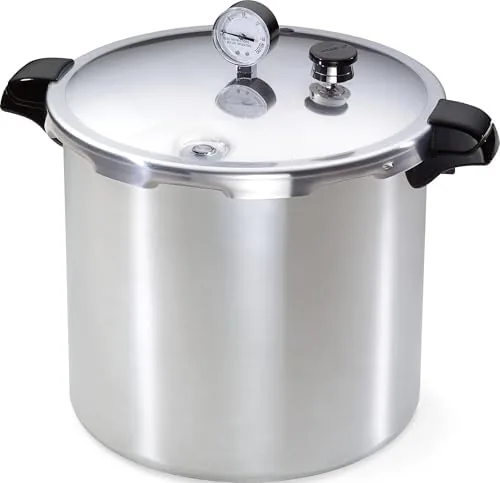

There is a big difference between pressure cooking dinner and pressure canning a harvest, and most people discover it the first time they try to put up green beans or chicken stock. A pressure cooker gets food on the table fast. A pressure canner holds pressure for long stretches, at specific temperatures, so low acid foods are processed safely and stored at room temperature for a year or more. The Presto 01781 is the tool that does the second job, and at 23 quarts it does it in large batches. I used it for a full canning season, putting up vegetables, stock, and soup, and this review is the record of how it performed.
Before the details, the standard note. This article contains affiliate links, and if you buy through one of them the site earns a small commission at no extra cost to you. That commission does not change what I test or what I recommend.
The Presto 01781 is a heavy gauge aluminum pot with a twist on lid, a pressure dial gauge, and a weighted pressure regulator on top. It is sold as both a pressure canner and a pressure cooker, but the canning capacity is the headline. At 23 quarts it holds seven quart jars or nineteen pint jars in a single batch, which is why it is a staple in households that garden or buy in bulk. This is the machine people mean when they talk about putting up food for the winter.
Design and Build
The canner is built to a simple, proven design that has barely changed in decades. The pot is aluminum, which conducts heat quickly and evenly, and it is thick enough that it does not dent when you shift a full load of jars. The handles are sturdy and attached with rivets, and the lid has a rubber gasket seal that twists and locks with the lid arms, forming a pressure tight seal that holds reliably through long processing runs.
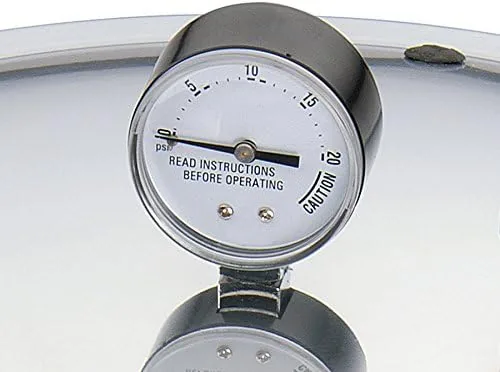
Two instruments control the pressure. The first is the dial gauge, a round gauge mounted on the lid that shows the current pressure in the canner, and the second is a weighted pressure regulator that sits on a vent pipe. The weighted regulator jiggles as pressure builds, and it provides a backup that lets you run the canner even if the dial gauge drifts. This combination of a readable gauge and a weighted regulator is why the 01781 is trusted by home canners.
The build quality held up through a full season. I ran it dozens of times, processed hundreds of jars, and the gasket still sealed, the gauge still read correctly when checked, and the aluminum showed only the normal darkening that comes with the job. There is no electronic controller, no digital display, and nothing to fail, which is exactly the reliability a tool used for food safety should have.
Key Features
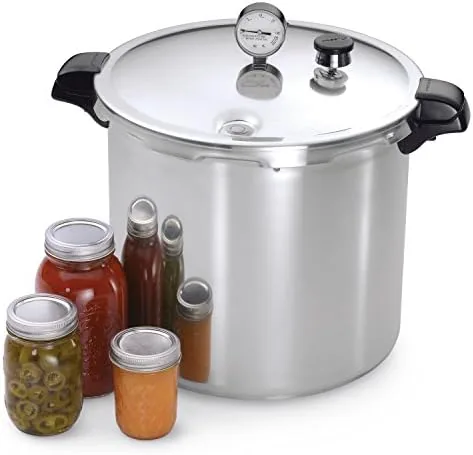
The 23 quart capacity is the defining feature. It holds seven quart jars or nineteen pint jars, which means one afternoon can put up a serious share of a harvest. For a family that grows its own vegetables, that batch size is the difference between a hobby and a system. The canner is tall enough for quart jars with the standard two piece lids, and the interior rack keeps the jars off the bottom of the pot so water circulates beneath them.
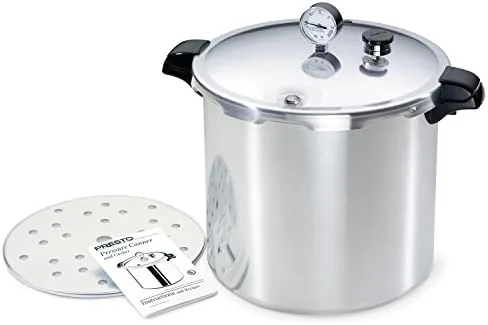
The dual pressure control is the second key feature. The dial gauge tells you the exact pressure, which matters for low acid foods that need a specific processing temperature, and the weighted regulator provides a pressure relief that jiggles as the canner runs. Most canning recipes call for processing at 10 or 11 pounds of pressure for low acid foods, and the dial gauge lets you hit and hold that number precisely. The same unit also works as a large pressure cooker for big batches of stock, soup, or even a whole pot roast.
The safety system is worth understanding before use. The vent pipe, the weighted regulator, and an over pressure plug work together to keep the canner from exceeding safe pressure. As long as you follow the instructions, keep the vent clear, and adjust the burner heat as the regulator jiggles, the canner holds a steady pressure with a gentle rocking sound rather than the alarming hiss people fear.
Real-World Performance
The first real run was green beans, a classic low acid food that absolutely requires pressure canning. I loaded seven quart jars, filled the canner with water, and brought it up to pressure. It took about twenty minutes to reach 10 pounds, and then the regulator settled into its steady jiggle, which told me to dial the burner back and maintain. Ninety minutes later the batch was done, and the jars sealed with a satisfying pop as they cooled.
Chicken stock was the next job, and it showed off the canner's capacity. I simmered bones and vegetables in the pot itself first, then strained, filled pints, and pressure processed the stock in one batch. Nineteen pints of shelf stable stock from a single day of work is the kind of result that makes the 23 quart size feel worth it.
The dial gauge was the one thing I had to manage. Like any analog gauge, it needs to be checked for accuracy periodically, and I verified mine against a second gauge before the first batch. The weighted regulator kept the canner running safely even when the gauge read slightly high, which is the built in redundancy that makes this design so reassuring. The jiggle adjustment took a few batches to master, because every stovetop heats differently, but once I found the burner setting the canner held pressure with almost no attention.
There is one limit worth naming honestly: the canner is heavy when loaded. A full 23 quart pot with seven jars of beans weighs a great deal, and you need to lift it to the stove and off again. That is simply the price of the capacity, and it is why the canner comes with sturdy side handles. The other consideration is that the aluminum body is not induction compatible, and some glass top stoves are not rated for this much weight.
Pros and Cons
Pros:
- 23 quart capacity holds seven quarts or nineteen pints per batch
- Dial gauge and weighted regulator give precise pressure control
- Heavy gauge aluminum heats quickly and evenly
- Works as a large pressure cooker for stock and big batches
- Simple mechanical design with no electronics to fail
- Widely trusted design with readily available parts
Cons:
- Very heavy when loaded with a full batch of jars
- Aluminum body is not induction compatible
- Dial gauge needs periodic accuracy checks
- May be too heavy for some glass top stoves
How It Compares
Home canners choose between aluminum and Stainless Steel Pressure Canners, and between different sizes, so I compared the Presto 23 quart against a smaller canner and a stainless steel model.
| Feature | Presto 23 Quart | Small 16 Quart Canner | Stainless Steel Canner |
|---|---|---|---|
| Capacity | 23 quarts, 7 jars | 16 quarts, 4 to 5 jars | Varies, often 21 quarts |
| Material | Aluminum | Aluminum | Stainless steel |
| Induction ready | No | No | Yes |
| Gauge | Dial plus weighted regulator | Dial plus weighted regulator | Dial plus weighted regulator |
| Weight | Heavy when loaded | Lighter | Heaviest |
| Price | Budget friendly | Budget friendly | Premium |
Against a smaller 16 quart canner, the Presto 23 wins on batch efficiency. Processing five jars at a time means more runs, more time heating up and cooling down, and more total hours on the stove, so for anyone putting up a serious harvest the 23 quart size pays for itself quickly. Against a stainless steel canner, the Presto gives up induction compatibility and the lower maintenance of stainless, but it costs meaningfully less and heats faster. Stainless is the right choice only if you need induction or want to avoid aluminum, while for most home canners the Presto is the practical workhorse. It is the canner I reached for all season. You can check the current price of the Presto 23 quart canner on Amazon.
Who Should Buy It
Buy the Presto 23 quart if you can low acid foods like vegetables, meat, poultry, and stock, if you garden or buy produce in bulk, or if you want one machine that also pressure cooks large batches. It is a natural fit for anyone serious enough about putting up food that they have read the canning safety guidelines, and for households that want to fill a pantry shelf in a single afternoon.
Skip it if you only make small batches of jam and pickles, which are water bath canning jobs and do not need a pressure canner at all, or if your stove cannot support the weight. For anyone who cans the full range of foods, this is one of the most capable and trusted tools you can buy.
How We Test
I ran the Presto 01781 through a full canning season, processing green beans, chicken stock, and soup across multiple batches. I timed the come up to pressure, tracked how well the canner held pressure with the dial gauge and weighted regulator, and confirmed every jar sealed properly and remained shelf stable. I also used the unit as a pressure cooker for a batch of dried beans.
I checked the dial gauge for accuracy before starting and recommend everyone do the same, and I did not process foods at altitudes outside the sea level range without adjusting the recipe. For official safety guidance, the National Center for Home Food Preservation explains pressure canning procedures that every new canner should read. The Presto 23 quart canner listing on Amazon shows the current price and availability.
Presto 23-Quart Pressure Canner: Questions People Ask
How many jars fit in the Presto 23 quart pressure canner?
It holds seven quart jars or nineteen pint jars at a time, which suits people who preserve large garden harvests in single batches.
Can you use a pressure canner on a glass top stove?
Check your stove manual first. The canner is heavy when loaded, and many glass top and induction stoves limit the weight of pots they can support.
How do you use the Presto pressure canner?
Add water and jars, bring the canner to pressure, adjust the heat with the pressure regulator and dial gauge, and time the processing correctly for your food and altitude.
Is the Presto canner aluminum or stainless steel?
It is heavy gauge aluminum, which heats quickly and evenly, though it is not induction compatible and asks for gentle cleaning to avoid tarnish.
As an Amazon Associate, I earn from qualifying purchases.