
The poached egg is one of those foods that looks effortless on a restaurant plate and turns into a disaster in a home kitchen. The whites feather out, the yolk bursts too early, and the pot of swirling water ends up full of cloudy ribbons instead of a tidy dome. The OXO Good Grips 2 Piece Silicone Egg Poaching Set takes a different route entirely. Instead of teaching you a vortex technique with vinegar and a slotted spoon, it hands you two soft yellow silicone cups that hold each egg in simmering water until the white sets. I have spent the last month making breakfast with this set to find out whether it delivers the clean, round poached egg that the marketing promises.
Before the details, the standard disclosure. This article contains affiliate links. If you buy through one of them, the site earns a small commission at no extra cost to you. That commission never changes what I test or what I recommend.
Design and Build
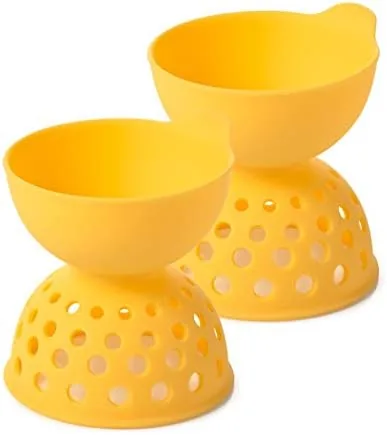
The set arrives as two identical silicone cups with matching lids, each in that unmistakable OXO yellow that has become a kitchen shorthand for thoughtful ergonomics. Each cup is roughly the size of a large egg, with a rounded bowl, a flat base that sits level in a pan, and a molded handle on the side that gives you something to grip when the water is bubbling. The silicone is thick and sturdy rather than flimsy, with enough heft that the cup does not float or tip over when you crack an egg into it. I pressed on the walls and watched them spring back, a sign that the material is rated for repeated boiling without fatigue.
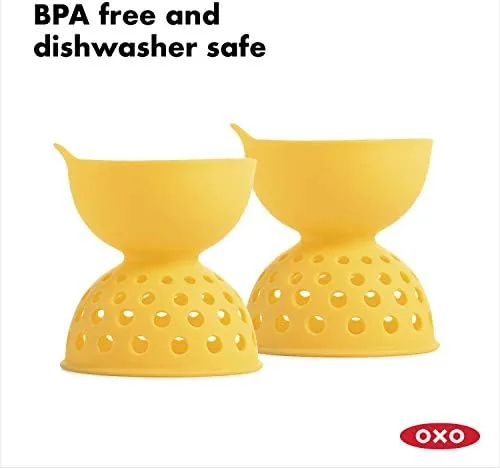
Each cup has a vented lid that snaps on and off with a firm click. The lid traps steam and heat over the top of the egg while letting pressure escape through small slots, which is the trick that cooks the top of the white instead of leaving it raw and glossy. The whole set is food-grade silicone, free of the harsh chemical smell that cheap molds give off, and it survived boiling water without any odor or taste transfer. The two cups nest together for storage, and the whole thing is dishwasher safe, which matters when you are scrubbing egg off your breakfast gear at 7 a.m.
Key Features
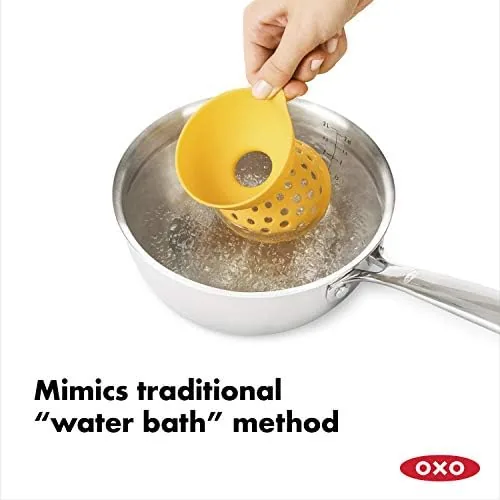
The headline feature is the method itself. You fill a skillet with about an inch of water, bring it to a gentle simmer, set the cups in the water, crack an egg into each cup, cover the cups, and wait. No whirlpool, no vinegar, no fragile ribbon of white to corral. The silicone insulates the egg from the violent water, so the white sets evenly from the outside in while the yolk stays molten in the middle. The vented lids are the second trick, trapping enough steam to cook the top surface without turning the egg into a hard rubber ball.

The flat base is a small but important detail. Many competitor pods wobble or float, which sends the egg sliding sideways before it sets. The OXO base sits firmly on the pan bottom, so the cup stays put even when the water shimmies. A molded handle on each side is big enough for kitchen tongs or bare fingers, and it stays cool enough to grab quickly after cooking. For anyone who wants to compare the current price against other egg poaching setups, the OXO egg poaching set listing on Amazon shows the current asking price and shipping details.
Real-World Performance
I made poached eggs five mornings a week for a month, which is far more eggs than most home cooks will ever attempt in that span. The first attempts taught me the one real quirk of the design: the egg sticks to the silicone unless you oil it first. A quick wipe of olive oil or a spritz of spray inside the cup before cracking the egg, and the finished poached egg slides out onto toast without tearing. Skip that step and you will need a silicone spatula to coax the white free, which can split the dome you worked so hard to build.
Timing became predictable by the second week. Six to seven minutes at a gentle simmer produces a fully set white and a yolk that still runs when you cut into it. Eight minutes edges toward a soft-set yolk, and anything past nine turns the egg into a solid golf ball. The vented lid does the top-of-the-egg work better than I expected: within a few minutes the surface of the white had gone opaque and set, which is exactly what the free-floating method struggles to achieve. The result was a consistently round, compact dome with a plump yolk at its center.
The set shines for batch cooking. Both cups cook at once, so a single pan produces two perfect eggs in one go, and the cups hold their shape through dozens of washes. Cleanup is the fastest of any cooking method I tried: the eggs come out clean, a rinse under the tap clears the water film, and a quick trip through the dishwasher finishes the job. The one limitation is capacity. Two eggs is the ceiling here, so a family breakfast for four means running two batches or buying two sets.
Pros and Cons
Pros:
- Consistent round poached eggs without vinegar or a vortex
- Vented lids cook the top of the white cleanly
- Sturdy food-grade silicone with no odor or taste transfer
- Dishwasher safe and quick to hand wash
- Flat base and molded handles make handling easy
Cons:
- Eggs need a light oiling to release cleanly
- Only two eggs per batch
- Timing matters; overcooking produces a firm yolk
- Water level must be maintained through the cook
How It Compares
Egg poaching divides into three camps: the traditional free-floating method, silicone pod sets like this OXO one, and metal egg poaching pans with their little inserts. I ran the OXO set against the free-floating method and a classic metal poaching pan to see which one deserves your counter space.
| Feature | OXO Silicone Set | Free-Floating Method | Metal Poaching Pan |
|---|---|---|---|
| Skill required | Very little | High, takes practice | Moderate |
| Eggs per batch | 2 | 1 to 4 | 4 |
| Vinegar needed | No | Yes, for whites | No |
| Top of white cooks | Yes, via lid | Needs basting | Yes |
| Cleanup | Rinse or dishwasher | One messy pot | Multiple pieces |
| Consistency | Very high | Variable | High |

The free-floating method produces the most beautiful egg when it works, and the metal pan produces four at once, but both demand technique that the OXO set simply forgives. For a home cook who wants a dependable breakfast with zero ceremony, the silicone set is the more practical daily tool. It costs less than a metal poaching pan, stores smaller, and cleans faster. The trade-off is the four-egg ceiling and the need to oil the cups, two compromises that disappear if you cook for one or two.
Who Should Buy It
Buy this set if you love eggs Benedict but cannot nail a free-floating poached egg, if you cook for one or two and want the same result every morning, or if you are teaching a beginner to cook eggs without fear of a wrecked pot of water. It is also an excellent gift for a college student or new apartment owner who has a stove, a skillet, and a taste for runny yolks.

Skip it if you host large breakfasts and need four eggs at once, if you already make gorgeous free-floating poached eggs and enjoy the ritual, or if you hate washing an extra piece of silicone. If the two-egg cap sounds right for your mornings, check the OXO Good Grips egg poaching set on Amazon for the current price.
How We Test
I tested the OXO set over a full month of daily poached eggs, which gave me more than twenty cooking cycles to judge consistency. I varied the cook time from five to ten minutes to map the texture range, tried it with and without oiling the cups, tested the dishwasher cycle repeatedly, and compared it head to head with the free-floating method and a classic metal poaching pan. I also cooked the eggs in both a shallow skillet and a deep saucepan to confirm that water depth does not break the seal or float the cups.
I did not test the set in a microwave, an oven, or on a grill, because silicone behavior outside simmering water is a different question entirely. For a wider view of egg cooking techniques from a professional kitchen, the guide at The Spruce Eats explains the traditional method well. You can also review the exact listing, full product images, and current price for the OXO set on its Amazon product page.
OXO Silicone Egg Poaching Set: Questions People Ask
How do you use the OXO silicone egg poaching set?
Fill a skillet with about an inch of water, bring it to a gentle simmer, set the cups in the water, crack an egg into each cup, cover with the lids, and cook for six to seven minutes for a runny yolk.
Do the silicone cups need to be greased before poaching?
A light wipe of oil or a spritz of cooking spray makes the eggs release cleanly. Without it, a thin film of white can cling to the cup and need a spatula to free it.
Can the OXO egg poaching cups go in the microwave?
No. The set is designed for stovetop use in simmering water and is not intended for microwave cooking, so keep these cups in the pan and away from the turntable.
Are the OXO silicone poaching cups dishwasher safe?
Yes. The silicone cups and lids survive the dishwasher without warping, though a quick hand wash with warm suds takes seconds and protects the surface longer.
As an Amazon Associate, I earn from qualifying purchases.