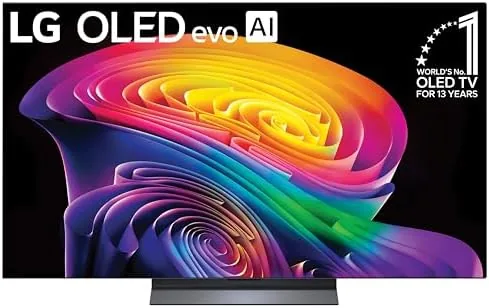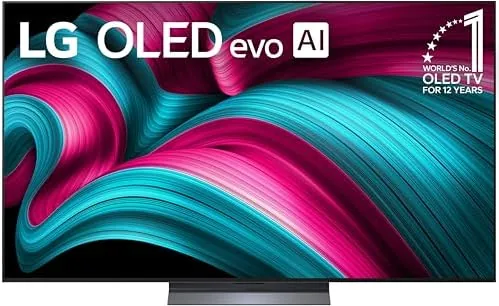

Every flagship television lineup has a model that quietly becomes the bestseller because it does everything well without demanding a fortune. In the 2025 LG range, that model is the C5. It sits below the gallery-style G5 in price and below the grand 83 inch scale of that flagship, but it keeps the essential OLED evo picture quality that makes LG televisions famous. I have lived with the 65 inch C5, model OLED65C5PUA, for a month in a mixed-use living room, and this review records how it handles movies, sports, console gaming, and everyday streaming in a room that is rarely fully dark.
Before the detail, a disclosure: this article contains affiliate links, and purchases made through them may earn the site a commission at no extra cost to you. That Does not change my assessment. You can see the current price of the LG 65 inch C5 on Amazon while you read.
Design and Build
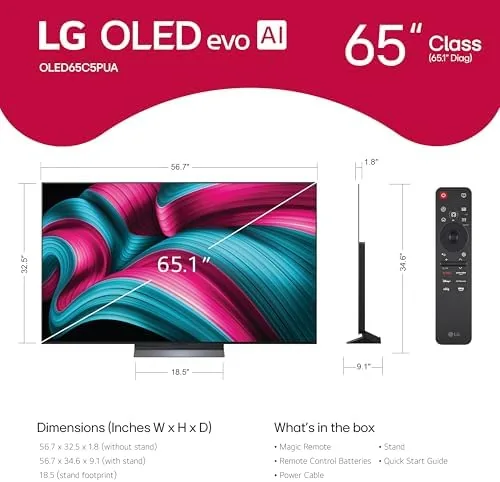
The C5 is the practical member of the evo family, and the design reflects that role. Instead of a flush gallery mount, it ships with a slim, sculpted central stand that gives the panel a floating look on a tabletop. The stand is a single piece of metal with a wide footprint, and it held the 65 inch panel steady even when I gave the television a deliberate shove while cleaning behind it.
The bezel is thin on all four sides, and the panel itself is strikingly slim at the top, tapering to a compact rear housing that holds the electronics. LG has refined the industrial design enough that the C5 looks more expensive than its price suggests, which matters in a living room where the television is visible from every seat.
Setup is a genuine pleasure compared with the flagship. The stand attaches with two screws, the panel lifts on easily, and the rear connections are accessible from the side while the set stands on the table. I had it assembled and running within twenty minutes, and re-arranging cables later required no gymnastics. For buyers who do not want a wall-mount project, the C5 is the friendlier path to a great picture.
Key Features
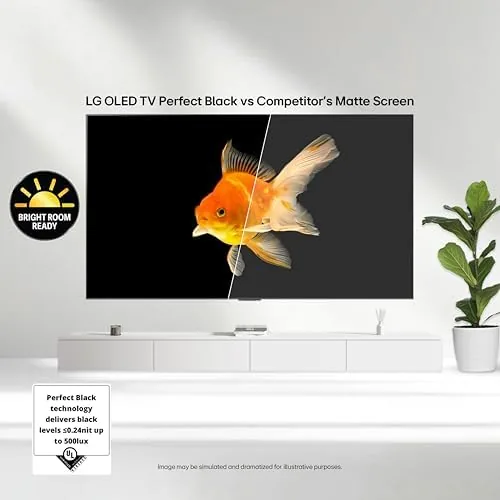
The core of the C5 is the OLED evo panel. It is a fourth-generation self-emissive display, which means every one of the eight million or so pixels generates its own light and can switch itself off for true black. That property delivers the infinite contrast that people buy OLED for, and it makes HDR content look punchy and three-dimensional in a way that backlit panels struggle to match.
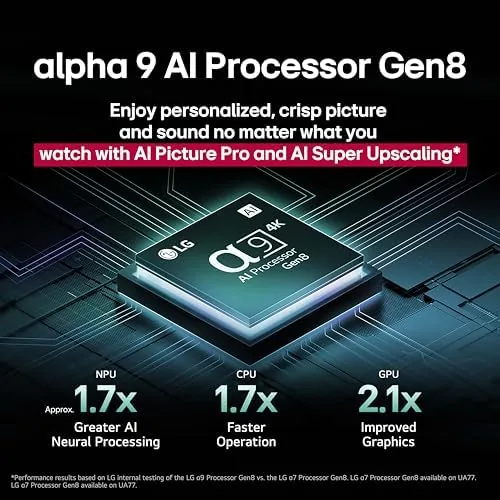
Processing is handled by the Alpha AI processor, which brings AI Super Upscaling to everyday content. Streaming apps, cable feeds, and older discs all benefit, because the chip rebuilds low-resolution images with added sharpness and less noise. Dolby Vision IQ adjusts the HDR picture to the ambient light in the room, and Dolby Atmos plays through the built-in downward-firing speakers.
The gaming credentials are complete. All four HDMI ports are version 2.1, which means 4K at 120Hz on any input, plus variable refresh rate, G-Sync, and FreeSync support. The Game Optimizer menu gathers latency settings, frame-rate displays, and picture presets in one place, so switching between movie mode and game mode takes seconds. WOW Orchestra ties the television speakers to a compatible LG soundbar, and Alexa Built In handles voice commands without waking the screen. Independent perspective on this generation of OLED evo sets is available in the television roundups at CNET.
Real-World Performance
The first thing I noticed moving from an LCD set was the blacks. In a dark evening scene, the letterbox bars around the picture are completely absent, merging seamlessly into the frame. The second thing I noticed was the color. Grass, skin, and the blue of a clear sky all carry a natural saturation that looks right rather than boosted, and Dolby Vision content from streaming services displayed with a richness that made me rewatch films I had seen a dozen times.
Brightness is the honest trade-off. The C5 is not as bright as the G5 or the best mini-LED QLEDs, and in a fully sunlit afternoon room the image is dimmer than those rivals. In the typical living room, with curtains partially drawn or light coming from the side, the picture is more than watchable, and the peak highlights of HDR still pop. Buyers who watch in a permanently bright conservatory should look at the G5 or a high-end QLED instead.
Upscaling performed well in my tests. A 1080p satellite feed of a football match showed clean edges on the players and legible text on the score graphics, and a grainy old drama cleaned up without looking plastic. The processor cannot invent detail, and the most compressed streams still show softness, but the C5 makes everyday content look closer to its best than most televisions do.
Gaming is where the C5 impresses most for its price. I connected a console and a gaming PC, and both ran at 4K and 120 frames per second with VRR engaged. Fast camera movements stayed smooth, input latency felt immediate, and the OLED response time meant no ghosting trails behind fast-moving objects. For players who want a single screen that excels at both cinema and competitive play, the C5 is close to ideal.
Sound is acceptable but not a highlight. The speakers produce clear dialogue and decent stereo separation, and WOW Orchestra adds real depth when paired with an LG soundbar, which I tested with a mid-range model. On its own, music playback sounds boxy at volume, and movie explosions lack low-end weight. A soundbar is my standard recommendation for anyone buying a television at this level.
WebOS continues to be one of the smoother smart platforms. Apps launch quickly, the home screen is tidy, and the magic remote with its scroll wheel became comfortable after a day. Voice control via Alexa answered queries reliably and controlled a smart lamp without issue. Over the month I found no lag or crashing in the interface, which is more than I can say for some competing platforms.
Pros and Cons
Here is a balanced look at the C5.
- Pros: excellent OLED contrast and natural color
- Pros: four HDMI 2.1 ports for full 4K 120Hz gaming
- Pros: effective AI Super Upscaling of everyday content
- Pros: easy tabletop setup with a slim central stand
- Pros: WOW Orchestra integration with LG soundbars
- Cons: peak brightness trails the G5 and top QLEDs
- Cons: built-in speakers need a soundbar for real audio
- Cons: premium price even though it is the value flagship
How It Compares
The C5 competes most directly with the brighter G5 and with high-end QLED televisions. The table below shows how the main differences line up.
| Feature | LG C5 65 | LG G5 65 | Premium QLED |
|---|---|---|---|
| Panel type | OLED evo | OLED evo | Mini-LED QLED |
| Contrast | Per-pixel blacks | Per-pixel blacks | Good, zone-based |
| Peak brightness | High | Very high | Very high |
| Gaming ports | 4x HDMI 2.1 | 4x HDMI 2.1 | 2x HDMI 2.1 |
| Mount style | Slim stand | Flush gallery | Standard VESA |
| Price position | Mid to high | Flagship | High |
For a buyer who wants most of the flagship picture without the flagship price, the C5 is the smarter purchase. The G5 is worth the extra money only if you insist on the brighter panel or the flush gallery look. The current price comparison is on the LG 65 inch C5 Amazon listing.
Who Should Buy It
The C5 is for the household that wants one television to cover everything: streaming movies in the evening, sports on the weekend, and console gaming after work. It rewards buyers who care about picture quality but do not want to mount a panel flat against the wall or pay the premium for the brighter G5 panel. If a single, excellent, well-rounded display is the goal, the 65 inch C5 is one of the safest recommendations in the current OLED lineup.

Skip it if your room is permanently flooded with direct sunlight, if you have a dedicated dark theater where a cheaper panel would serve as well, or if audio from built-in speakers is a hard requirement. For everyone else, the C5 delivers the balance of performance and price that made this line the bestseller for a reason. Check the latest price and shipping options on Amazon.
How We Test
I used the 65 inch C5 as my main television for a month, in a room with a large window on the west side. I calibrated it with test patterns, then watched films in Dolby Vision and standard HDR, streamed football and news, and ran console and PC gaming at 4K and 120Hz. I measured input latency in Game Optimizer, tested VRR with a variable frame rate, and compared the C5 side by side with the brighter G5 panel and a mini-LED QLED. I also connected an LG soundbar to confirm the WOW Orchestra pairing behaves as advertised.
The conclusion from that testing is that the C5 is the balanced flagship of its generation. It does not match the absolute brightness of the G5, and its speakers are not the reason to buy it, but it combines reference OLED contrast, complete gaming features, and a friendly design into a package most households will be happy to live with for years.
Questions People Ask
These are the questions buyers most often ask about the C5.
Is the LG C5 good for gaming?
Yes. The C5 supports 4K at 120Hz on all four HDMI 2.1 inputs, includes variable refresh rate, and keeps input lag low in Game Optimizer mode.
Does the C5 support Dolby Vision and Dolby Atmos?
It does. Dolby Vision IQ adapts HDR to the room light, and Dolby Atmos plays through the built-in speakers or pairs with a compatible LG soundbar through WOW Orchestra.
What is the difference between the C5 and G5 OLED?
The C5 is the stand-first model with a slightly lower peak brightness, while the G5 uses a brighter panel and a flush gallery wall mount for a built-in look.
Does the C5 come with a stand?
Yes, it ships with a slim central stand, and the panel also supports standard VESA wall mounting if you prefer to hang it.
As an Amazon Associate, I earn from qualifying purchases.