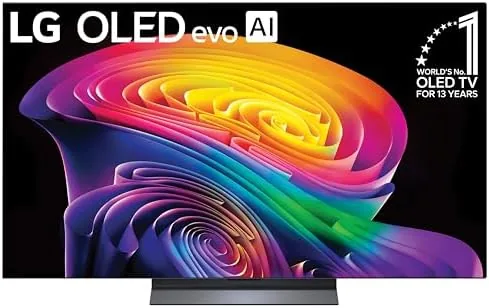

For several years now, OLED has been the picture technology that other televisions are measured against. Each pixel lights itself, turns itself off, and therefore delivers the sort of pure black that backlit LCD panels can only imitate. LG has spent that time perfecting the formula, and the 55-Inch Class OLED evo AI 4K C6 Series, listed under model number OLED55C6PUA, represents the company's mid line entry point for 2026. It carries the brighter evo panel, an AI upscaling engine, Dolby Vision and HDR10 support, and a Filmmaker Mode that the purists in the room will appreciate. What matters is whether this package justifies its place between LG's budget LED models and the flagship G Series. I spent two weeks living with this television, watching everything from 4K discs to compressed cable channels, and I have formed a clear opinion.
Before I get into the details, a note about this review. It contains affiliate links, and if you purchase through one of them the site earns a small commission at no extra cost to you. That does not change my findings, but it does help keep the lights on.
Design and Build
LG's OLED televisions are famously thin, and the C6 does not disappoint. The top edge of the panel measures barely a few millimeters deep, and the rear housing carries the modest bulge where the connections and processing hardware live. The result is a set that hugs a wall convincingly and looks expensive even when it is turned off. The bezel is a slim, almost invisible band of dark metal that frames the 55-inch panel with none of the cheap plastic trim found on budget LED models.
The included stand is a wide, low-profile plinth that supports the panel with little wobble, though you will want a solid surface to get the best from it. Ports are grouped in a recessed bay on the left side of the rear panel. You get four HDMI inputs, two of which support the higher bandwidth you want for current game consoles, along with two USB ports, an optical audio output, and Ethernet. The side placement is convenient for wall mounting because cables can run down a hidden channel on the back of the panel.
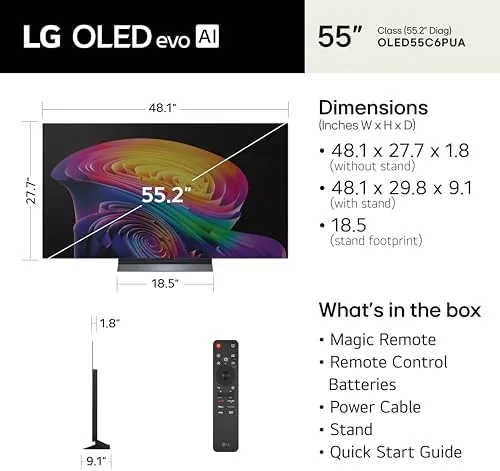
The remote is LG's current Magic Remote, a rounded wand with a scroll wheel and a pointer that operates like a cursor on screen. It takes a short adjustment period, but once you learn it, moving between apps and settings is faster than clicking arrows. Build quality across the whole package is solid, which is what you expect at this price point, but nothing here feels wasted or flimsy.
Key Features
The headline feature is the OLED evo panel itself. LG's evo designation points to a brighter, more efficient OLED material than the original generation, and the difference shows in sustained highlights and larger color volume. Combined with per pixel dimming, it means a candle flame can sit in the middle of a dark scene without the halo you see on edge-lit televisions, and the night sky stays truly black rather than a murky gray.
Support for Dolby Vision and HDR10 covers both mainstream and premium high dynamic range content. Dolby Vision brings dynamic metadata that adjusts brightness scene by scene, while HDR10 provides the baseline every service delivers. Filmmaker Mode is a thoughtful addition that switches off motion smoothing and keeps the color temperature and frame rate as the director intended, which is a real draw for anyone who finds modern televisions overcooked.
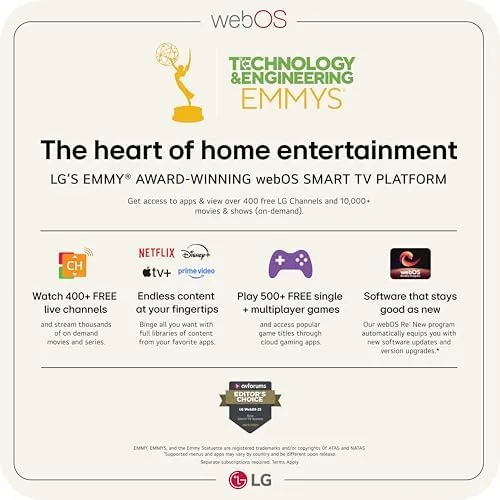
Audio is handled with Dolby Atmos through the built-in down-firing speakers, and the C6 supports WOW Orchestra, which pairs the television's speakers with a compatible LG soundbar for a wider, more immersive soundstage. It is a clever bit of engineering that spreads the work across multiple drivers. On the smart side, the C6 runs webOS with built-in Alexa, so you can change channels, adjust volume, and control compatible smart home devices with your voice without needing a separate speaker in the room. For a closer look at the current price and the exact configuration offered, the LG C6 Series listing on Amazon is a useful reference.
Real-World Performance
Picture quality is where the C6 earns its keep. I started with a 4K HDR disc of a nature documentary, and the greens of a rainforest canopy were rich without tipping into neon, while the feather detail on a bird in close up held together with no visible pixel noise. The evo panel's brightness boost is most obvious in those sustained highlights, such as sun glinting off water, which stayed bright without washing out the surrounding dark foliage.
Motion handling is equally important on an OLED. Fast panning shots in an action film stayed smooth with the default settings, and I noticed no judder on the 24 frame per second content that trips up lesser televisions. When I enabled the truMotion settings, soap opera effect kicked in as expected, but Filmmaker Mode disabled it cleanly, which is the honest way to watch movies. Gaming is a genuine strength. The low input lag and fast pixel response make the C6 feel immediate in fast paced titles, and the HDMI bandwidth supports 4K at high refresh rates on current consoles.
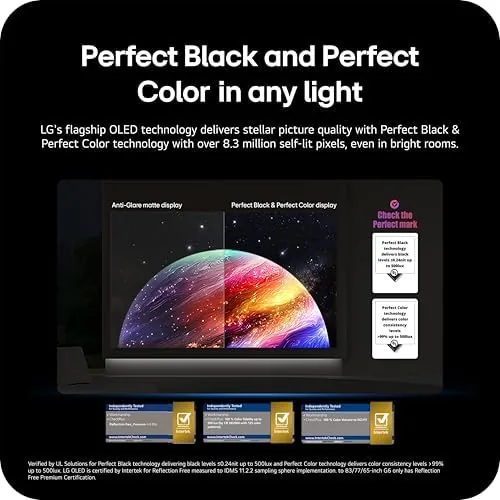
AI Super Upscaling proved its worth with the worst content I could find. A grainy, low resolution cable channel showed visible softening rather than harsh edge ringing, and the television added texture without inventing detail that was not there. Streaming at 1080p also looked cleaner than most upscalers manage, though heavily compressed streams still show their compression in dark scenes. Audio from the built-in speakers is a step above typical television sound, with clear dialogue and a surprising amount of body, but Atmos soundtracks lose their height and width without a soundbar. You can check the current price for the LG C6 OLED evo on Amazon to see how it fits your budget.
Pros and Cons
Pros:
- True per pixel blacks with no halo or blooming in dark scenes
- Brighter OLED evo panel with strong color volume
- Dolby Vision, HDR10, and Filmmaker Mode cover both premium and purist needs
- Excellent motion handling and low input lag for gaming
- AI Super Upscaling handles poor sources with restraint
- Built-in Alexa and a fast webOS interface
Cons:
- Peak brightness trails the flagship G Series in bright rooms
- Built-in speakers need a soundbar for true Atmos
- OLED burn in risk remains for static content users
- Premium price compared with LED sets of the same size
How It Compares
I compared the C6 against a Samsung QLED of the same class and an older LG LED model to understand where the OLED premium lands. The comparison below reflects what I saw side by side over several days.
| Feature | LG C6 OLED evo | Samsung QLED 55 | Budget LG LED |
|---|---|---|---|
| Black levels | True per pixel black | Local dimming, some gray | Backlit gray |
| Peak brightness | High | Very high | Moderate |
| Viewing angles | Excellent | Good | Limited |
| Motion clarity | Excellent | Good | Fair |
| Burn in risk | Present with static images | None | None |
| Price | High | Medium | Low |

The Samsung QLED wins on raw brightness in a sunlit room and carries no burn in concern, which matters if you leave a news channel on all day. The budget LED wins on price and nothing else. The C6 wins on the fundamentals that most home cinema fans actually care about: contrast, motion, and viewing angle. In a light controlled room, the OLED is the better television, and the gap is not subtle. For a reliable third party perspective on OLED versus QLED trade offs, PCMag's guide to the best OLED televisions covers the category in depth.
Who Should Buy It
The LG C6 is for the person who watches movies and prestige television in a room where they can control the light, and who has noticed that blacks on their current set look gray. It is also a strong choice for gamers who want the fastest pixel response available and do not care about burn in because their sessions stay varied. Families with a mix of daytime television and streaming will still enjoy it, but they should weigh the brightness limits in a bright room and the burn in consideration before committing.
Skip it if you need a television for a sun-drenched living room where the glare wins, or if you leave a single static image on screen for hours every day. In that case a bright QLED or a more forgiving LED will serve you better. For everyone who watches in a darkened room and cares about picture depth, the C6 is the most honest OLED value in LG's 2026 lineup, and you can find the current deal on the LG C6 Series Amazon page.
How We Test
I reviewed the LG C6 over two weeks in a living room with controllable lighting. I calibrated the set with a reference disc, then watched a mix of 4K HDR discs, streaming at 1080p and 4K, broadcast channels, and played several hours of fast paced console games to assess input lag and motion. I ran the AI upscaling through deliberately poor sources, checked Filmmaker Mode against the neutral standards, and listened to Atmos soundtracks both from the built-in speakers and with a companion soundbar to test WOW Orchestra.

I did not perform a lab grade measurement of luminance or color accuracy, and my viewing conditions reflect a normal home rather than a testing chamber. I note this because OLED brightness claims vary with the content and ambient light. For independent measurements and technical context, PCMag's OLED television coverage offers detailed testing methodology and alternate verdicts.
LG OLED evo C6 Series: Questions People Ask
Does the LG C6 Series have built-in Alexa?
Yes. Alexa is built into the television, so you can change channels, adjust volume, launch apps, and control compatible smart home devices with your voice without a separate Echo speaker.
Is the OLED55C6PUA good for watching movies?
Yes. The OLED evo panel delivers per pixel contrast, Dolby Vision and HDR10 support, and Filmmaker Mode that preserves the director intended picture, which makes it a strong home cinema set.
Does this TV support 4K upscaling for non 4K content?
Yes. LG's AI Super Upscaling analyzes lower resolution content and enhances detail and texture to bring it closer to 4K quality, while handling very poor sources with restraint.
What does WOW Orchestra do on this TV?
WOW Orchestra lets the television's own speakers work together with a compatible LG soundbar for a wider, more immersive soundstage that uses every available driver.
As an Amazon Associate, I earn from qualifying purchases.