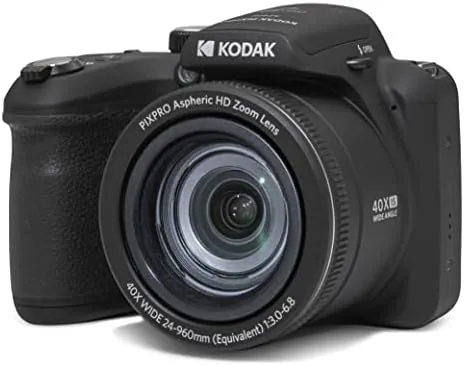

The bridge camera is the middle child of the photography world. It is too serious to be a point and shoot and not serious enough to be an interchangeable lens system, but for a large group of buyers that is exactly the point. The Kodak PIXPRO AZ405 sits in that middle lane with a 40x optical zoom, a 20 megapixel sensor, and a price that undercuts almost every mirrorless kit by a wide margin. I carried one to a wildlife park, a city street, and a family event to see how much reach you can actually buy at this end of the market.
The standard disclosure up front. This review contains affiliate links, and if you buy through one of them this site earns a small commission at no cost to you. That does not influence what I test or recommend.
Design and Build
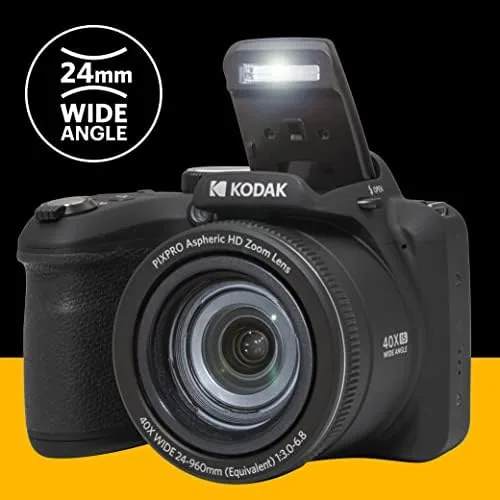
The AZ405 looks like a compact DSLR from a distance, with a prominent lens barrel, a textured grip, and a large built in flash. The body is plastic but the construction is solid, with no creaking panels and a grip that feels secure in the hand. The weight is noticeable, which is actually reassuring, because it means the 40x lens is not balanced on a featherweight shell.
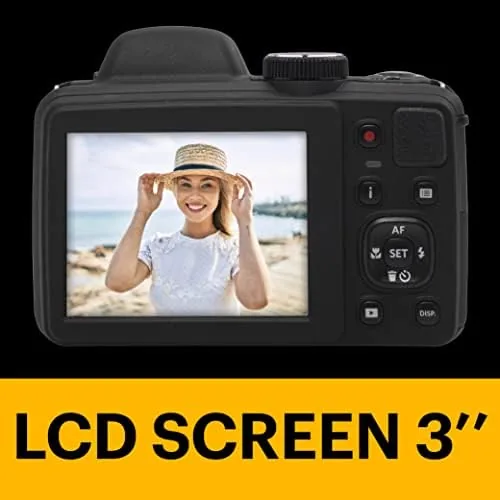
The control layout is straightforward. A mode dial on top, a shutter button, and a zoom lever around the shutter that operates the lens motor. The 3 inch rear LCD is fixed rather than articulating, which is a compromise at this price, but the screen is bright enough for outdoor framing. The camera Runs on AA Batteries, which is a deliberate choice for the budget market, and the battery compartment holds four cells with a secure latch.
Build quality holds up for the class. The lens barrel extends and retracts smoothly, the mode dial clicks through its positions without overshooting, and the overall feel is that of a tool built to be used, not admired. It is not weather sealed, so a light drizzle means finding cover, but that is true of almost everything in this price range.
Key Features
The defining feature is the lens. A 40x optical zoom that starts at 24mm wide angle and extends to an equivalent of roughly 1000mm at the long end. That reach is the reason to buy this camera, because it puts wildlife, stadium events, and distant landscapes within framing range for a fraction of the cost of a super telephoto lens.
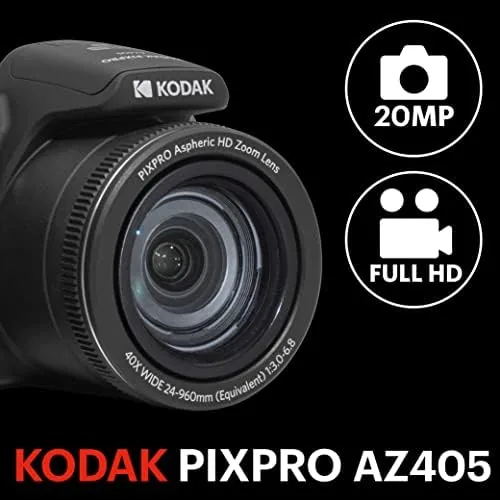
The 20 megapixel sensor captures enough detail for prints and social sharing, and optical image stabilization helps steady the long end of the zoom. The camera records 1080p Full HD video at 30 frames per second, which is modest by modern standards but usable for family memories and travel clips. A scene detection system offers a range of auto modes that pick settings based on what the camera sees.
The 24mm wide angle end is easy to overlook until you need it. It lets you fit a full room or a wide landscape into the frame without stepping back through a wall, and it gives the camera genuine flexibility beyond the zoom reach. Combined with the long end, the lens range covers almost any situation a casual photographer will face.
Real-World Performance
At the wildlife park, the AZ405 earned its keep. The 40x zoom brought distant birds and animals into filling the frame from a respectful distance, and the optical image stabilization made handheld shots at full extension possible in good light. The lens motors moved smoothly, and the autofocus locked onto subjects reasonably quickly in bright conditions.

The honest limitations surface when the light fades. At full zoom and modest aperture, the autofocus hunts in low light, and images at high ISO show noise that a larger sensor would not. The softening at maximum zoom is also real, so the sharpest results come from stepping the zoom back slightly or resting the camera on a solid surface. These are predictable trade offs at the price, and they do not cancel the value of the reach.
In everyday use the camera is pleasant to operate. The AA battery system is a genuine convenience for travel, because you can buy replacements anywhere rather than hunting for a charger, and a set of four batteries lasted a full day of casual shooting. The 1080p video is fine for clips and will not disappoint anyone who is not grading footage, and the scene modes make handing the camera to a family member painless. The menu system is worth a moment because it shapes the whole experience. Kodak keeps the menus short and plain, with clear labels that avoid the jargon found on more expensive cameras, and the quick menu button puts white balance, ISO, and exposure compensation within a couple of presses. It is not a fast camera in the way a sports body is, because the buffer fills after a short burst and the shot to shot time is leisurely, but the deliberate pace suits the audience. A macro mode at the wide end adds versatility for flowers, food, and small subjects, and the results at that setting are among the sharpest the camera produces.
Pros and Cons
Pros:
- Genuine 40x optical zoom at a budget price
- 24mm wide angle covers indoor and landscape work
- Optical image stabilization helps handheld long shots
- AA batteries are easy to replace anywhere
- Simple controls that anyone in the family can use
- Solid build for the price
Cons:
- Images soften at maximum zoom extension
- Autofocus hunts in low light
- High ISO performance shows its sensor size
- Fixed LCD cannot swing out for self framing
How It Compares
The AZ405 competes with other budget super zooms and the smartphone in your pocket. I compared it against two common alternatives to place its strengths and limits.
| Feature | Kodak AZ405 | Budget Super Zoom Rival | Modern Flagship Phone |
|---|---|---|---|
| Optical zoom | 40x | Up to 50x | Usually 3x to 5x |
| Sensor | 20 MP, 1/2.3 inch | 16 to 20 MP, 1/2.3 inch | Large, computational |
| Low light quality | Limited | Limited | Excellent |
| Video | 1080p at 30 fps | 1080p at 30 fps | 4K with stabilization |
| Battery | AA batteries | Rechargeable | Internal |
| Price | Budget | Budget | Premium |
Against a smartphone, the AZ405 wins the moment the subject is far away, because no phone zoom comes close to 40x optical reach. The phone wins everywhere else, with better low light, video, and processing. Against a rival super zoom, the differences are marginal, and the choice comes down to ergonomics and price. The AZ405’s AA battery flexibility is a real advantage for travelers, while a rival with a rechargeable pack removes the need to carry spares.
Who Should Buy It
Buy the Kodak PIXPRO AZ405 if you want long zoom reach without spending mirrorless money. It is the right camera for someone who photographs birds at the feeder, kids at soccer games, or scenery from a cruise ship deck, and who has no interest in carrying a bag of lenses. It is also a sensible first real camera for a teenager or a traveler who wants to move beyond a phone.
Skip it if you shoot mostly indoors or at night, because the sensor will frustrate you, and skip it if you expect the sharpness of a larger sensor, because the softening at full zoom is part of the package. For anyone whose subjects are mostly in daylight and mostly far away, this camera delivers remarkable value. You can check the current Kodak PIXPRO AZ405 price on Amazon when you are ready to decide.
How We Test
I used the AZ405 across three outings: a wildlife park for the long end, a city walk for the wide end and general use, and a family event for indoor performance. I shot the same subjects at multiple zoom steps to chart where sharpness begins to drop, and I tested the autofocus in bright and fading light. Battery life was tracked through a full day of mixed use.
I did not test video beyond confirming the 1080p output was usable, and I did not push the camera into weather it was not designed for. The lens was used without filters or adapters, exactly as a buyer would use it out of the box. For independent perspective on bridge cameras and when they make sense, the coverage at CNET Computing is worth reading.
If the zoom reach appeals to you, the Kodak PIXPRO AZ405 listing on Amazon shows the current price and available bundles.
Kodak PIXPRO AZ405: Questions People Ask
Is the 40x zoom sharp at full extension?
At maximum zoom the lens reaches far but the image softens, so a steady hand or a tripod makes a real difference in the results.
Why does the AZ405 use AA batteries?
AA cells keep the camera cheap and easy to refill in the field, and you can carry spares instead of hunting for a charger.
Does the camera have image stabilization?
Yes, the optical image stabilization helps steady the long lens, though it cannot fully counter heavy camera shake.
Is the AZ405 good for beginners?
Yes, the scene detection modes and simple controls make it approachable, and the 24mm wide angle helps when the subject is close.
As an Amazon Associate, I earn from qualifying purchases.