
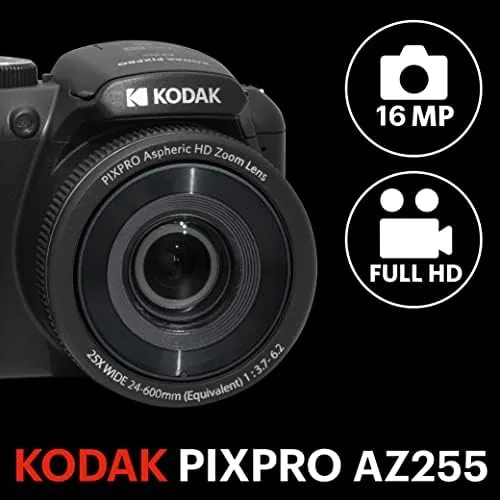
Most modern cameras assume you want to charge a battery, manage a smartphone app, and spend a small fortune. The KODAK PIXPRO AZ255 assumes the opposite. It is a 16 megapixel bridge camera with a 25x optical zoom, optical image stabilization, and 1080p Full HD video, and it runs on four AA batteries that you can buy at any corner store. There is no charging ecosystem to maintain, no proprietary cable to lose, and no app required. It is a refreshingly simple machine aimed at beginners, travelers, and anyone who wants reach without the weight of an interchangeable lens kit.
I spent two weeks with the AZ255 shooting daylight landscapes, wildlife at the far end of the zoom, and handheld video, and this review records what the camera does well and where it falls short. As always, a note up front: some links here are affiliate links, and a purchase through one earns the site a small commission at no cost to you. That never changes what I recommend.
Design and Build
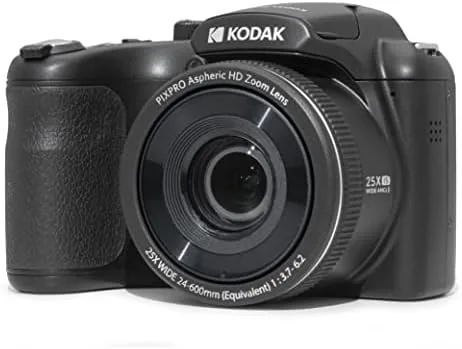
The AZ255 has the classic bridge camera silhouette, a chunky grip on the right, a long lens barrel in the center, and a broad 3 inch LCD on the back. It is not a pocket camera by any stretch, but the shape fits the hand well, and the raised rubber grip gives you something secure to hold at the full 25x zoom, where camera shake is the biggest enemy. The controls are straightforward: a mode dial on top, a zoom rocker around the shutter, and a set of clearly labeled buttons for playback, menu, and the optical stabilization toggle.
The body is plastic but feels solid enough for its price class, with no creaks or flex under normal handling. The lens retracts fully into the body when the camera is off, which protects the glass in a bag and keeps the camera compact for travel. The battery door sits on the bottom and opens to reveal the four AA slots and the SD card bay, and the fact that you can swap in fresh cells from any convenience store is genuinely liberating on a long trip.
Key Features
The defining feature is the 25x optical zoom, which reaches the equivalent of a 600mm lens at the long end. That is real reach. A bird in a distant tree, a player across a field, or a mountain peak across a valley all become workable subjects that a phone simply cannot capture. The optical zoom holds image quality across the whole range, unlike digital zoom, which only enlarges the pixels you already have.

Optical image stabilization sits at the heart of the system, and it matters more on a long zoom than anywhere else in photography. Handheld shots at 600mm shake violently without help, and the stabilization steadies the frame enough to make the reach actually usable. The 16 megapixel sensor delivers clean daylight files that survive light editing, and the camera shoots 1080p Full HD video at the press of a dedicated button, so you can grab a clip mid-photo session without diving into menus.
The 3 inch LCD is bright enough for outdoor framing, and the scene modes cover the common situations a beginner meets, including portrait, landscape, sports, and night. There is also a simple auto mode that decides everything for you. For the current street price and any bundle options, the Amazon listing for the KODAK PIXPRO AZ255 is the place to check.
Real-World Performance
In good daylight the AZ255 is a capable and fun camera. A walk through a park produced sharp, well exposed shots of flowers at wide angle and distant trees at the full zoom, and the stabilization kept the long end steady enough that I could shoot without a tripod in most situations. The colors lean toward the vivid side, which flatters travel snaps and makes prints look cheerful without editing.
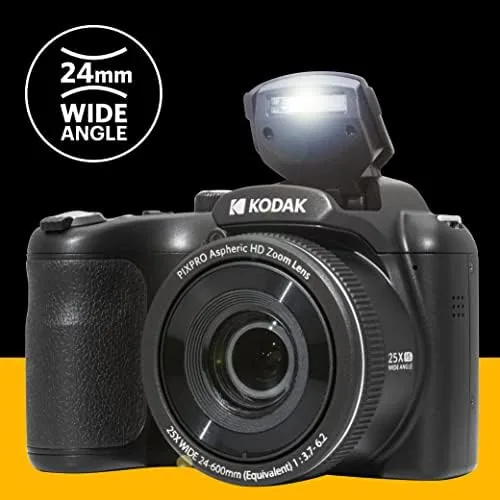
The reach is the real joy. At an afternoon game I could fill the frame with a player on the far side of the field, and at a nature trail I photographed a heron that a phone user could only squint at. The stabilization allowed clean handheld shots where I expected blur, and the optical zoom meant I did not sacrifice detail for the distance.
Video is usable but not spectacular. The 1080p clips are stable thanks to the stabilization, and the dedicated record button makes capture instant, but the autofocus hunts noticeably when the subject moves, and the microphone picks up the lens motor and any wind. For casual vlogging and family memory clips it is perfectly fine, but it will not rival a phone for fast action.
The honest weakness is low light. Beyond indoor lighting and twilight, the sensor struggles, and shots become soft and noisy as the ISO climbs. The autofocus also slows and hunts in dim conditions, and without optical stabilization tricks the flash is the only real rescue. This is a daylight camera, and treating it as one keeps expectations realistic.
Pros and Cons
Pros:
- 25x optical zoom reaches subjects that phones cannot touch
- Runs on four AA batteries, no charging ecosystem needed
- Optical image stabilization makes the long zoom usable handheld
- Simple dial controls and auto modes suit beginners
- Dedicated video button for instant 1080p recording
- Affordable price for a real optical zoom camera
Cons:
- Sensor struggles in low light with visible noise
- Autofocus hunts in dim conditions and during video
- AA batteries need frequent changes on heavy shooting days
- No viewfinder, so framing relies entirely on the LCD
How It Compares
Bridge cameras sit between a smartphone and an interchangeable lens system, and the AZ255 competes against two other obvious choices. I compared it with a typical flagship phone and a mid range mirrorless camera to clarify where the value lies.
| Feature | KODAK PIXPRO AZ255 | Flagship Smartphone | Entry Mirrorless |
|---|---|---|---|
| Optical zoom | 25x (to 600mm) | 3x to 5x typical | Depends on lens |
| Sensor quality in low light | Modest | Excellent | Very good |
| Battery | 4 AA batteries | Internal rechargeable | Internal rechargeable |
| Image stabilization | Yes | Yes | Lens dependent |
| Ease of use | Very simple | Instant | Learning curve |
| Price | Low | High | Mid to high |
| Weight and size | Bulky | Pocket size | Moderate |

Against a flagship phone, the phone wins decisively on image quality in low light, video polish, and portability, but the AZ255 wins on reach, offering a 25x optical zoom that no phone matches without a separate telephoto module. Against an entry mirrorless, the mirrorless wins on sensor quality and lens choice, but it costs several times more and requires you to buy lenses for zoom range. The AZ255 is the budget route to real optical reach, and that is its entire reason to exist.
Who Should Buy It
Buy the AZ255 if you want a genuine optical zoom for travel, wildlife, or kids' sports without spending mirrorless money, and if the simplicity of AA batteries appeals to you. It is an excellent first Camera for a teenager learning photography, a fine companion for a hiking trip where you do not want to worry about chargers, and a great gift for someone who wants to shoot farther than their phone allows.

Skip it if you shoot mostly indoors or at night, where a modern phone will give you cleaner photos, or if you expect professional quality images at this price, which no camera at this level delivers. For everyone else, the AZ255 is a genuinely enjoyable gateway into real photography. You can check the current price of the KODAK PIXPRO AZ255 on Amazon before you decide.
How We Test
I shot with the AZ255 for two weeks in mixed conditions. I photographed landscapes and close subjects at wide angle, distant birds and playing children at the full 25x zoom, and ran handheld stabilization tests at the long end with and without the image stabilization enabled. I recorded video clips with moving subjects to stress the autofocus, and I tracked battery life across a full day of shooting to confirm the AA performance.
I did not test the camera in heavy rain or extreme cold, and I used fresh alkaline batteries rather than rechargeable cells, which change the runtime math. For a broader look at what to expect from this class of camera, independent resources such as Tom\'s Hardware on bridge cameras explain the trade offs in more depth. The AZ255 listing on Amazon shows the current bundle and price.
KODAK PIXPRO AZ255: Questions People Ask
How long do the AA batteries last in the KODAK PIXPRO AZ255?
You can expect several hundred shots from a fresh set of four AA batteries, and the camera gives a clear low battery warning well before shutdown.
Does the AZ255 have image stabilization for video?
Yes. The optical image stabilization helps steady both still photos and handheld 1080p video, though it does not replace a tripod for very long zoom shots.
What memory card does the PIXPRO AZ255 use?
It accepts standard SD, SDHC, and SDXC cards, and the camera records 1080p Full HD video directly onto the card.
Can beginners use the AZ255 right out of the box?
Yes. The automatic modes handle most scenes, and the bundled guide explains the dial settings in plain language for new photographers.
As an Amazon Associate, I earn from qualifying purchases.