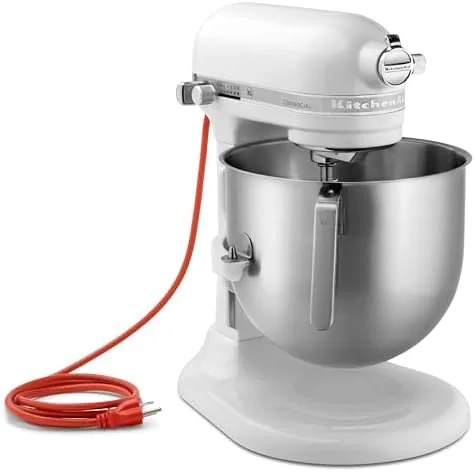

Every serious baker eventually hits the wall that a 4.5-quart mixer creates: the dough that is too stiff, the batch that is too big, the recipe that calls for twelve eggs and eight cups of flour in a bowl that barely fits half. The KitchenAid KSM8990 is the answer that kitchen appliance makers keep pointing at when you ask for more. This is the 8-quart bowl lift Stand Mixer from the Commercial Series, a machine that carries NSF certification and a full horsepower motor. It is also one of the most intimidating appliances you can put on a countertop, and for two weeks I ran it through the kind of workload that most home mixers would refuse, just to find out where that intimidation turns into real capability.
Before we begin, the disclosure. This review contains affiliate links. If you buy through one of them, I earn a commission at no additional cost to you, and that commission never influences what I write.
Design and Build
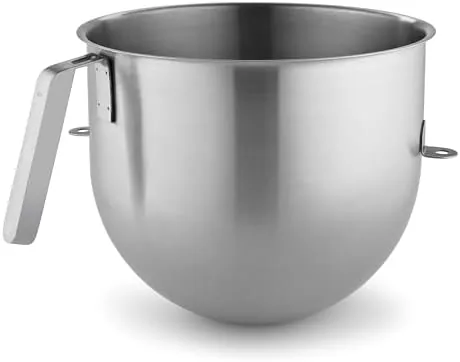
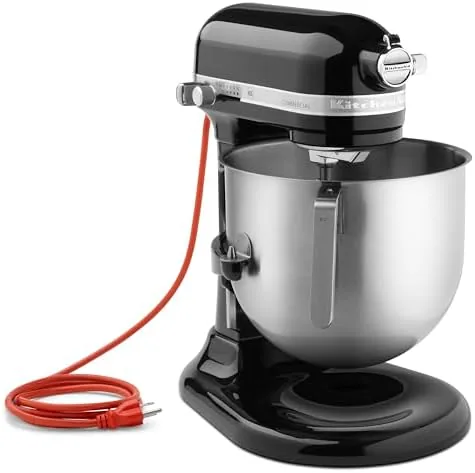
The KSM8990 is a big machine in every sense. It stands taller than a typical tilt-head mixer, and its 8-quart stainless steel bowl dominates the footprint. The bowl lift mechanism is the defining feature: instead of tipping the head back, you pull a lever on the side, and the bowl rises on a vertical arm to meet the beaters. The arm is steel, the hinges are heavy, and the whole assembly feels built for a bakery, because that is exactly where this mixer is certified to work. The metal base is solid enough that the mixer does not walk across the counter even at speed five with thick dough in the bowl.
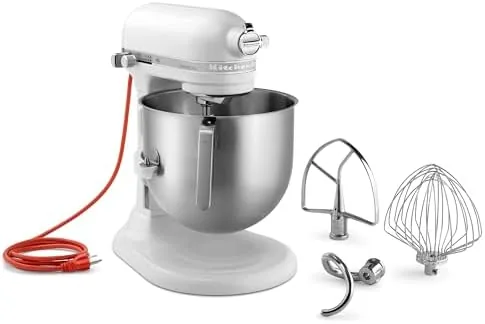
The attachments that ship in the box are sized to the task: a flat beater, a dough hook, and a wire whip, all in the larger commercial scale. The bowl has a handle and a pouring spout, and the head has the standard KitchenAid attachment hub on the front, which opens the door to the entire ecosystem of attachments. The speed control sits on the top of the head with the classic ten-position slider, and the bowl lift lever is smooth and positive. Every control has the kind of reassuring heft that tells you the designers did not cut corners.
Key Features
The headline specification is the 1.0 horsepower motor, which is roughly twice the power of a standard home KitchenAid. That power shows up immediately in bread dough. A batch of stiff whole wheat dough that stalled a smaller mixer kneaded with a steady, determined rhythm in the KSM8990, with no strain in the motor note and no complaint from the drive train. The NSF certification matters too: it means the mixer is built to commercial sanitation standards, which is a confidence signal about materials, seals, and durability rather than just marketing.
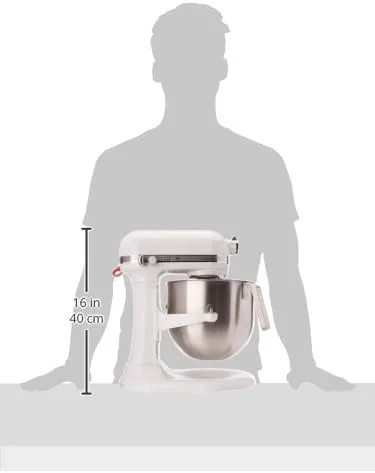
Capacity is the other headline. The 8-quart bowl holds up to six loaves of bread dough, about 32 cups of batter, and enough cookie dough for seven dozen cookies in a single batch. For the home baker who doubles recipes out of habit, this means fewer batches and less cleanup. The mixer also runs quieter than most home units because of the DC motor design, and the ten speeds cover everything from a slow fold to a fast whip. You can see the current price for the KSM8990 on Amazon if the full specification list interests you.
Real-World Performance
I started with bread because that is where most mixers fail. A double batch of sourdough-style white bread, about 1.5 kilograms of dough, went through the dough hook at speed two without a hitch. The bowl lift keeps the head locked in place, so there is none of the head-hopping you see on tilt-head machines with heavy dough. I followed with a brioche, which is the ultimate test: a wet, sticky dough that takes ten minutes of kneading. The KSM8990 handled it without climbing the hook or stalling, and the finished loaves had the proper open crumb that comes from proper gluten development.
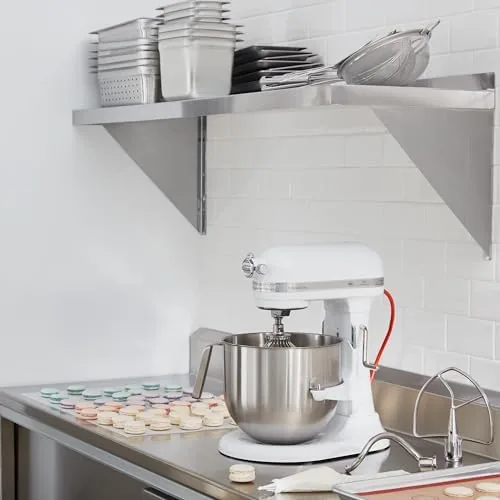
For batters, the machine is almost absurdly easy. A birthday cake recipe scaled to the full bowl whipped up in seconds, and the wire whip turned a batch of meringue into glossy, stiff peaks in about six minutes. Cream cheese frosting came out perfectly smooth with no graininess. The one thing to plan around is the minimum batch size: a single egg-white meringue or a small quantity of frosting will get lost in the bottom of that huge bowl, so this is a machine for people who cook in volume, not for a lone muffin recipe.
Pros and Cons
Pros:
- 1.0 horsepower motor handles the heaviest doughs without strain
- 8-quart bowl offers true commercial-scale capacity
- Bowl lift design keeps the head locked steady under load
- NSF certification signals real commercial-grade construction
- Full attachment hub works with the entire KitchenAid ecosystem
Cons:
- Large footprint and heavy weight are impractical for small kitchens
- Price is far above a standard home mixer
- Small batches get lost in the oversized bowl
- Bowl lift mechanism takes practice compared with tilt head
How It Compares
The 8-quart bowl lift sits in a class of its own, but most buyers cross-shop it against the classic 5-quart tilt-head KitchenAid and the 7-quart bowl lift models. The table below shows how the options line up for the most important decisions.
| Feature | KSM8990 8-Quart | 5-Quart Tilt Head | 7-Quart Bowl Lift |
|---|---|---|---|
| Motor Power | 1.0 horsepower | 0.5 horsepower | 0.85 horsepower |
| Bowl Capacity | 8 quarts | 5 quarts | 7 quarts |
| Lift Type | Bowl lift | Tilt head | Bowl lift |
| NSF Certified | Yes | No | No |
| Bread Dough Load | Up to 6 loaves | Up to 3 loaves | Up to 5 loaves |
| Weight | ~35 pounds | ~25 pounds | ~30 pounds |
Against the 5-quart tilt head, the KSM8990 wins decisively on power, capacity, and stability, and it costs considerably more for that privilege. Against the 7-quart bowl lift, the KSM8990 adds the extra quart, the stronger motor, and the NSF rating, which is why it is the pick for anyone baking at the edge of a home machine's limits. The 5-quart remains the sensible choice for occasional bakers who mostly make cookies and cakes, but if you are routinely pushing past that machine, the KSM8990 is where the upgrade money should go.
Who Should Buy It
Buy the KSM8990 if you bake bread in volume, run a small cottage bakery, make meringues and whipped cream by the bowl, or simply want a mixer that will never be the thing that limits your recipes. It is a machine for people who have already outgrown a smaller mixer and who measure success in finished loaves and cooling racks rather than in single cakes. If you are that person, the KSM8990 on Amazon is worth the look.
Skip it if you bake occasionally, if your counter space is limited, or if most of your recipes are single batches. The 8-quart bowl is genuinely impractical for small jobs, and the price is hard to justify if the machine sits idle most weeks. For everyone in between, the honest advice is to buy the machine that matches your batch size, and only step up to this one when your current mixer has clearly become the bottleneck.
How We Test
I ran the KSM8990 through a two-week testing battery that included double batches of white and whole wheat bread, a brioche, an angel food cake, a batch of meringue, several rounds of buttercream, and a double batch of chocolate chip cookie dough. I recorded motor strain by ear and by checking the dough temperature, tested the bowl lift at each of the ten speeds, and measured how long the machine took to knead each dough to full gluten development. I also cleaned the bowl and attachments by hand after every session and evaluated how the exposed surfaces held up.
I did not test this mixer in a licensed commercial kitchen, so I cannot comment on years of continuous commercial duty, but the NSF certification is an independent signal about that durability. Independent guidance from Wirecutter's stand mixer coverage is worth reading to compare this machine against the wider market. The KSM8990 listing on Amazon has the current price and shipping options.
KitchenAid KSM8990: Questions People Ask
What is the difference between a bowl lift and tilt head mixer?
A bowl lift mixer raises the bowl into the beater on a vertical arm, which keeps the motor head stable under heavy loads, while a tilt head mixer tips the head back for access and suits lighter use.
How much dough can the 8-quart bowl hold?
The 8-quart bowl handles up to six loaves of bread dough in one batch, roughly 32 cups of batter, and more than seven dozen cookies worth of dough.
Is the KSM8990 NSF certified?
Yes. The Commercial Series carries NSF certification, which covers the materials and design for frequent commercial-style use, and it is built to that stricter standard.
What attachments work with the 8-quart mixer?
It accepts the standard KitchenAid attachment hub, so pasta makers, grinders, spiralizers, and the included wire whip, flat beater, and dough hook all fit.
As an Amazon Associate, I earn from qualifying purchases.