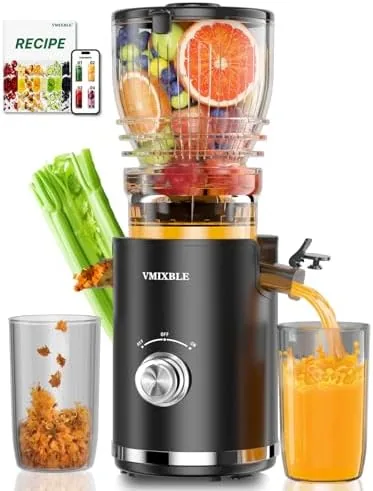

Juicing has a very specific failure mode that stops most people within a week: the prep takes longer than the drinking, and the cleanup takes longer than both. A centrifugal juicer makes you chop everything into small pieces before feeding it in, then leaves you with a frothy liquid and a stained basket. The cold press juicer reviewed here attacks that problem from two directions, with a 5.8 inch wide feed chute that swallows whole fruit and a slow 300W masticating auger that presses out a higher yield. I ran this machine through apples, carrots, leafy greens, ginger, and a bag of berries over two weeks of daily juicing. This review covers yield, pulp dryness, noise, and the cleanup that decides whether the machine actually gets used.
The note before the details. Some links in this article are affiliate links, and the site earns a small commission if you buy through them at no extra cost to you. That never affects my testing or my conclusions. The juicer was bought at retail and used exactly as a home user would use it, with no manufacturer involvement in this review.
The pitch is that a slow auger squeezes more juice from the same produce than a fast spinning blade, while the wide chute removes most of the chopping. The rest of this review is whether both halves of that promise hold up in a real kitchen.
Design and Build
The juicer is a vertical slow masticating machine with a white body, a wide mouth at the top for the feed chute, and a clear pulp container and juice jug that click into place around the base. The build is solid for the class: the body is stable and does not shimmy during operation, and the feed chute rim has a raised lip that catches stray produce before it bounces off the counter. The parts that touch the food, the auger, the strainer basket, and the pusher, are BPA free and dishwasher safe on the top rack.
Assembly is more involved than a centrifugal juicer, which is the tradeoff for the design. The auger, the strainer, the housing, and the lids all need to line up correctly, and there is a specific order to follow. After a few runs the process becomes muscle memory and takes under a minute, but the first assembly genuinely benefits from the manual. The machine feels built to be taken apart and washed often, which is exactly what the design demands.
Key Features
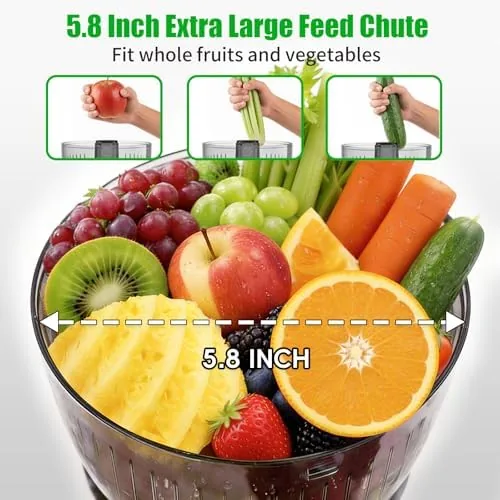
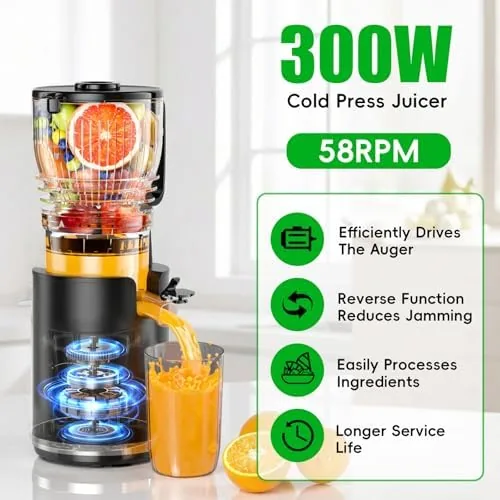
The headline feature is the 5.8 inch wide feed chute, which changes the juicing routine in a real way. Whole apples, pears, peeled oranges, and trimmed carrots drop straight in without chopping, which removes the step that usually kills the habit. The 300W slow masticating motor drives an auger that crushes and presses the produce against the strainer, extracting juice at low speed to limit heat buildup and preserve more of the nutrients.
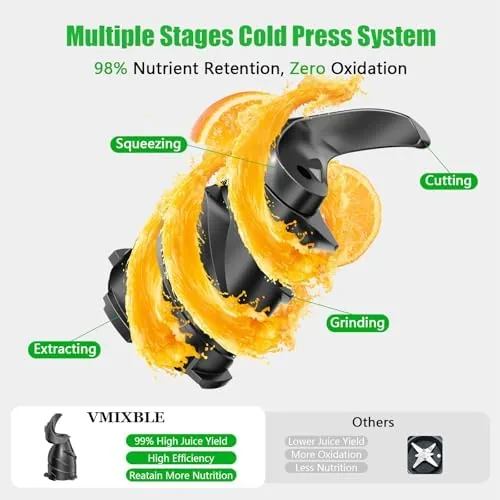
High juice yield is the other claim, and the design supports it. The slow auger presses more moisture out of the pulp than a centrifugal spinner, and the machine runs at a low enough speed that the juice does not foam or separate as quickly. The design also handles leafy greens and soft fruits, the two categories that defeat a centrifugal juicer, which makes the machine genuinely more versatile. All parts that contact food are BPA free, and the wide pieces rinse clean in under a minute.
Real-World Performance
The wide chute performed as promised from the first run. A whole apple went in without pre cutting, and the pusher barely needed to be used, which is the feature that makes a daily juice habit plausible. Carrots were trimmed to length and fed whole, and even a whole pear went through cleanly. The only produce that needed a cut was a large beet and a thick winter squash, which is a fair trade for everything else being drop in ready.
Yield was the second test, and the slow auger delivered. A batch of apples and carrots produced noticeably more juice than the same produce in a centrifugal machine, and the pulp came out dry and compact rather than soggy. Leafy greens, the usual killer for a fast spinner, pressed down to a dry disc with a decent green juice yield. The machine handles the full spectrum, from hard root vegetables to soft berries, which is the versatility that justifies the design.
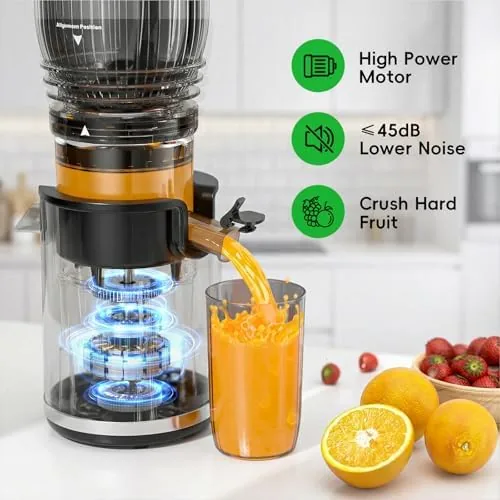
Noise is where the cold press design shows its biggest daily advantage. The machine runs with a low, steady hum rather than the shrieking whine of a centrifugal juicer, which makes early morning juicing a neighbor friendly affair. It is not silent, but it is dramatically more pleasant to run, and it does not disturb anyone in the next room the way a 1000W spinner does.

Cleanup is the deciding feature for any juicer, and this one lands in the better half of the category. The wide parts rinse under running water, the strainer basket needs the included brush to clear the fine mesh, and the whole disassembly washes in about two to three minutes. It is not a one piece rinse, which is the main drawback of the design, but it is faster than most cold press machines and dramatically faster than a centrifugal basket with its stuck pulp.
The juice quality is where the machine earns its place. The output is smooth, with less foam than a centrifugal machine, and the slow extraction produces a juice that tastes noticeably brighter, especially with greens and apples. Over two weeks the machine did not clog, did not stall on whole fruit, and did not overheat during the repeated short runs that daily juicing involves.
The honest limitations are the motor power and the run time. The 300W motor is not built for marathon sessions, so heavy continuous loads like a gallon of hard produce at once are best broken into batches with a pause. The machine also leaves a fair amount of pulp by design, which means there is more to wash than with a push through juicer. For the household quantities most people actually make, neither is a real problem.
Pros and Cons
Pros:
- 5.8 inch chute swallows whole fruit without pre cutting
- High juice yield with dry, compact pulp
- Handles leafy greens and soft berries that defeat fast juicers
- Runs quietly with a low hum instead of a whine
- BPA free parts that are dishwasher safe
- Fast rinse for most parts after each session
- Juice is smooth with minimal foam
Cons:
- More parts to assemble and disassemble than a centrifugal unit
- 300W motor prefers batch runs over marathon sessions
- Strainer basket needs a brush for the fine mesh
- Whole produce above chute size still needs a single cut
How It Compares
Cold press juicers and centrifugal juicers are the two families on the market, and the wide chute slow masticator sits against the cheaper and faster alternative. The table below lines up the two approaches.
| Feature | 300W Cold Press | Centrifugal Juicer | Push Through Juicer |
|---|---|---|---|
| Feed chute | 5.8 inch, whole fruit | 2 to 3 inch, pre cutting | Small, requires prep |
| Juice yield | High, dry pulp | Moderate, wetter pulp | High, very dry pulp |
| Leafy greens | Handled well | Poor | Handled well |
| Noise | Low hum | High whine | Very low |
| Speed | Slower, presses | Fast, spins | Slow, manual |
| Cleanup | Rinse plus brush | Stuck pulp, longer | Simple rinse |
The centrifugal machine is faster per batch, but it demands pre cutting, yields less juice, and turns leafy greens into dry chaff with almost no yield. The push through juicer wins on cleanup but loses on speed and convenience. The cold press design balances all of it: it takes longer per batch than the centrifugal, but it handles whole fruit, higher yield, greens, and far less noise, which is the package most daily juicers actually want.
Who Should Buy It
Buy this juicer if you want to juice whole fruit without spending ten minutes chopping, and if you care about getting the most juice out of your produce. It suits people who juice greens, people who want a daily habit that survives contact with a busy morning, and anyone upgrading from a centrifugal machine that wastes produce and struggles with kale. The quiet operation makes it a realistic choice for apartment mornings.
Skip it if you need to produce gallons of juice in one sitting, because the 300W motor prefers batches. It is also not the pick for someone who will not accept a two minute rinse and a brush after each use, and it is a poor match for anyone who only juices soft fruits occasionally and does not want the assembly learning curve. For everyday cold press juice, this machine delivers strong value. You can check the current price of this cold press juicer on Amazon when you are ready to buy.
How We Test
I ran the juicer daily for two weeks, processing whole apples, carrots, pears, beets, ginger, leafy greens, and a bag of berries. I compared yield against a centrifugal machine using the same produce batches, measured pulp dryness by hand and eye, and kept track of assembly and cleanup times for every session. I tested noise levels with a phone meter at a fixed distance and ran a continuous heavier batch to test the motor limits.
I did not run a laboratory nutrient analysis, and juice yield numbers vary with produce freshness. For a solid grounding on how juicer types compare and what to expect, Tom's Guide has a useful roundup of the best juicers that explains the design tradeoffs well. The cold press juicer listing on Amazon shows the current price and the full spec sheet.
Cold Press Juicer: Questions People Ask
Can the juicer really process whole fruits without pre cutting?
The 5.8 inch chute swallows whole apples, pears, and trimmed carrots, though very hard items like whole beets still work better cut in half.
How high is the juice yield compared to a centrifugal juicer?
The slow masticating auger presses more moisture out of the pulp, so you see higher yields from leafy greens and berries than a fast spinner.
Is the cold press juicer noisy?
It runs noticeably quieter than a centrifugal machine, more like a low hum than a shriek, which makes morning juicing less disruptive.
How long does cleaning take after a full pitcher?
A quick rinse of the strainer and auger plus the included brush takes about two minutes, though the many parts make the full teardown slower than a wide mouthed unit.
As an Amazon Associate, I earn from qualifying purchases.