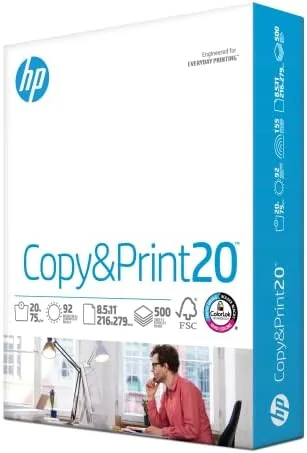

Every office has a default. The paper that sits in the copier tray day after day, that nobody thinks about until it runs out, and that does its job so quietly that it becomes invisible. For a huge number of businesses, that default is HP printer paper, and the specific product that fills supply cabinets is the 20 pound, 8.5 by 11 inch ream rated at 92 brightness. It is FSC certified, sold in 500 sheet reams, and priced to be the unremarkable backbone of daily printing. I spent a month running reams of it through laser printers, inkjet machines, and a high volume copier to decide whether this workhorse lives up to the reputation that earned it the default spot.
The standard disclosure comes first. This article contains affiliate links, and if you buy through one of them the site earns a small commission at no extra cost to you. That commission does not influence what I test or recommend.
Design and Build
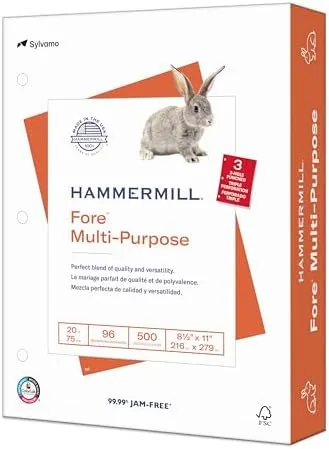
The paper arrives in the familiar HP ream wrap, a plain white package that communicates utility rather than glamour. Inside, the sheets are clean, flat, and evenly cut, with no rough edges and no debris in the stack. The 20 pound weight is the standard for general office use, stiff enough to feed reliably through any machine but light enough to keep costs down, and the white color is bright and neutral, the kind of paper that flatters both text and business color printing.
The 92 brightness rating is the number that defines this paper's position in the market. It is a full step above the cheapest economy stocks, which sit in the 84 to 87 range and look visibly gray by comparison, but it does not pay for the 100 brightness premium of top tier color papers. That middle placement is exactly where daily office printing lives: crisp enough for professional documents, affordable enough to run by the ream without thinking.
Key Features
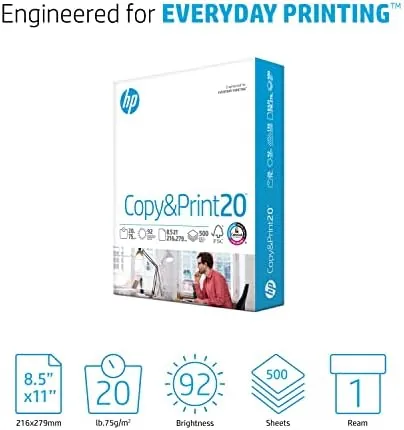
The specifications are deliberately mainstream, and that is the point. The paper is 8.5 by 11 inches, the letter size used for nearly all business documents, and it weighs 20 pounds, the standard basis weight that balances stiffness against economy. The 92 brightness gives text strong contrast without the glare that can make ultra bright papers tiring to read under office lighting.
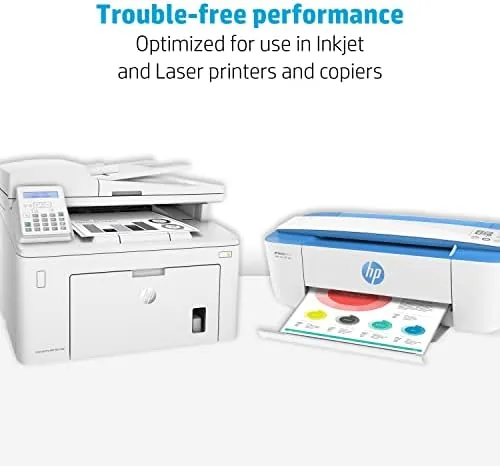
HP rates this as a Multipurpose Paper for everyday use across printers and copiers. It is built for laser printers, where it takes toner cleanly with no flaking or smearing, and for inkjet printers, where the surface holds both dye and pigment inks without bleeding. It is also designed to run through high volume copiers and to handle double sided printing, which is where lightweight paper often fails by curling or showing through.
The FSC certification is a meaningful feature for environmentally conscious buyers. It confirms the paper fiber comes from responsibly managed forests, which matters to businesses tracking their sustainability commitments. The ream is a standard 500 sheets, and HP also sells the same stock in multi ream cases for offices that go through paper quickly.
Real-World Performance
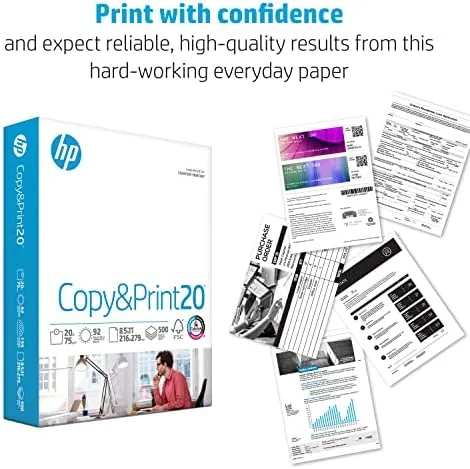
I began the test the way an office would, by loading a ream into a copier and running high volume jobs. The HP paper fed flawlessly across the whole month: no jams, no misfeeds, no problems with static cling in dry weather. The sheets stayed flat through long runs, and the output tray stack was tidy rather than scattered, which is the sign of paper with consistent moisture content and clean cutting.
Print quality held up across every machine. On the laser, black text came out dense and sharp with clean edges, and color documents looked solid and professional, with the 92 brightness giving charts and logos a bright, presentable base. On the inkjet, the surface handled both dye and pigment inks without feathering or bleed on solid fills, and double sided prints showed minimal show through even on denser layouts. Grayscale images reproduced with a clean, neutral tone that made scanned documents and photo previews look respectable, which is more than many budget stocks manage. The paper simply disappears into the job, which is exactly what office paper should do.
Reliability is where this paper earns its keep. In a month of mixed printing, including double sided volumes, color decks, and routine single page output, I did not have a single wasted sheet. The paper does not curl at the edges, it does not pick up dust on the stack, and it works in every printer I own, from a cheap home inkjet to an office laser. There is no drama, and for office paper, no drama is the highest praise. That consistency also shows up in the smaller things: sheets separate cleanly from the stack instead of clinging together, edges stay smooth enough to run through a feeder repeatedly, and even a sheet left in the tray for a week came out as clean as the day it was loaded. It is the kind of behavior that is easy to take for granted until you switch to a cheaper brand and suddenly spend your mornings clearing jams.
Pros and Cons
Pros:
- Feeds reliably with no jams across all printer types
- 92 brightness gives crisp text and clean color
- FSC certified for responsible sourcing
- Double sided printing stays clean with minimal show through
- Consistent quality from sheet to sheet and ream to ream
- Affordable everyday pricing in a standard 500 sheet ream
Cons:
- 92 brightness trails 100 brightness premium color stocks
- 20 lb weight is not suited to presentation quality work
- Photo printing remains out of scope
- Single ream pricing is higher per sheet than bulk cases
How It Compares
Office buyers typically choose between an everyday 20 pound stock like this one, cheaper economy paper, and heavier premium color paper. The table below lays out the practical difference.
| Feature | HP 20 lb 92 Bright | Economy Paper | Premium 32 lb Color |
|---|---|---|---|
| Weight | 20 lb | 20 lb | 32 lb |
| Brightness | 92 | 84 to 87 | 100 |
| Feeding reliability | Excellent | Average | Excellent |
| Best for | Daily office printing | Internal drafts | Presentations |
| Show through | Minimal | Noticeable | None |
| Cost per sheet | Low | Lowest | High |
For daily office volume, the HP 20 pound stock is the right balance: it is only marginally more expensive than economy paper but dramatically more reliable and better looking, and it costs a fraction of the premium 32 pound color stock. Economy paper saves pennies and costs time in jams and poor output. Premium color paper is a waste of money for routine copies. The HP sits exactly where the bulk of office printing lives.
Who Should Buy It
Buy the HP 8.5 x 11 printer paper if you run an office, a home business, a classroom, or any environment where reliable everyday printing is the norm. It is the paper to stock when you want consistent results, clean double sided output, and an affordable price, and the FSC certification makes it a defensible choice for buyers who care about sustainability. For small offices that do not want to commit to a bulk case, the single ream format is a low risk way to test the stock.
Skip it if you need heavyweight paper for client presentations or vivid color reproduction, where the 32 pound premium stocks earn their higher price. You can check the current price of the HP printer paper on Amazon if you want to compare ream pricing.
How We Test
I ran multiple reams of HP 8.5 x 11 printer paper through a full month of office use. I tested it in a high volume copier, a color laser printer, and an inkjet machine, tracked jams and misfeeds, evaluated print quality on both faces, and compared the 92 brightness output against economy and premium stocks in side by side prints.
This is a hands-on field test rather than a laboratory brightness measurement, and results depend on individual printers and settings. For an independent perspective on what makes good office paper and how printers use it, PCMag has guidance on printers and paper handling that is useful reading. The HP printer paper listing on Amazon shows the current pricing and shipping details.
HP Printer Paper: Questions People Ask
Is HP printer paper good for double sided printing?
Yes, the 20 lb stock has low show through and feeds reliably in duplex mode on most office printers.
Does the 92 brightness matter for daily printing?
A 92 brightness rating gives crisp text contrast and clean grayscale, which is why it is the common standard for everyday office paper.
Is this the same paper sold in bulk cases?
This listing is a single ream of 500 sheets, while HP also sells the same 20 lb stock in multi ream cases for offices that go through paper quickly.
Is HP printer paper FSC certified?
Yes, the paper is FSC certified, meaning the fiber is sourced from responsibly managed forests.
As an Amazon Associate, I earn from qualifying purchases.