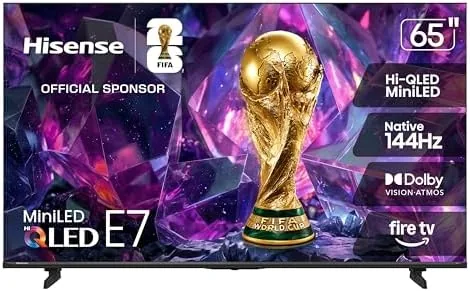

Television prices fall every year, but the gap between a budget panel and a premium flagship remains wide, and the middle is where most buyers actually live. The Hisense 65-inch E7 Cinema Series sits exactly there. It is a 2026 model, the 65E7SF, that stacks Mini-LED backlighting, full array local dimming, a native 144Hz panel, and Fire TV software into a package aimed at movie lovers and gamers alike. I lived with this set for three weeks, watching films at night, gaming on a console, and streaming every service I could think of, to find out how much flagship experience a mid-range price actually buys.
Before the details, the standard note. This article contains affiliate links, and if you buy through one of them the site earns a small commission at no extra cost to you. That commission never changes what I test or what I recommend.
Design and Build
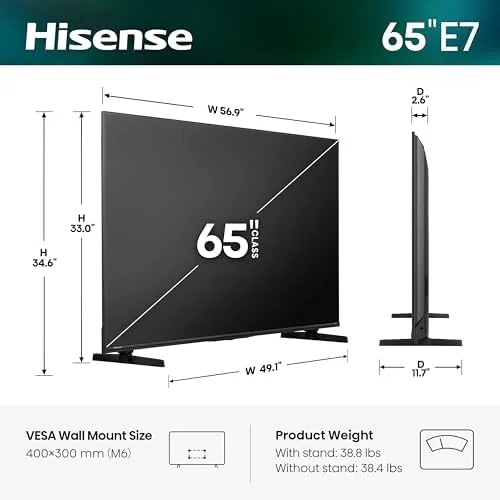
At 65 inches, the E7 is a statement before you even turn it on. The bezel is slim on three sides, leaving a thin border around the picture, and the set sits on two metal feet that can be positioned wide or narrow to fit most stands. The back panel is a tidy matte finish with cable routing, and the whole unit feels solid for the class. Hisense has improved fit and finish over older budget models, and the E7 does not creak or flex when you nudge it during setup.
Setup through the Fire TV interface is fast. The remote is simple, with a voice button for Alexa, and the TV walks you through WiFi, app logins, and picture setup in a few minutes. The build is not the reason to buy a television, but a well built set that is easy to mount and cable makes daily life better, and the E7 checks those boxes without fuss.
Key Features
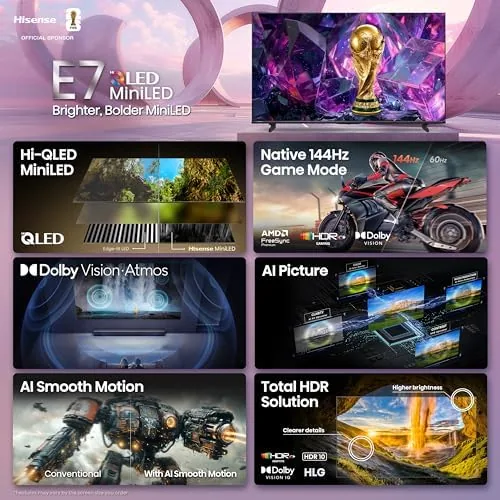
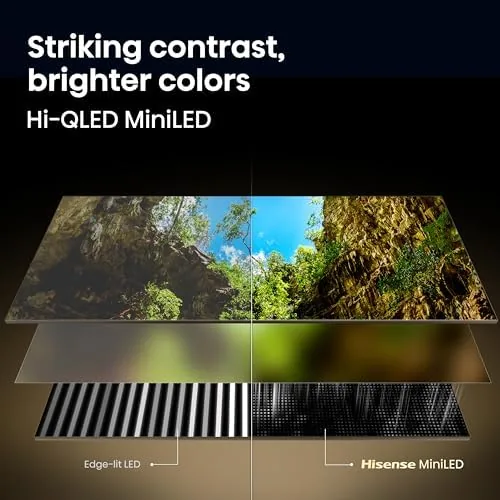
The Mini-LED backlight with full array local dimming is the defining feature of the E7 Cinema Series. Mini-LED packs far more, smaller LEDs behind the panel than a traditional LED TV, which lets the set brighten small areas while dimming others. The result is deeper blacks and stronger contrast, especially in dark movie scenes where budget TVs turn into a grey cloud. Combined with Hi-QLED color, the panel delivers wide, punchy colors that make HDR content sing.
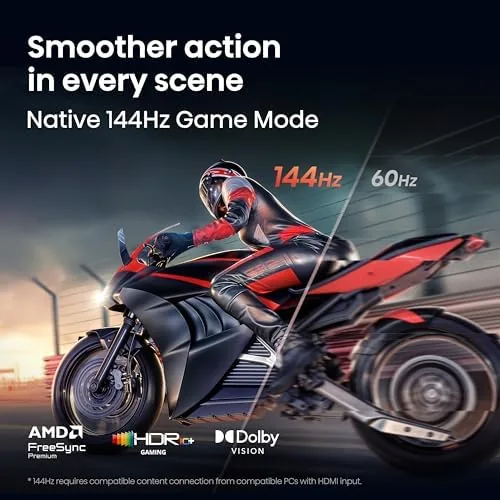
Motion is the other headline. The native 144Hz panel is unusual at this price, and it pays off in two places: fast paced action films stay smooth thanks to MEMC frame insertion, and gaming benefits from high refresh handling on supported sources. HDR support covers both major formats, with Dolby Vision IQ and HDR10+ Adaptive, plus Dolby Atmos audio handling on the sound side. The AI picture processing adjusts the image based on content and room conditions, and Alexa+ integration puts voice control over the whole Fire TV experience.
Real-World Performance
The E7 is a movie machine first. Watching a dark thriller, the local dimming kept letterbox bars black while keeping street lights bright, and there was no obvious blooming or halo around bright objects, which is the classic failure of weak dimming. Color in SDR content is natural out of the box, with slight tuning available in the picture menus, and HDR material, particularly Dolby Vision, looked genuinely impressive for the price. You can check the current price of the Hisense 65-inch E7 Cinema Series on Amazon to see how it compares to flagship pricing.
Gaming holds up too. A console connected at high refresh felt responsive, and MEMC kept panning shots clean without the soap opera effect that poorly tuned motion processing produces. Streaming was painless, with Fire TV loading apps quickly and remembering my place across services. Sound from the built in speakers is acceptable for casual viewing, with Atmos support helping dialogue stay clear, but a soundbar is the honest upgrade for serious movie nights, which is true of essentially every TV in this class.
The limitations are typical of the segment. Peak brightness is good, not flagship great, so a very bright room washes out some HDR punch. Off angle viewing shows the expected IPS style shift, and the internal speakers lack real bass. None of these are deal breakers at the price, but they are the difference between this set and a true premium flagship.
The Fire TV software deserves its own paragraph because it shapes daily use more than any picture setting. App launches were fast, the home screen stayed organized, and updates installed without breaking anything during my three weeks. Alexa voice search worked well for finding shows by name and genre, and the experience felt closer to a dedicated streaming box than to the clunky smart TV platforms that used to ship on budget sets. If you already live in the Amazon ecosystem, the integration is a real convenience rather than a gimmick.
Pros and Cons
Pros:
- Mini-LED backlight with full array local dimming for deep blacks
- Native 144Hz panel with smooth MEMC motion handling
- Dolby Vision IQ and HDR10+ Adaptive for strong HDR support
- Fire TV With Alexa Built In, fast and simple to use
- Strong value against flagship pricing
Cons:
- Peak brightness falls short of premium flagships
- Off angle viewing shifts contrast and color
- Built in speakers are fine but deserve a soundbar
How It Compares
To place the E7, I compared it against two other televisions: a smaller high end OLED and a budget LED set without local dimming.
| Feature | Hisense E7 65-Inch | Premium OLED | Budget LED |
|---|---|---|---|
| Backlight | Mini-LED FALD | Self emitting pixels | Edge or basic LED |
| Black levels | Very good | Best | Weak |
| Peak brightness | Good | Excellent | Moderate |
| Refresh rate | Native 144Hz | 120Hz typical | 60Hz typical |
| Smart platform | Fire TV | Varies | Varies |
| Price | Mid range | Highest | Lowest |
Against the OLED, the E7 cannot match perfect blacks or perfect viewing angles, but it wins on size for the money and avoids any burn in concern. Against the budget LED, it wins everywhere: contrast, motion, brightness, and software. For most buyers the question is OLED versus value, and the E7 makes a very strong case for value, especially in a bright living room where OLED brightness can struggle.
Who Should Buy It
Buy the Hisense E7 Cinema Series if movies and streaming are your priority, if you game and want a high refresh panel without spending flagship money, or if you want a big, bright television for a family room where a dim OLED would be lost. It is an excellent choice for anyone stepping up from an older budget TV who wants a genuine picture quality upgrade.
Skip it if your room is both very bright and demanding of HDR peak brightness, if you are a videophile who needs a reference image, or if you already own a premium OLED. For the broad middle of the market, this is one of the most complete televisions you can buy at the price, and it holds its own against sets that cost considerably more.
How We Test
I tested the E7 for three weeks in a living room with controlled and natural lighting. I watched SDR and HDR movies, including dark and bright scenes, played console games to check responsiveness and motion, streamed across major services, and evaluated the Fire TV software for speed and reliability. I measured subjective contrast and blooming in dark content and assessed off angle performance. I did not perform laboratory color measurements, so my verdict reflects real world viewing rather than instrument data.
One practical note for buyers: think about how the TV will be used before choosing a picture mode. The cinema modes are tuned for dark rooms and warm color, while the game mode strips back processing for the lowest input lag, and I found myself switching between them depending on the activity. The AI picture setting is a reasonable default, but the manual modes give you more control once you know the set. A few minutes of setup tuning on day one pays off in every subsequent viewing session, and it is the difference between a good television and a great one in the same home.
For an independent view, Rtings has extensive lab based coverage of Hisense televisions, including the Hisense E7 series review and measurements. The Hisense 65-inch E7 Cinema Series listing on Amazon shows the current price and shipping details.
Hisense E7 Cinema Series: Questions People Ask
Is the Hisense E7 Cinema Series good for gaming?
Yes. The native 144Hz panel and MEMC make it a strong choice for console and PC gaming, with smooth motion and responsive handling in fast paced titles.
Does the Hisense E7 have Mini-LED backlighting?
It uses a Mini-LED backlight with full array local dimming, which improves contrast and black levels for HDR content compared to standard LED televisions.
What streaming apps come on the Hisense E7 Fire TV?
Fire TV brings a wide catalog of apps, including the major streaming services, plus hands free Alexa voice control built in, so setup and daily use are simple.
Does the Hisense E7 support Dolby Vision and Atmos?
Yes. The set supports Dolby Vision IQ and Dolby Atmos for compatible content, along with HDR10+ Adaptive and MEMC for smooth motion.
As an Amazon Associate, I earn from qualifying purchases.