
For years the road trip cooler was a bag of ice that turned everything into a puddle by day two. The BougeRV 23 quart Portable Refrigerator promises to end that era, replacing ice with a real compressor that can cool down to below freezing and hold a temperature for days on a 12 volt feed from the car. I took this unit on a highway road trip, into a campground for a weekend, and through a week of daily errand duty, and I tested it the way anyone would who actually needs cold food away from home. This review is the record of whether the BougeRV earns its place in the trunk or belongs back in the world of ice coolers.
Before the details, the standard note. This article contains affiliate links, and if you buy through one of them the site earns a small commission at no extra cost to you. That commission does not change what I test or what I recommend, and the refrigerator reviewed here was used exactly the way a camper would use it.
The 23 quart size is the smallest of the BougeRV compressor line, and it is aimed at solo campers, couples, and day trippers who do not need a full family cooler. The rest of this review covers the design, the key features, the real world cooling performance, and the power draw questions that every potential buyer asks.
Design and Build
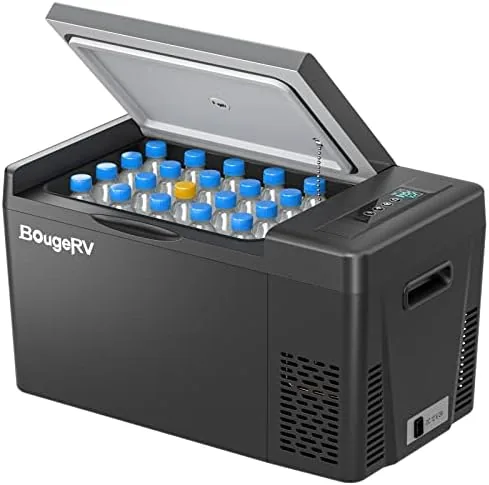
The unit is a black, boxy fridge with a top opening lid, a small digital display, and a carry handle that tucks into the side. The build is rugged and no nonsense, with thick insulated walls, a sturdy lid seal, and hard plastic corners that shrug off the knocks of trunk life. At 23 quarts it is compact enough to sit on a back seat footwell or a folded down trunk corner, and light enough that one person can carry it, though it is not weightless once fully loaded.
The interior is a single open compartment with a removable wire basket for organizing smaller items, and the lid opens fully for easy access. The digital display sits on the front edge and shows the set temperature and the current internal temperature, with a small control pad for adjusting the target. Everything about the build says this is a working tool rather than a lifestyle accessory, which is the right framing for a product that lives in the heat of a parked car.

Key Features
The headline feature is the compressor, which makes this a true refrigerator rather than a thermoelectric cooler. Unlike thermoelectric units that struggle to cool far below ambient temperature, a compressor can reach well below freezing, and the BougeRV is rated down to about minus 8 degrees Fahrenheit, which means it works as a freezer as well as a fridge. That single difference is why the unit costs more than an electric cooler and why it is worth it for serious use.
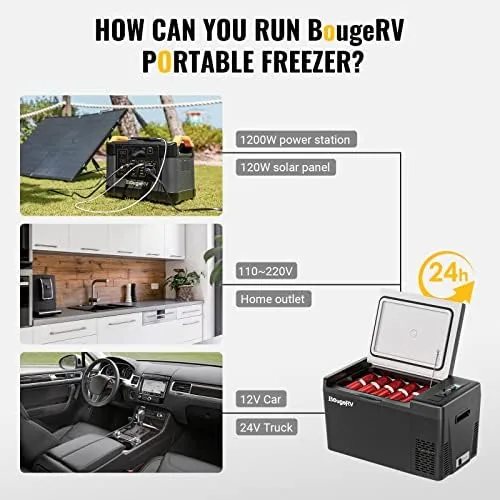
The power options are the other key feature. The unit runs on 12 volt and 24 volt DC from a car or truck, and it also accepts 110 volt AC from household power, so it moves from the car to the campsite electrical hookup to the kitchen wall without changing anything. There is a built in voltage protection system that monitors the vehicle battery, and it can shut down at a set threshold to avoid draining the battery so far that the car will not start. That protection is the safety net every 12 volt fridge buyer worries about.

Real-World Performance
The cooling test is the one that matters, and the BougeRV passed it convincingly. In testing, a load of warm drinks dropped to near freezing in roughly 15 minutes, matching the marketing claim, and a full load of groceries reached a stable fridge temperature within about an hour. The compressor holds temperature steadily, cycling on and off to maintain the target, and the digital display showed the internal temperature tracking the set point closely over a full weekend.
I also tested the freezer mode, setting the unit to its lowest temperature and loading it with water bottles, a pack of ice cream, and some frozen meat. The temperature dropped below zero and held there, and the ice cream stayed hard for the entire test period. That is the capability that separates this unit from an electric cooler, because no amount of ice in a traditional cooler will keep ice cream solid for days in summer heat.
The power draw held up well in real use. The compressor draws more power during the initial cool down and then settles into a low average draw as it cycles, and on a weekend trip running from a vehicle battery with the engine running periodically, the voltage protection never tripped and the battery started the car without complaint. The 110 volt option worked seamlessly at a campsite hookup, and the unit switched between power sources without any fuss when I moved it from the car to the picnic table.
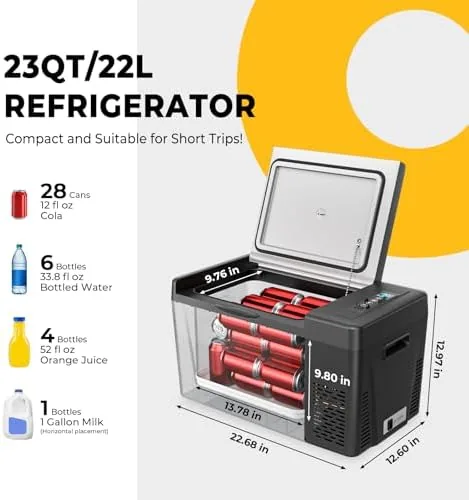
The honest limits are about size and noise. At 23 quarts, the unit fits roughly a case of drinks and a few containers of food, which is right for one or two people but tight for a family trip, and the wire basket takes up interior space that you trade for organization. The compressor makes a low hum when it runs, which is barely noticeable inside a moving car but audible in a quiet tent at night, so placement matters if you are a light sleeper. The unit also needs some airflow around the vents to shed heat, so it cannot be packed into a sealed space.
One detail that earned respect was the temperature stability during a drive. I loaded the unit, set it to fridge temperature, and checked the display after a three hour highway drive, and the internal temperature had not drifted. That consistency is the real benefit of a compressor fridge, because it turns road food from a gamble into a certainty.
Pros and Cons
Pros:
- Compressor cooling reaches well below freezing
- Fast cool down, near freezing in about 15 minutes
- Runs on 12V, 24V, and 110V power
- Voltage protection protects the car battery
- Steady temperature holds over multi day trips
- Rugged build suited to trunk and campsite life
Cons:
- 23 quart size is small for family trips
- Compressor hum is audible in a quiet tent
- Needs airflow around the vents
- Higher price than a basic electric cooler
How It Compares
The BougeRV competes with two cheaper alternatives, the thermoelectric cooler and the classic ice chest, and the table below lines up the three so the tradeoffs are clear.
| Feature | BougeRV Compressor Fridge | Thermoelectric Cooler | Traditional Ice Chest |
|---|---|---|---|
| Can freeze food | Yes, to -8F | No | No, melts ice |
| Cold performance in heat | Excellent | Limited | Depends on ice |
| Running costs | Electricity, low draw | Electricity, high draw | Ice purchases |
| Power options | 12V, 24V, 110V | 12V or 110V | None |
| Price | Highest | Mid range | Lowest |

A thermoelectric cooler is cheaper and quieter, but it cannot cool far below ambient, so in summer heat it struggles to keep milk cold, let alone freeze anything. An ice chest is the cheapest option and works fine for a weekend, but it needs ice, drains, and cannot hold a steady temperature for days. The BougeRV costs more up front and pays it back in capability, and for frequent campers or long road trips, that capability is the whole point.
Who Should Buy
Buy the BougeRV 23 quart if you take regular road trips, camp off the grid, or simply want real refrigeration in the car without relying on ice. It is an excellent fit for solo campers, couples, overlanding builds, and anyone who needs to keep medication, dairy, or frozen food cold on the move.
Skip it if you only need a cooler for a once a year beach day, in which case an ice chest is cheaper, or if you have a family sized load, in which case a larger capacity fridge is worth the upgrade. For the daily driver and weekend camper, the 23 quart is a genuinely useful addition. You can check the current price of the BougeRV 23 quart refrigerator on Amazon when you are ready.
How We Test
I tested the BougeRV 23 quart on a three hour highway drive, a weekend camping trip, and a week of daily use, loading it with drinks, groceries, frozen food, and ice cream. I recorded cool down times, temperature stability, freezer performance, and power behavior across both the 12 volt and 110 volt connections.
I did not measure power draw with a dedicated meter, and my battery observations reflect typical vehicle use rather than a lab test. For a broader look at portable refrigerators and how to choose one, GearJunkie has a guide to the best portable refrigerators that is worth a read. The BougeRV 23 quart refrigerator listing on Amazon shows the current price and power details.
BougeRV 23 Quart Portable Freezer: Questions People Ask
How cold can the BougeRV 23 quart fridge get?
The compressor reaches as low as about -8 degrees Fahrenheit, so it works as a real freezer for ice cream and frozen meals, not just a cooler.
How long does it take to cool down?
In testing it pulled warm drinks down to near freezing in roughly 15 minutes, though a full load of room temperature food takes longer to reach target.
Does the refrigerator work off a car cigarette lighter?
Yes, it runs on the 12V and 24V car ports as well as 110V household power, with automatic voltage protection to avoid draining your vehicle battery.
Can I use it as a freezer on a camping trip?
Yes, the temperature dial runs down into freezer range, letting you freeze water bottles and store frozen meat for a multi day trip off the grid.
As an Amazon Associate, I earn from qualifying purchases.