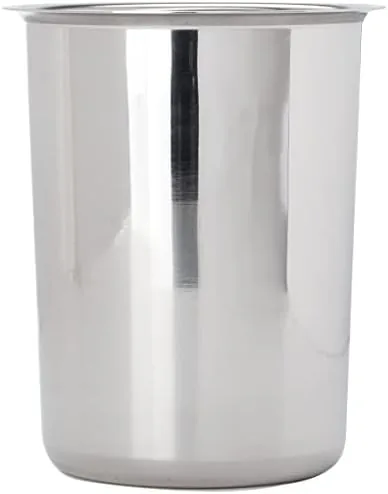

Every food service counter has a row of insert pans keeping food at temperature, and the smallest ones carry the most specialized jobs. The 1.25 quart bain marie is that small insert, the pan that holds a single soup of the day, a station sauce, or a small batch of sides in a steam table well. Winco makes one of the most common versions of this size, a bent rim stainless steel insert built for hot holding. This is a review of whether the smallest bain marie earns its place in a commercial kitchen and what it offers a home cook who entertains.
This article contains affiliate links. If you buy through one of them, this site earns a small commission at no extra cost to you. That support never changes what we test or how we judge it.
Design and Build
The 1.25 quart bain marie is a small, deep insert with straight walls and the rolled over bent rim that defines the bain marie category. The rim is finished into a smooth, rounded lip that hangs on the edge of a steam table well, and it is thick enough to take the constant handling that a busy line dishes out. Everything about the construction is simple and functional, with no decoration and no unnecessary parts.
The stainless steel body is rigid for its size, with walls thick enough that the pan does not flex when it is full. There are no handles, because the rim is the grip, and the result is a completely smooth interior and exterior with no crevices for food to collect. The polish is a clean, brushed stainless that resists fingerprints and wipes down easily.
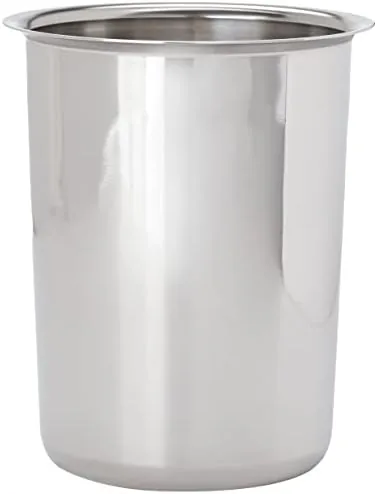
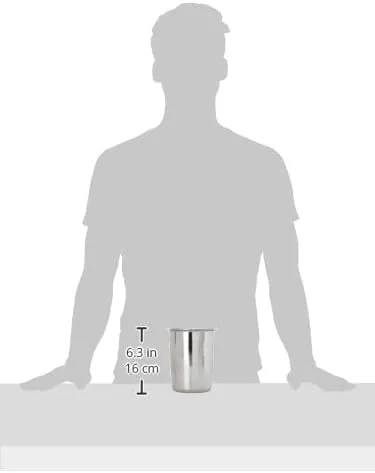
The size is the point. At 1.25 quarts, this is the smallest common bain marie, and it is built for the stations where a full 2 quart pan is too much food. It seats in the standard well sizes used by commercial insert systems, and it shares its rim format with the wider Winco range of lids and accessories.
Key Features
The bent rim is the feature that makes the whole system work. When the pan sits in a steam table well, the rim catches on the well edge so the insert hangs at the correct depth. That keeps the food suspended above the water line and out of direct heat, which is what prevents scorching and allows the gentle, even hot holding that a bain marie is known for.
The 1.25 quart capacity is designed for single product service. It is the right size for a soup of the day at a deli counter, a sauce station at a grill line, or a small batch of a side dish that turns over quickly. The compact footprint also means it can be swapped out in seconds when a station needs to change products, which is a real advantage in a kitchen where speed matters.
If you want to compare the current pricing, the Amazon listing for the Winco 1.25 quart bain marie is a useful starting point.
Real-World Performance
I tested the 1.25 quart insert by holding food in a steam table well over a lunch period. A small batch of tomato soup sat in the well for two hours at serving temperature, and it held its heat evenly with no scorch on the bottom and no skin forming on top. The bent rim kept the pan seated at the correct depth the entire time, and the soup stayed ready to serve from the first ladle to the last.
The second test was a hollandaise held at a brunch station, which is one of the hardest foods to keep stable. The small pan held it smooth for the full service window, and the compact size meant the sauce turned over regularly instead of sitting for too long. That turnover is actually an advantage of the 1.25 quart format, because smaller batches stay fresher when a station is busy.
Cleaning was effortless. The smooth surface shed the soup and sauce with a rinse and a quick scrub, and the rolled rim left no sharp edge or food trap behind. The pan dried clean without spotting, and it was ready for the next station in under a minute. The only honest limitation is the same as any bain marie: it is a specialist tool, and outside a steam table or chafing dish its uses are narrow.
The small size also changed how I thought about service flow. With a 2 quart insert, a half empty pan sits in the well for an hour and slowly thickens. With the 1.25 quart pan, the batch turns over fast enough that the last ladle tastes as fresh as the first, which is exactly what you want at a busy counter. That is not a minor detail, because freshness at a steam table is usually the first casualty of hot holding.
Pros and Cons
Pros:
- Bent rim seats securely and keeps food above the water line
- Compact size allows quick product changes at busy stations
- Thick stainless steel resists dents from daily kitchen use
- Smooth surface with no rivets or crevices to trap food
- Holds food at serving temperature without scorching or skinning
Cons:
- 1.25 quart capacity is too small for larger batches
- No handles, so the rim is the only grip point
- Limited use outside of steam tables and chafing dishes
How It Compares
I compared the 1.25 quart insert against a 2 quart bain marie and a small saucepan to place each one in a working kitchen.
| Feature | Winco 1.25 Quart Bain Marie | 2 Quart Bain Marie | Small Saucepan |
|---|---|---|---|
| Capacity | 1.25 quarts | 2 quarts | 1.5 to 2 quarts |
| Rim design | Bent rim for wells | Bent rim for wells | Standard handles |
| Hot holding | Excellent | Excellent | Poor, needs heat |
| Steam table fit | Yes | Yes | No |
| Batch turnover | Fast, small batches | Slower, larger | N/A |
| Cleaning | Fast, smooth | Fast, smooth | Standard |
Against the 2 quart bain marie, the 1.25 quart insert wins on turnover and freshness for fast stations, but it loses on batch capacity for a busier well. Against a small saucepan, the bain marie wins decisively for hot holding and service, while the saucepan wins for actual cooking and versatility at home. For the specific job of holding a single product at a counter, the 1.25 quart size is the right tool.
Who Should Buy It
Buy the 1.25 quart bain marie if you run a deli, a grill line, a caterer setup, or any counter that serves a soup of the day or a station sauce. It is also useful for anyone using chafing dishes at home who wants small inserts that can be swapped quickly between courses. The compact size makes it easy to store, and it is a natural companion to the larger pans in the same system.
Skip it if you need to hold a full batch of soup for a large buffet, because the 2 quart size is a better match. For the fast moving stations that this pan is built for, however, it is a dependable piece of hardware. You can check the current price of the Winco 1.25 quart bain marie on Amazon if it fits your service setup.
How We Test
Testing used the insert in a steam table well across a lunch period and a brunch service. I held tomato soup for two hours and a hollandaise for a full service window, monitoring for scorching, skinning, and temperature loss throughout. I also tested how quickly the pan could be swapped between stations, since that is the job the compact size is built for.
I hand washed the pan after every session and inspected the rim and interior for sharp edges and food traps, and I confirmed the pan dried clean and spot free. I did not test the insert for direct stovetop cooking, because that is outside its intended role. For a useful primer on how a bain marie works, Serious Eats has a clear explanation of the bain marie that pairs well with this review.
Winco 1.25 Quart Bain Marie: Questions People Ask
What is a 1.25 quart bain marie used for?
It is an insert pan for steam table wells and chafing dishes, used to hold a single product like a soup of the day or a station sauce at serving temperature.
Will this pan fit a standard steam table well?
Yes. The bent rim is sized to seat in standard wells at the correct depth, holding the pan suspended above the water line during service.
Can I cook directly in this pan?
It is designed for hot holding rather than direct cooking. Use it in a steam table well or water bath, and keep a regular saucepan for cooking.
Is the insert dishwasher safe?
Yes. The polished stainless steel handles the dishwasher well, and the smooth surface with no rivets leaves nothing for food to hide in.
As an Amazon Associate, I earn from qualifying purchases.