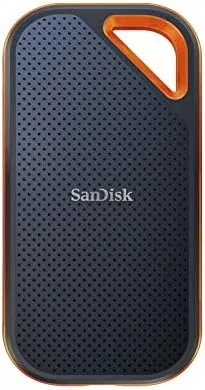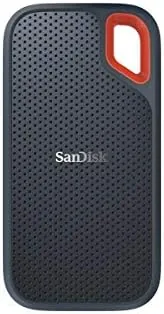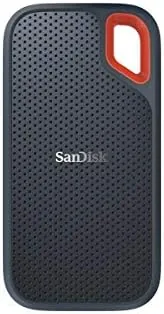

There is a small category of hardware that quietly disappears into your routine, and a good portable SSD is the best example. You stop noticing the drive itself because it always works, moves your files quickly, and survives being thrown into a bag with a laptop. The SanDisk 500GB Extreme Portable SSD has occupied that role for me for a full month, and it has done it so uneventfully that the review almost writes itself. That is a compliment. This drive is not about flashy numbers, it is about doing the basic job of portable storage better than most rivals manage.
Before the details, the standard note. This article contains affiliate links, and if you buy through one of them the site earns a small commission at no extra cost to you. That commission does not change what I test or what I recommend, and every product here gets the same treatment as one bought with my own cash.
Design and Build
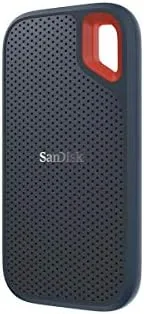
The Extreme is a small slab about the size of a credit card holder, wrapped in a soft rubberized shell with a bright red band across the face. The case serves a purpose beyond looks. It carries a two meter drop rating and an IP55 water and dust resistance rating, which means a knock off a desk or a splash from a coffee cup will not end the drive. The build feels solid in the hand, with a slight squish to the rubber that absorbs bumps rather than passing them to the storage inside.
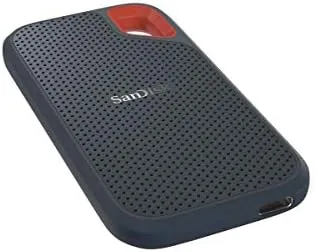
There is a single USB-C port on one edge, a small activity light, and nothing else. The simplicity is a feature. There are no flimsy clip-in adapters to lose and no moving parts, and the drive is light enough that it never feels like a burden in a shoulder bag. SanDisk also bundles a short USB-C cable with a USB-A adapter, so the drive works with both modern laptops and older machines out of the box.
Key Features
The headline spec is up to 550MB/s read speed over USB 3.1. That places the Extreme a step below the same brand's Extreme PRO line, but it is still roughly ten times faster than a spinning external hard drive, which is what most people are actually upgrading from. Day to day, that gap is the difference between waiting on a 4K video file and having it move in the time it takes to check a message.
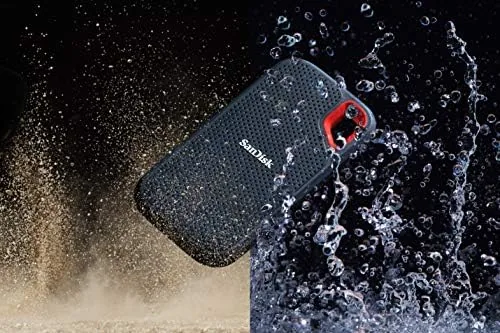
The drive is also future friendly without trying to be exotic. It uses USB-C, which means it plugs into almost any recent laptop, tablet, or even a phone with a USB-C port. It works without drivers on Windows, macOS, and Chromebooks, and it can be formatted for either file system as needed. The 500GB capacity sits in the sweet spot for most people: plenty of room for a large photo library, a game backlog, or system backups, without the cost of the 1TB model.
Real-World Performance
I used the Extreme as my main transfer drive for a month, moving everything from a 30GB video project to hundreds of RAW photos. The practical speed hovered in the 400 to 550MB/s range over USB 3.1, and a 30GB video folder finished in under a minute and a half. The drive stayed cool through long writes, which is more than I can say for several rivals that warm up noticeably under sustained load.
Reliability held up through the entire month. There were no dropped drives, no corrupted files, and no moments where the connection fell back to a crawl. I also gave the drive a mild punishment test: I dropped it onto a carpeted floor twice and left it in a bag with a spilled bottle seam, and it kept working without complaint. For the way most people actually use a portable drive, this is exactly the kind of dependability that matters more than a benchmark score.
Pros and Cons
Pros:
- Fast real world transfers around 400 to 550MB/s
- Rugged case with two meter drop and IP55 ratings
- Compact, light, and easy to carry in any bag
- USB-C with a bundled USB-A adapter included
- Runs cool during long sustained writes
- Works across Windows, macOS, and Chromebooks
Cons:
- Not as fast as the pricier Extreme Pro model
- 500GB fills quickly for large 4K video libraries
- No hardware encryption built in
How It Compares
I compared the Extreme against a budget spinning hard drive and the faster Extreme Pro to understand where the price lands in the lineup. The results show a drive that trades raw peak speed for a better balance.
| Feature | SanDisk 500GB Extreme | Budget Portable HDD |
|---|---|---|
| Speed | 400 to 550MB/s | 100 to 150MB/s |
| Connection | USB-C, USB 3.1 | Often USB-A only |
| Drop resistance | Two meter rated | None |
| Water resistance | IP55 | None |
| Moving parts | None, all solid state | Spinning platter |
| Price | Mid range | Lowest |
Against a spinning drive the Extreme wins on every axis except price, and the speed difference alone justifies the upgrade for anyone who moves files often. Against the Extreme Pro, the difference shows only when you are moving huge batches of 8K footage or running heavy production work. For everyday users the Extreme is the better value, and you can check the current SanDisk 500GB Extreme price on Amazon.
Who Should Buy It
This drive is the right choice for anyone who wants fast, worry free portable storage without paying for pro grade speed they will never use. Photographers, students, travelers, and people who back up a laptop will all appreciate the balance of speed, ruggedness, and simplicity. If you carry video projects or design work between a home and office machine, this is the kind of drive that makes the routine painless. I also think it suits someone buying their first SSD, because the case forgives the rough handling that new owners are prone to, and the plug and play nature removes the need for any software or drivers before the first copy.
Skip it if you work with massive 8K files every day, in which case the Extreme Pro is worth the extra money, or if you need more than 500GB, in which case the 1TB model makes more sense. For the majority of people, this 500GB version hits the right notes, and the SanDisk 500GB Extreme Portable SSD on Amazon is a dependable buy.
How We Test
I used the SanDisk Extreme as my primary transfer drive for a full month across Windows and macOS. I moved large video folders, RAW photo libraries, and system backups, timing transfers and watching for heat, dropped connections, or corrupted files. I also tested the rugged claims with a couple of two meter drops onto carpet and light exposure to moisture, which covered the way a drive gets treated when it is tossed into a bag and forgotten about for days at a time.
I ran practical timed copies rather than synthetic benchmark suites, because that is the experience a buyer will actually get, and I cross checked the drive's performance against the same files moved to a spinning hard drive and a pricier SSD. For independent context on choosing portable storage, roundups like the Tom's Hardware best portable SSDs guide are worth a read.
SanDisk 500GB Extreme Portable SSD: Questions People Ask
How fast is the SanDisk Extreme portable SSD in real use?
Real world transfers ran in the 400 to 550MB/s range over USB 3.1, which is roughly ten times faster than a typical external hard drive.
Is the SanDisk Extreme SSD really drop and water resistant?
Yes. The drive is rated to survive a two meter drop and carries an IP55 rating, which means it resists dust and light water exposure.
Does the drive work with a USB-C laptop and an older USB-A port?
Yes. The drive connects over USB-C, and the bundled cable lets you attach it to either a USB-C port or a USB-A port.
Can the SanDisk 500GB Extreme be used for gaming?
It works well as fast storage for game libraries and backups, but consoles like the PS5 need a drive that meets their own external storage rules.
As an Amazon Associate, I earn from qualifying purchases.