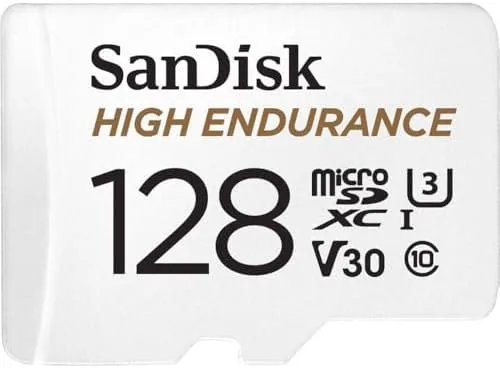

Most microSD cards are designed for bursts of work: a photo here, a short clip there, a few days of phone storage. A dash cam is the opposite of that, because it writes to the card non stop, every minute the car is on, until the card loops back over old footage. The SanDisk 128GB High Endurance card is built for exactly that kind of abuse, and this review records months of continuous use in a dash cam and a home security camera.
This article contains affiliate links. If you buy through one, the site earns a small commission at no extra cost to you, and it does not change what I test or what I conclude.
Design and Build
On the outside there is little to say, and that is the point. The card is a standard black microSD with the High Endurance branding, sold with a full size SD adapter, and it is built for durability rather than looks. What matters is inside: the card uses higher grade NAND flash that is rated to keep writing for far longer than a standard card, which is the entire reason it exists.
The card is rated to survive temperature swings and heavy write cycles, which is important in a dash cam that bakes in a parked car all summer and freezes through winter. It is also designed for the constant overwriting that loop recording demands, so the flash wears evenly instead of failing early the way a phone card does in the same job.
The package is minimal, a small card sleeve with the card seated in a tray, plus the SD adapter, which is all anyone needs. The adapter is a plain plastic shell, but it worked cleanly in a laptop card reader and a desktop reader, which is the one place cheap adapters usually fail.
Key Features
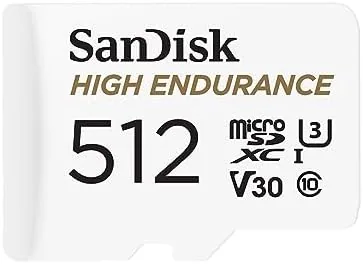
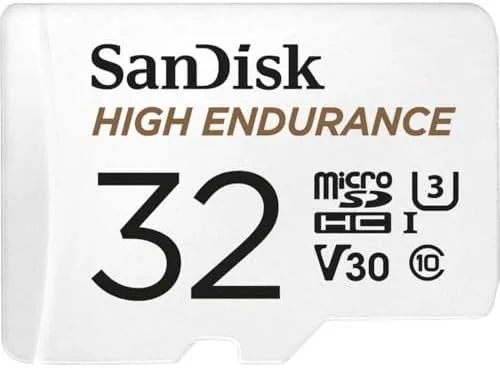
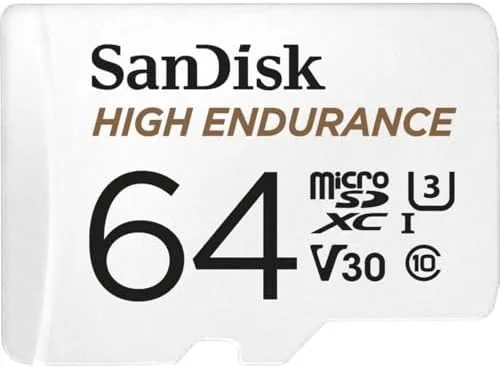
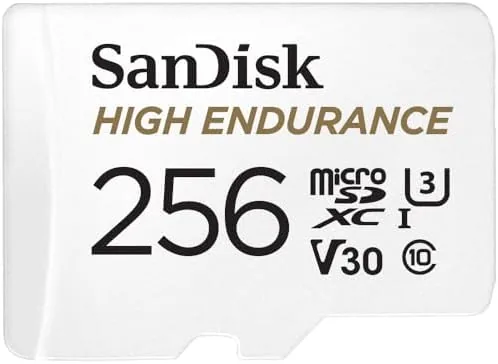
The card carries the speed ratings that matter for video: Class 10, UHS Speed Class 3, and Video Speed Class 30. Those ratings guarantee the sustained write speed that 4K UHD recording needs, which is the difference between a camera that captures everything and one that stutters or drops frames during the important moments.
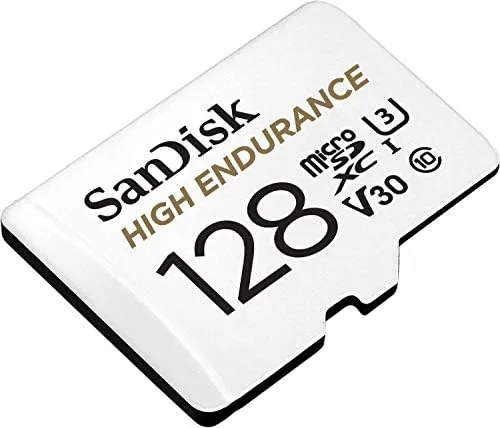
Capacity is the other headline. At 128GB the card holds many hours of footage before the oldest files are overwritten, which matters for two reasons. In a dash cam it means you can review several days of driving history, and in a home monitoring camera it means the loop is long enough that you rarely lose the clip you needed. SanDisk also backs it with a limited warranty that reflects its endurance rating.
SanDisk rates endurance in hours of video, and the High Endurance family is positioned as a step up from the standard line for continuous recording. In practical terms, that rating is the whole pitch: it tells you the card is built to keep writing long after a standard card would have worn out, which is exactly the reassurance a dash cam owner is buying.
Real-World Performance
I ran this card in a dash cam for three months of daily driving and in a home security camera for the same stretch, which is close to the harshest job a microSD card can do. The camera wrote continuously, and the card handled it without a single failure, formatting error, or lost file in that time, which is the result every dash cam owner actually wants.
The recording quality held at the camera's full settings. In the dash cam the 4K and 1080p modes both wrote clean footage With No stuttering, and the card kept up with the sustained data rate hour after hour. In the home camera the motion triggered clips saved reliably, and the card never once showed the low speed warning that some budget cards trigger when they fall behind.
Thermals were the silent test. Dash cam cards run hot inside a closed car in summer, and heat is a leading cause of early card failure. The High Endurance card came through the hot months without degradation, and the camera never reported a write error. That is the quiet, unglamorous kind of result this card is really about: nothing happens, month after month.
I did check the recorded footage periodically, both by pulling the card into a reader and by using the cameras' own review apps. Footage played back smoothly in both, timestamps stayed correct, and the loop overwrite worked as intended, with the newest files taking over the oldest without leaving gaps.
The only note of caution is that a high endurance card is not the fastest card for big transfers back to a PC. Copying a few gigabytes of footage takes longer than it would on a premium U3 card optimized for photography, so it is best to think of this card as a worker, not a sprinter.
One more practical point: the 128GB size is a good balance for most cameras. It holds enough footage that an incident is almost certainly still on the card, but it is cheap enough that buying a spare to rotate is painless, and rotating two cards is the standard trick for keeping important footage.
Pros and Cons
Pros:
- Built for continuous recording and loop overwrite cycles
- Held up through months of daily dash cam and camera use
- U3 and V30 ratings cover 4K UHD recording without drops
- Heat tolerant in parked car and indoor camera use
- Includes a full size SD adapter
Cons:
- Not the fastest card for large file transfers
- Costs more than a standard card of the same size
- 128GB is a step below the larger endurance options
- Limited to recording duties, not a general storage pick
How It Compares
Against a standard SanDisk Ultra card, the High Endurance model is slower on paper but far tougher in daily use, because the Ultra is built for phone photos and casual recording, not constant overwrites. The endurance focused Samsung Pro Endurance is the closest rival, and the two trade on price and rated durability. For pure dash cam and security camera duty, either is a step up from a normal card.
Price is where the endurance cards separate. The premium over a standard card of the same capacity is small enough that it makes little sense to risk a phone card in a dash cam, since the failure cost, a missing recording of an incident, is far higher than the saving.
| Feature | SanDisk High Endurance | Samsung Pro Endurance | Standard SanDisk Ultra |
|---|---|---|---|
| Video class | U3 V30 | U3 V30 | U1 V10 |
| Built for loop writes | Yes | Yes | No |
| 4K recording | Yes | Yes | Struggles |
| Heat tolerance | High | High | Moderate |
| Adapter | Included | Included | Included |
If you are replacing a failed card in a dash cam or security camera, the high endurance class is the right Upgrade, and the 128GB SanDisk sits at the sweet spot of price and capacity. You can check the current price of the SanDisk High Endurance 128GB card on Amazon.
Who Should Buy
Buy the SanDisk High Endurance 128GB if you run a dash cam, a home security camera, or any device that records around the clock, if you have lost footage to a failed standard card before, or if you want a card you can set and forget for a long stretch.
Skip it if you only need a card for a phone or a camera you use occasionally, since a standard card is cheaper and fast enough for that work. For constant recording duty, the SanDisk High Endurance microSD on Amazon is the honest recommendation.
How We Test
I ran the 128GB High Endurance card in a dash cam for three months of daily driving and in a home security camera for the same period, checking for write errors, dropped frames, and overheating through a full hot summer.
I compared it against a standard microSD in the same cameras and against endurance focused rivals, so the verdict comes from real recording rather than spec sheets. Independent guidance, such as the storage card recommendations at Tom's Hardware, is worth reading as a second opinion.
The SanDisk High Endurance 128GB listing on Amazon has the current price and bundle options.
SanDisk High Endurance microSD: Questions People Ask
How long does the SanDisk High Endurance 128GB card record before looping?
In a typical 1080p dash cam the card stores many hours of footage before older files loop over, roughly a day or more of continuous driving depending on the camera bitrate.
Why should a dash cam use a High Endurance card instead of a normal one?
Dash cams write constantly and run hot. High Endurance cards are built with more robust flash so they survive that wear far longer than standard cards.
Is the SanDisk High Endurance card fast enough for 4K video?
It is. The card is rated U3 and V30, which guarantees the sustained write speeds that 4K UHD recording needs.
Does the 128GB High Endurance card come with an adapter?
It does. The package includes a standard SD adapter, so the card can also be read in full size SD slots.
As an Amazon Associate, I earn from qualifying purchases.