
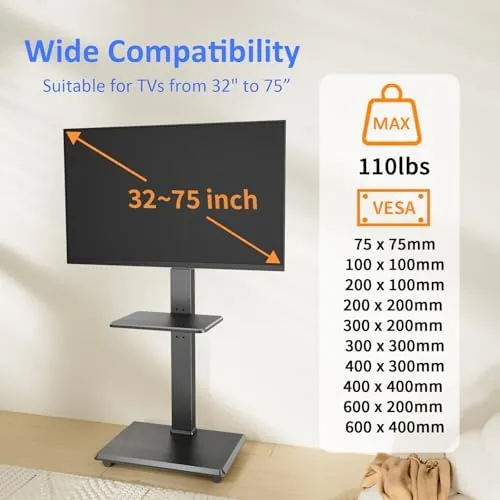
Some rooms are lucky enough to have one obvious wall for a television. Mine is not one of them. Between a home office that wants the screen for video calls, a bedroom that wants it for movies, and a patio that wants it for summer evenings, a fixed TV would mean buying three televisions or constantly moving one from a shelf. The rolling TV stand solves that problem by turning a single screen into a room to room device. This cart carries any TV from 32 to 75 inches, wheels it anywhere with lockable casters, and adjusts to 18 different heights with a 30 degree swivel. I spent a month rolling a 55 inch set across an entire home, and this review records what held up and what surprised me.
Before the details, the standard note. This article contains affiliate links, and if you buy through one of them the site earns a small commission at no extra cost to you. That commission never changes what I test or what I recommend, and the cart was assembled and used the way a homeowner would assemble it.
A mobile TV cart has to earn its place in a home. It competes with a Wall Mount that stays out of sight, so it must justify its visible presence with stability, adjustability, and the freedom to move the screen anywhere. The rest of this review covers the build, the movement, the height and swivel mechanics, and whether the convenience outweighs having a cart in the room at all.
Design and Build
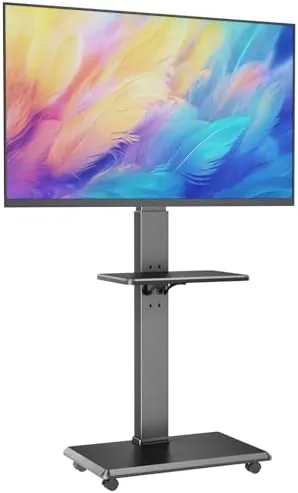
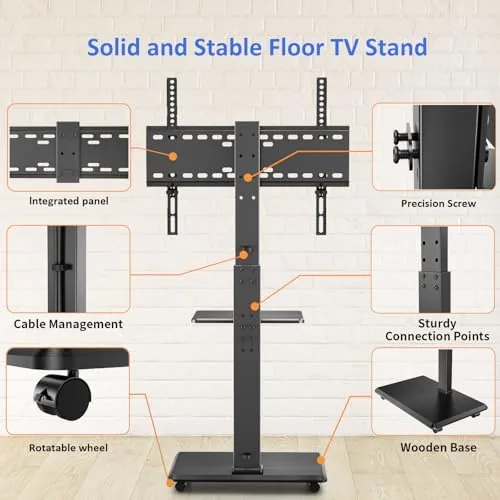
The cart is a study in practical metalwork. A wide steel base sits on four casters, a telescoping center column rises from that base, and the mounting head at the top accepts a standard VESA plate. The whole frame is powder coated in a neutral black, and the proportions are honest: a generous footprint that is exactly wide enough to keep a 75 inch television from tipping when you push it across a threshold.
Build quality is a real strong point. The steel feels dense, the welds are clean, and the column locks with a solid click at each height position. A removable shelf mounts on the column at a second level, giving you a place for a cable box, streaming stick, or the remote collection that always seems to multiply. Nothing about the frame flexed under the weight of a 55 inch TV, and the whole assembly moved as one piece rather than wobbling at the joints.
Key Features
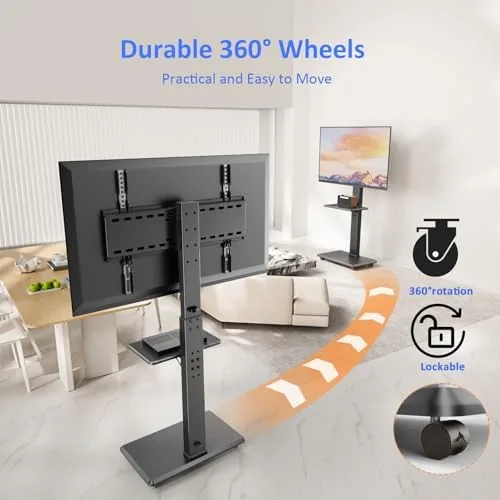
The casters are the first feature that matters. Each of the four wheels locks independently, which sounds like a small detail until you realize how much it improves the experience. Locked, the cart is as stable as a fixed stand, so the TV does not drift when you vacuum or when a dog brushes past. Unlocked, the cart glides smoothly across hardwood and tile, and the wheels are soft enough that I never worried about scuffs.
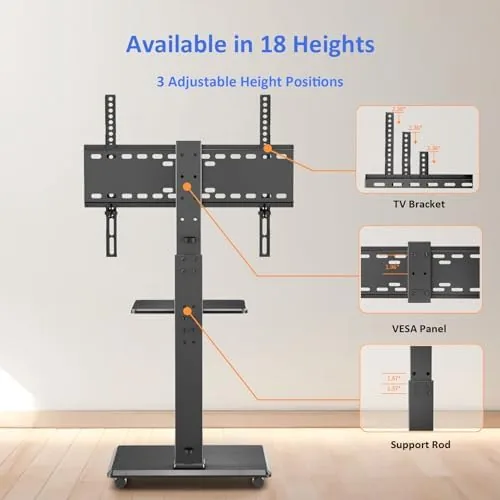
The 18 height options cover everything from a low bedroom viewing angle to a standing desk position. The mounting plate slides along the column and pins into place, so a quick change between rooms takes under a minute. The 30 degree swivel on the mounting head handles the rest, angling the screen toward a bed, a second couch, or a desk without moving the whole cart. The VESA range spans 75 by 75 mm up to 600 by 400 mm, which covers nearly every modern television, and the 110 pound capacity clears the weight of most large screens.
Real-World Performance
The core test of a rolling cart is the movement, and this one passed cleanly. I rolled the 55 inch television from the office to the living room and out to the patio over a month, and each trip took about two minutes, wheel locks down, roll, wheel locks up, adjust the height to the room. On hardwood and tile the motion was smooth and direct, and even a small rug transition only needed a gentle push rather than a fight.
Stability was the bigger surprise. A cart that carries a large TV needs to feel planted, and this one does. With the wheels locked, the set stayed perfectly still during a movie, and I could lean on the cart without any sway. The low center of gravity and the wide base do their job, and I never once felt the television was in danger, even when I moved it through a doorway that required a careful angle.
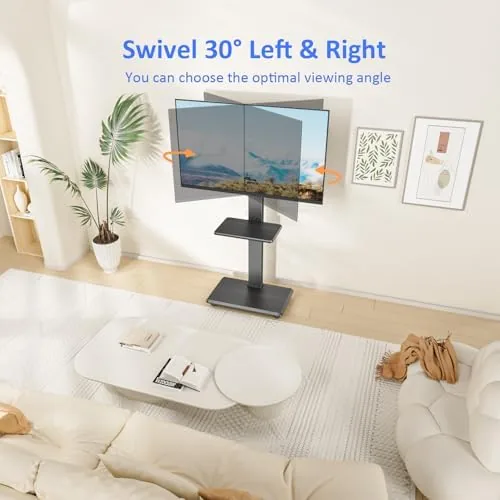
The height adjustment earned its keep more often than I expected. In the office I set the screen at standing desk height for video calls, and in the bedroom I dropped it low to match the line of sight from the pillows. Each change is a matter of pulling a pin and sliding the plate, which is fast enough that I stopped dreading the adjustment. The swivel also proved useful, angling the screen toward the kitchen from the living room during meal prep without moving the cart an inch.
The honest limits are about assembly and cable management. Building the cart took most of an hour with the included hardware, and the manual is not the clearest, so set aside time and a second pair of hands for the mounting plate. Cables also have to be managed by hand, because a rolling cart moves the power cord and HDMI with it, and I found a few zip ties essential to keep the look tidy. Neither issue affects how well it works, but both are real parts of the experience.
Pros and Cons
Pros:
- Wide, stable base carries large TVs without tipping
- Independent wheel locks keep the cart planted
- 18 height positions cover bed, desk, and standing use
- 30 degree swivel angles the screen without moving the cart
- 110 pound capacity fits most modern televisions
- Removable shelf holds a streaming box and remotes
Cons:
- Assembly takes about an hour and needs patience
- Cables require manual management on a moving cart
- Large footprint is always visible in the room
- Manual is not the clearest for first time builders
How It Compares
The main choice is between a rolling cart like this and a fixed wall mount. The table below lines up the two approaches honestly.
| Feature | Rolling TV Stand | Fixed Wall Mount |
|---|---|---|
| Mobility | Rolls room to room | Stays in one place |
| Height options | 18 adjustable positions | Set once at install |
| Swivel | 30 degree manual swivel | Fixed angle |
| Installation | Floor assembly, no drilling | Wall drilling and studs |
| Stability | Stable with locked wheels | Very stable, fixed |
| Rentals | No wall damage | Leaves holes to patch |
| Best for | Multi room screens, rentals | Permanent living room setup |
If you want one screen to serve several rooms, or if you rent and cannot drill into walls, the cart is the clear winner. If the television lives in one spot forever, a wall mount looks cleaner and costs less. For flexible households, the cart adds a freedom that a fixed mount simply cannot match.
Who Should Buy It
Buy this rolling TV stand if you watch television in more than one room, if you are a renter who wants to avoid patching walls, or if you run a home office where the screen needs to swing between desk and couch positions. It is also a strong pick for classrooms, gyms, clinics, and outdoor patios, anywhere a screen needs to move with the activity.
Skip it if your television has a single permanent home, because a wall mount is cheaper and cleaner, or if you hate visible stands of any kind. For everyone with a screen that wants to travel, this cart is a genuinely useful piece of furniture. You can check the current price of the rolling TV stand on Amazon when you are ready.
How We Test
I assembled the cart from the box and mounted a 55 inch television on it, then lived with it for a month across a home office, a bedroom, and an outdoor patio. I moved the screen at least twice a day, changed the height for different rooms, locked and unlocked the wheels constantly, and used the swivel to angle the screen in every seating arrangement.
I did not test the cart to its rated 110 pound limit, and my stability notes come from a 55 inch set rather than a full 75 inch screen. For a broader look at mounting options, TechRadar has a practical guide to mounting a television that is worth reading before you choose a direction. The rolling TV stand listing on Amazon shows the current price and full specifications.
Rolling TV Stand with Removable Shelf: Questions People Ask
What size TVs fit this rolling stand?
The cart accepts TVs from 32 to 75 inches and supports VESA mounting patterns from 75 by 75 mm up to 600 by 400 mm, so most modern flatscreens pair cleanly.
Does the cart hold a 75 inch TV securely?
Yes, with a rated capacity of 110 pounds the cart carries large sets, and the wide base and lockable wheels keep it steady while you push it between rooms.
How do the 18 height options work?
The mounting plate slides on the telescoping column and locks at one of 18 positions with the included pins, so you can match the screen to your seated eye level.
Can I turn the TV to face another seat?
The mounting head swivels 30 degrees to the left or right, which is enough to angle the screen toward a bed, a desk, or a second couch without moving the cart.
As an Amazon Associate, I earn from qualifying purchases.