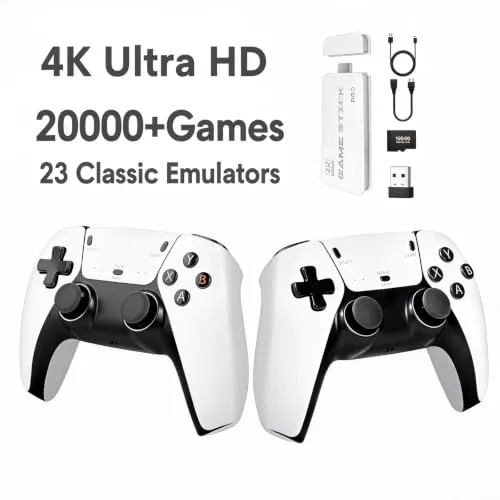

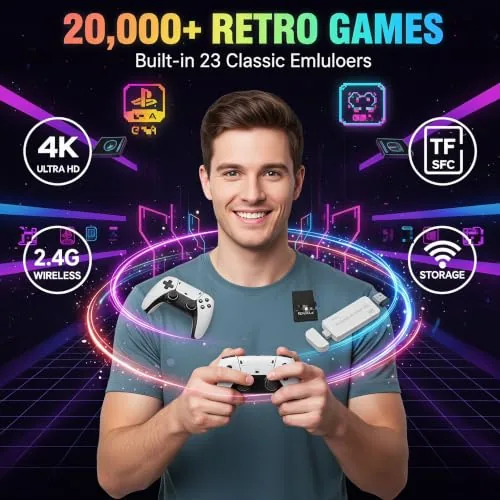
Family game night used to mean crowding around one console, squabbling over a single controller, and stopping when the batteries died. The Retro Game Console 128GB takes a different route to the same warm feeling. It is a small HDMI stick loaded with more than 20,000 built-in classic games, and it ships with two wireless controllers, so the whole family can play without passing the pad back and forth. I brought this console home to a house with a teenager, a grade schooler, and a pair of adults who remember arcades, and I watched how it actually behaved over three weeks of family sessions and travel.
Before the details, the standard note. This article contains affiliate links, and if you buy through one of them the site earns a small commission at no extra cost to you. That commission never changes what I test or what I recommend.
Design and Build
The console is a television stick about the size of a large thumb drive, with a black plastic body that hides its storage and radio inside. It plugs directly into an HDMI port and draws power from a short USB cable, which means the entire setup is: plug in, power on, play. There is no dock, no disc, no cartridge, and no network sign in. That simplicity is the design philosophy, and it is exactly right for a product aimed at kids and adults who should not need a computer science degree to reach the games.
The two included controllers are the real stars of the design. They are wireless gamepads with a classic layout, sized to fit both child and adult hands, and they pair with the console automatically within seconds of power on. The build quality is better than the price suggests, with responsive buttons and a comfortable grip for long sessions. Everything lives together in the box, so there is nothing left to buy before you play your first game.
Key Features
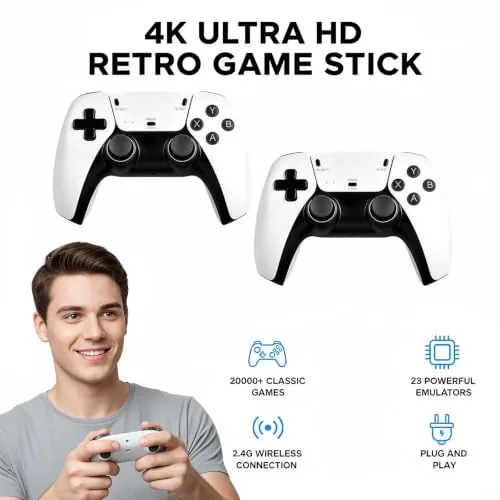
The library is the entire point. With 128GB of onboard storage, the console holds more than 20,000 classic games covering arcade, action, puzzle, racing, platform, and sports titles. For adults this is a trip back to the games of their childhood, and for kids it is an endless shelf of simple, colorful games that need no explanation. The games are organized by category and by system, and there is a search function that finds specific titles without scrolling through the whole list.
Output runs up to 4K over HDMI, so the console works with any modern television and the menu renders cleanly on a big screen. The games themselves are vintage, so they display with their original character, but the console handles scaling without the distortion you get from cheap converters. A save feature lets you stop any game and resume later, which is a genuine quality of life win for a household where game time comes in ten minute slices.
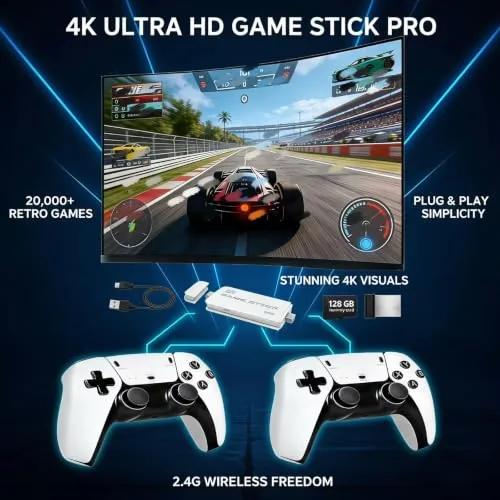
Portability is baked into the design. Because all the games live on the stick itself, you can unplug it from the living room TV, drop it in a bag with the controllers, and play on a hotel screen or on a television at a relative home with no setup at all. For a current look at the price and the exact bundle, the Amazon listing for the Retro Game Console 128GB is a useful reference.
Real-World Performance
Our first session was a family tournament, and the console handled it with the kind of ease the packaging promises. The stick connected to the living room TV in under a minute, both controllers paired before anyone finished choosing seats, and we were into a racing game moments later. Two player racing and fighting games ran smoothly, and the controllers responded without the lag that kills competitive family play. The grade schooler grasped the simple games instantly, and the teenager quietly admitted the retro library had more variety than the modern subscription service.
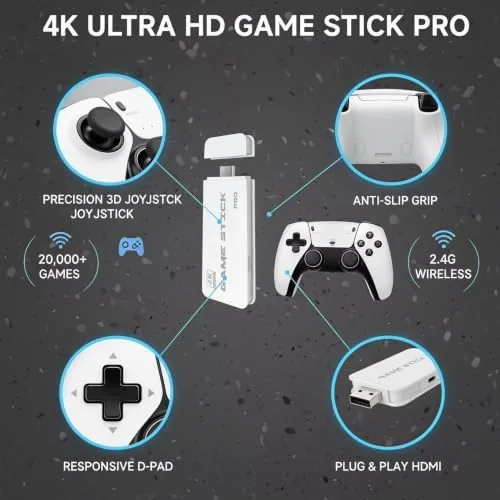
Across the week we sampled games from every major category, and the breadth is genuinely impressive. Platformers played with the precision the genre demands, puzzle games were perfect for short bursts, and the sports titles produced the loudest arguments of the whole test, which I take as a sign of engagement. The save feature became the family favorite: a child who had to leave mid level could come back the next day and pick up exactly where they stopped, which is something the originals never offered.
Then came the travel test. I packed the stick and controllers into a small bag and drove to my parents' house, where I plugged into their living room television. It worked exactly as it did at home, with the full library and both controllers ready in a minute. The kids played retro games while the adults talked, and my father, who has not touched a controller in years, spent a happy hour with the arcade classics from his youth. That single moment made the portability feature feel like the point rather than a perk.
The honest limitations are the ones that come with the territory. A handful of the 20,000 titles are familiar under different names, and a few games feel like filler next to the genuine classics. The controller batteries are replaceable rather than rechargeable, so a family that plays every night will cycle through pairs. And as with any emulation device, the visuals are what they are: charming, retro, and never mistaken for modern graphics. None of this dimmed the family enthusiasm.
Pros and Cons
Pros:
- More than 20,000 classic games on 128GB of storage
- Two wireless controllers included for instant two player play
- Minute long setup with no accounts or internet required
- 4K HDMI output works on any modern television
- Save and resume works across all games
- Truly portable and ready to play on any screen
Cons:
- Some library titles are re-branded or filler
- Controllers use replaceable batteries
- Retro visuals look dated on very large screens
- Documentation for individual games is minimal
How It Compares
Families choosing a retro gaming path have several doors to walk through, and the comparison is worth setting out plainly.
| Feature | Retro Console Stick | Handheld Emulator | Official Mini Console |
|---|---|---|---|
| Game Count | 20,000+ built in | User loaded | 20 to 60 built in |
| TV Play | Plug and play HDMI | Screen built in | HDMI included |
| Controllers | Two included | Built in controls | One to two included |
| Two Player | Yes, ready to go | Limited | Depends on model |
| Setup Effort | Under a minute | File management | Under five minutes |
| Best For | Family TV game nights | Solo travel play | Nostalgia collectors |
A handheld emulator is a better solo travel companion but asks you to manage game files and offers poor two player options on a couch. An official mini console is polished but stops at a few dozen famous games and usually costs more per title. The stick trades some curation for an enormous library and out of the box two player support, which is exactly the trade a family should make.
Who Should Buy It
This console is for households, not collectors. Parents who want a screen activity the whole family can share, grandparents introducing a new generation to the games they loved, and anyone who remembers arcade floors will find it hits a sweet spot. It is also the rare device that genuinely travels: a holiday visit or a hotel room becomes a game night with nothing but a stick and a screen.
It is not for purists who want original hardware and carts, and it is not for hobbyists who want to curate an exact personal library on a homemade emulator. If your goal is a full retro arcade on the family TV with zero effort, this stick delivers it. You can check the current price for the Retro Game Console 128GB before deciding.
How We Test
My testing ran three weeks across two homes and one hotel room. I ran family two player sessions in the living room, sampled games from every major category to assess the library, and used the save feature across genres to confirm it held progress. I packed the console into a bag and set it up on a second television to verify the portability claim, and I had both a child and a teenager play to judge how approachable the system was for different ages.
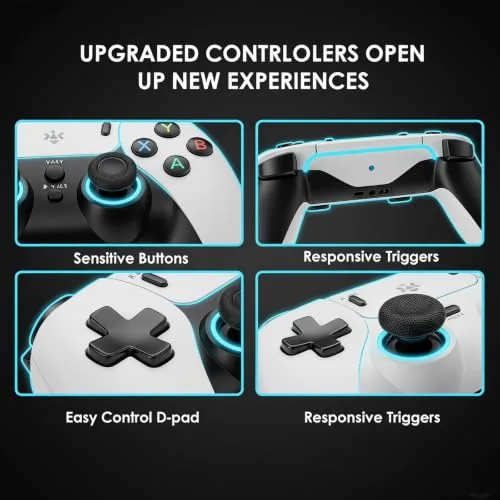
Controller response was judged by feel during racing and platforming, and picture quality was checked on a 55 inch living room panel and a hotel television. For a broader look at how retro gaming fits into modern entertainment, CNET keeps an active gaming section covering retro consoles and emulation.
Questions People Ask
How many games are built into this retro console?
The 128GB console ships with more than 20,000 classic games spanning arcade, action, puzzle, racing, platform, and sports titles. The built-in category browsing and search make the enormous list manageable, and the save feature lets you pause any title and return later.
Does the retro console work with a modern TV?
Yes. The stick plugs directly into an HDMI port and supports output up to 4K, so it works with current televisions and computer monitors. No adapter or dock is needed, and there is no internet requirement because all games are stored onboard.
Do both controllers work for two player games?
Yes. The two included wireless controllers pair with the console automatically within seconds of power on, and two player games run smoothly with both pads connected. My family ran two player racing and fighting sessions for the whole test without a drop.
Is the console portable?
Yes. The stick and controllers pack into a small bag, and because the entire library is stored onboard, you can play on any screen with an HDMI port. I set it up at a second house and in a hotel room during testing, and it worked exactly as it did at home.
As an Amazon Associate, I earn from qualifying purchases.