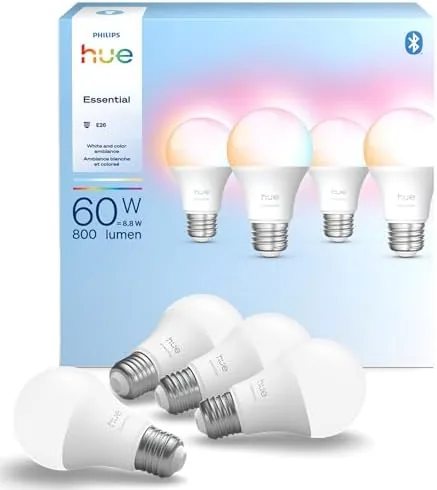

Smart lighting used to be a rich person's hobby. The entry price for a single Color Changing bulb was steep, and making a whole room smart meant spending more on bulbs than on the furniture. The Philips Hue Essential line is designed to change that math. This four pack of A19 bulbs delivers white and color ambiance, smooth dimming, an 800 lumen output, and a color range that runs from warm candlelight to cool daylight, all in a standard E26 base. I installed them in a living room, a hallway, and a reading nook, and I tested them across three weeks with two different home setups to see how the budget Hue line actually performs.
As always, the disclosure: this article contains affiliate links, and if you buy through one of them the site earns a small commission at no extra cost to you. That never changes what I test or what I recommend.
Design and Build
Physically, these are standard A19 bulbs with an E26 screw base, so they fit any lamp, ceiling fixture, or fan light in a typical home. The frosted plastic dome diffuses the light evenly, which means no harsh point source and no visible LED hotspots on the ceiling. They run at just 7.2 watts while producing 800 lumens, which is the equivalent of a 60 watt incandescent replacement, and that efficiency means a four pack will pay for part of itself in the first year of evening use.
The build quality is typical Hue, which is to say dependable. The bulbs have a satisfying heft, the base threads are clean, and I saw no flicker at any brightness level in any fixture. The heat management is solid too: after an evening of use, the base was warm but never hot to the touch, and the bulbs maintained their color accuracy without drifting as they warmed up.
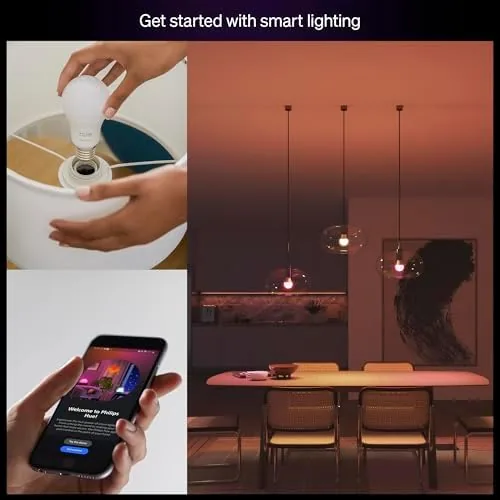
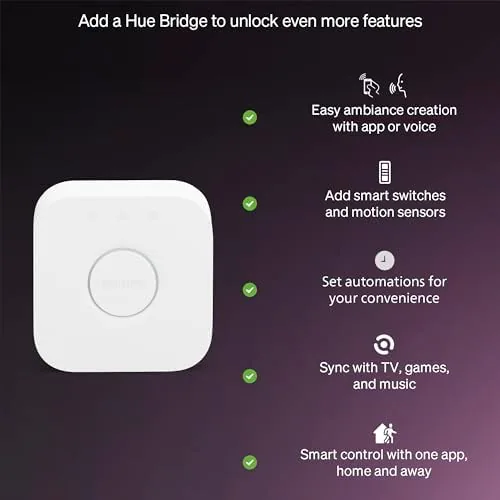
Setup starts with the Philips Hue app. The bulbs pair over Bluetooth, so you can get a single lamp working within minutes without any additional hardware. For the full experience, adding a Hue Bridge unlocks automations, away from home control, and voice assistant integration, and I tested both configurations because the choice genuinely changes what the bulbs can do.
Key Features
The headline feature is the full white and color spectrum. The bulbs step from a warm 2200K candlelight tone through neutral whites to a cool 6500K daylight, and then beyond that into a full range of saturated colors. That means one bulb can read as a cozy amber lamp in the evening, a neutral white for cooking, and a rich blue or purple for a game night, all from the same glass dome.
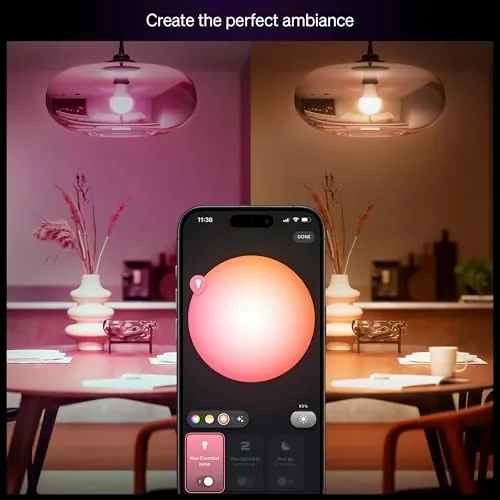
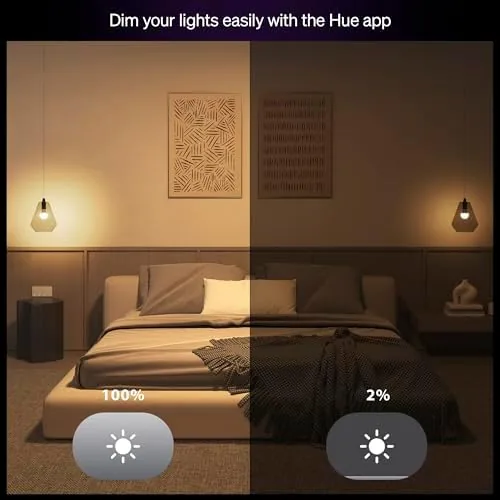
Dimming is handled smoothly through the app. There is no audible hum and no flicker as the light drops toward zero, which is a problem on cheap dimmable LED Bulbs and completely absent here. You can set scenes that shift the room's tone with one tap, and routines can ramp the light up gently in the morning rather than snapping on like an alarm.
The ecosystem is the deeper story. These bulbs sit inside the Philips Hue system, which is the most mature smart lighting platform available, with a wide catalog of scenes, integrations, and third party support. They work with Amazon Alexa, Google Assistant, and Apple Home when paired with the Hue Bridge, so voice control and automations work across the platforms most homes already use. For a look at the current price of the four pack, the Amazon listing for the Philips Hue Essential 4-pack is a useful reference.
Real-World Performance
My first test was a straight comparison in a living room lamp. I set one Essential bulb against an older, pricier Hue model on identical settings, and the color reproduction was indistinguishable in daily use. At 800 lumens the output is a full, comfortable room light, not a dim accent, and the warm whites had that rich, incandescent feel that cheap LEDs fail to copy.
The color modes performed well across the board. Saturated colors were vivid and consistent between the bulbs in the same room, with no noticeable difference from one unit to the next, which is a common failure on budget color bulbs. The cool whites were clean rather than sickly green, and the candlelight tones had real warmth at the lowest brightness levels.
I tested the Bluetooth only setup for a week in the hallway, using the app to switch colors and set a bedtime schedule. It worked reliably for a single room, and the response time from app to bulb was near instant. The limitation appeared when I wanted the hallway and the living room to coordinate, because Bluetooth control only reaches bulbs within range of the phone. Adding the Hue Bridge closed that gap, and suddenly both rooms responded to scenes, timers, and voice commands as one system.
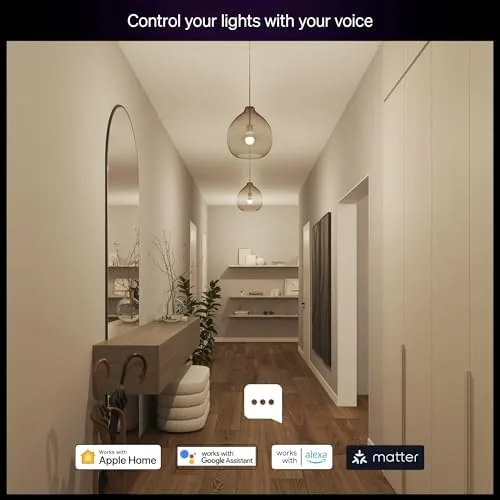
Voice control through the Bridge was the moment the package felt like real smart home gear. Saying "turn the living room to a warm white at fifty percent" executed cleanly through Alexa, and Google Assistant handled the same commands without fuss. Apple Home integrated through the Bridge as well, which matters for households that route everything through HomeKit.
Pros and Cons
Pros:
- Full white and color spectrum from 2200K to 6500K
- Smooth, flicker free dimming across the whole range
- 800 lumens at just 7.2 watts per bulb
- Works with Alexa, Google Assistant, and Apple Home
- Bluetooth setup means no hub required to start
- Color matched consistently across all four bulbs
Cons:
- Full automations require a separately sold Hue Bridge
- Essential line skips some advanced Hue extras
- Color output cannot beat a dedicated fixture
- Hue app setup feels cluttered to new users
How It Compares
Smart Bulbs come in three practical tiers: the Hue ecosystem, generic Wi-Fi bulbs, and Matter enabled bulbs from newer brands. I compared the Essential four pack against a generic Wi-Fi color bulb and a Matter capable competitor to judge where the Hue premium is worth paying.
| Feature | Hue Essential 4 Pack | Generic Wi-Fi Bulb | Matter Smart Bulb |
|---|---|---|---|
| Setup | Bluetooth, then Bridge | Direct Wi-Fi | Matter hub |
| Color quality | Excellent | Good | Very good |
| Dimming | Smooth and silent | Occasional flicker | Smooth |
| Voice support | Alexa, Google, Apple | Alexa, Google | Alexa, Google, Apple |
| Reliability | Proven platform | Varies by brand | Growing, newer |
| Price | Mid | Low | Low to mid |
Against a generic Wi-Fi bulb, the Hue Essential wins on color quality, dimming smoothness, and reliability, and it costs a little more for that margin. Against a Matter bulb, the Hue line has the advantage of a mature platform with years of tested behavior and a huge ecosystem, while the Matter option offers more open standards for homes that mix hardware brands. For a household that wants smart lighting that simply works every evening, the Hue Essential four pack is the safest money in the category.
Who Should Buy It
Buy this four pack if you are starting your first smart lighting setup and want a proven platform, if you want one room or one floor covered at a sensible price per bulb, or if you already own a Hue Bridge and want to expand without the premium model price. It is the right choice for households that value reliability and color quality over the absolute lowest price.
Skip it if you want to control bulbs with nothing but Wi-Fi and never add a hub, or if you only need plain white light and want to pay the absolute minimum. For everyone else, this is the balanced entry point into the best known smart lighting ecosystem. You can check the current price for the Hue Essential 4-pack on Amazon before you buy.
How We Test
I tested the four pack over three weeks in three locations: a living room, a hallway, and a bedroom reading nook. I ran the bulbs in a Bluetooth only configuration first, then added a Hue Bridge to test the full automation suite, and I compared color output, dimming smoothness, and reliability against an older Hue model and a generic Wi-Fi bulb.

I measured brightness against a light meter, checked color temperature accuracy across the range, and left the bulbs on overnight to confirm there was no drift or flicker. I also tested voice commands through Alexa, Google Assistant, and Apple Home to verify the multi platform claim. For balanced perspective on the smart bulb market, independent guidance such as CNET's guide to the best smart light bulbs compares the major ecosystems. The Hue Essential four pack listing on Amazon shows the current price and availability.
Philips Hue Essential A19 Bulb: Questions People Ask
Do the Hue Essential bulbs need a hub to work?
No. They pair directly over Bluetooth with the Philips Hue app, so a single lamp works out of the box. Adding a Hue Bridge unlocks full automations, away from home control, and voice assistant integration across the whole house.
What color range do these bulbs support?
They cover the full white and color ambiance spectrum, from warm candle light at 2200K through cool daylight at 6500K, plus millions of saturated colors in between. That range suits everything from cozy reading light to a full color mood.
How bright is an 800 lumen bulb?
It is roughly the output of a 60 watt incandescent replacement, which comfortably lights a bedroom, living room, or hallway when paired with a standard fixture. At 7.2 watts it uses a fraction of the energy of the bulb it replaces.
Will these bulbs work with Alexa, Google, and Apple Home?
Yes. With the Hue Bridge, they integrate with Amazon Alexa, Google Assistant, and Apple Home, so you can control them by voice and include them in automations across the platforms your home already uses.
As an Amazon Associate, I earn from qualifying purchases.