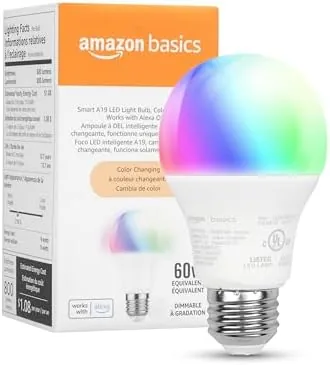

Smart lighting has a price problem. The big names in connected bulbs charge a premium for a single bulb, and when you want color in every lamp in the house the bill climbs fast. The Amazon Basics Smart A19 LED Bulb takes the opposite approach: it is a color changing 9 watt bulb, rated at 800 lumens, that talks to Alexa directly over 2.4 GHz WiFi with no hub required, and it costs a fraction of what the premium brands ask. The catch, and it is an important one, is in the name. This bulb works with Alexa only, so if your household runs on Google Assistant or Apple HomeKit, it is the wrong bulb for you. I installed a single pack in a living room lamp and ran it for three weeks to see how the budget price holds up against daily use, app reliability, and real brightness.
Before I get into the testing, the standard note. This article contains affiliate links. If you buy through one, the site earns a small commission at no extra cost to you, and that never changes what I test or what I recommend.
Design and Build
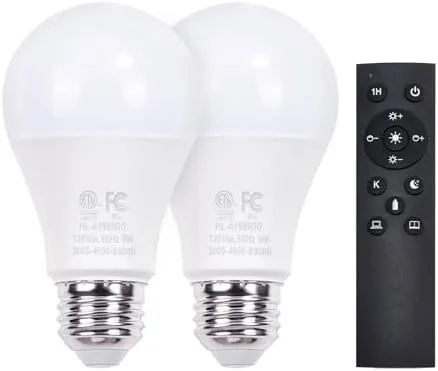
From a distance this looks like any other A19 LED bulb. The classic bulb shape fits standard sockets, the base is a normal E26 screw, and at 9 watts it draws about as much power as a low energy night light. Up close, the difference is the plastic housing and the lack of a visible controller puck, because the WiFi radio lives inside the bulb itself. The finish is matte white and the dome diffuses light evenly, which means you do not see harsh point sources when you look at the lamp directly.
The build feels appropriately budget oriented but not flimsy. The plastic shell is light, the base screws in smoothly, and there is no wobble once seated in a typical lamp socket. Heat management matters on smart bulbs because the radio electronics add warmth, and the Amazon Basics unit keeps its external temperature in a reasonable range even after several hours of use, which suggests the internal driver is doing its job. It is not a bulb you buy for its looks, but nothing about the hardware feels like it will fail early either.
Key Features
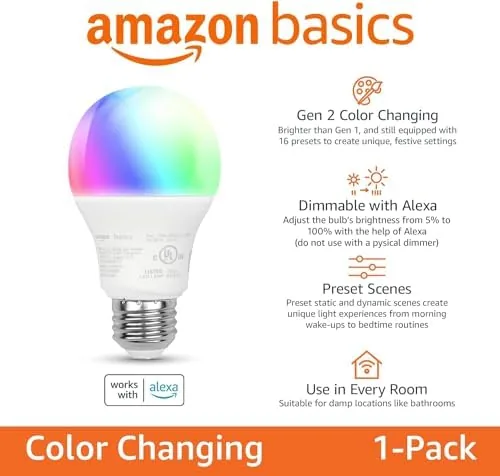
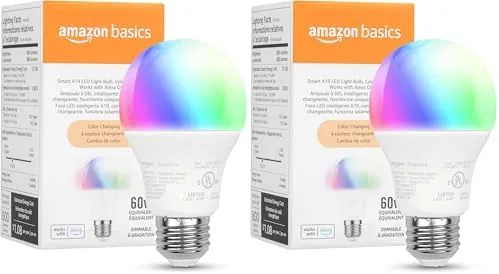
The headline feature is the color engine. The bulb produces a wide range of hues for mood lighting, from soft pastels to vivid primaries, plus tunable white light across the warm to cool spectrum. At 800 lumens, which is the rated output, it matches a traditional 60 watt incandescent in raw brightness, though colored light modes read dimmer because saturated color always reduces perceived lumen output.
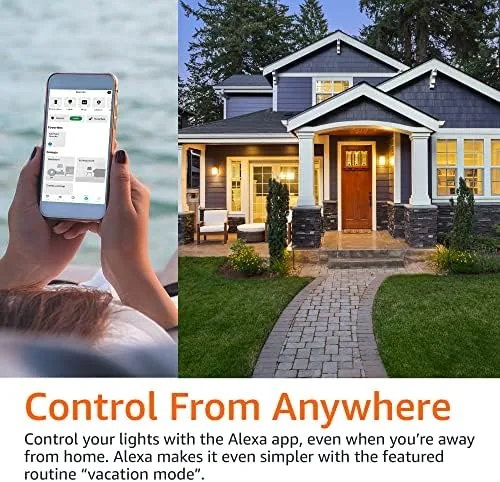
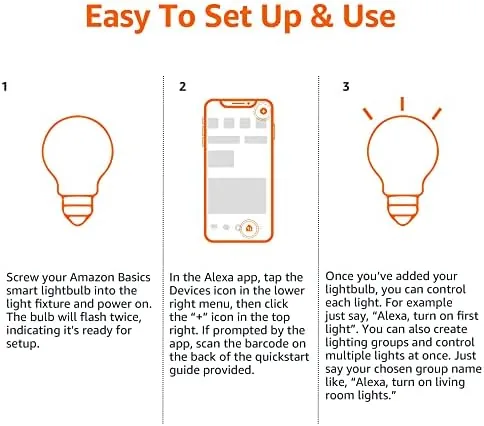
Connectivity is where this bulb makes its case. It connects directly to your WiFi network, so there is no bridge, hub, or extra gadget sitting on your shelf. The requirement is a 2.4 GHz network, because the radio cannot join 5 GHz bands, and the phone running the setup needs to be near the bulb while you pair it. Once paired, control comes through the Alexa app or by voice on an Echo device, and routines can tie the bulb to scenes, alarms, and schedules.
The energy angle is genuinely strong. Replacing a 60 watt incandescent with this 9 watt bulb cuts the power draw by roughly 85 percent, and with typical daily use the savings offset the purchase price well within the rated lifespan. For a current price check and the full list of colors and dimming levels, the Amazon Basics smart A19 bulb listing on Amazon has the details.
Real-World Performance
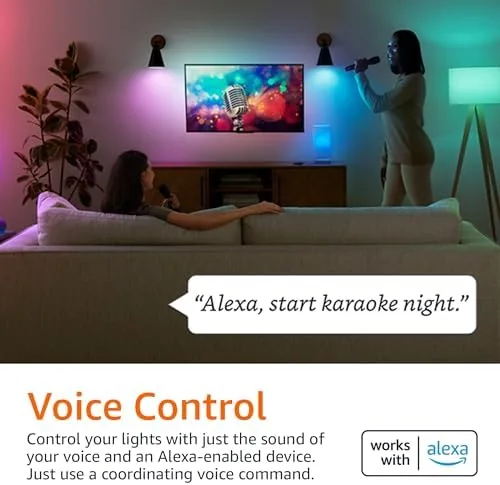
Setup took about six minutes on the first try. I removed the old bulb, screwed this one in, opened the Alexa app, and the app found the bulb almost immediately. The phone and the bulb were on the same 2.4 GHz network, and pairing completed without the dreaded fallback to setup mode. Once added, voice control worked as expected: Alexa turned the lamp on and off, dimmed it through steps, and cycled through colors with solid response times of under a second on an Echo Dot in the same room.
The white light quality is the pleasant surprise. At its warmest setting the bulb reads close to a classic soft white, and at the cool end it is clean and bright rather than harshly blue. Dimming is smooth down to a low level with no visible flicker on camera, and I noticed no hum from the bulb or the driver even at low brightness, which is a common complaint on cheap smart bulbs.
Color accuracy is acceptable rather than exceptional. Saturated primaries are vivid and fun for mood lighting, but pastel and mid tone hues skew slightly toward the same family, so two similar pinks can be hard to tell apart. That is a reasonable trade at this price, and for accent lighting, party scenes, and bedtime routines the color selection is more than enough.
Reliability across three weeks was good but not flawless. The bulb responded to every voice command during the day, and it stayed connected to the network overnight. I did see two incidents where the bulb was slow to respond in the app, once for about four seconds, and a single episode where a scheduled routine did not trigger at all until I cycled power. Neither is a deal breaker, but the app experience is a step behind the premium brands in polish.
Pros and Cons
Pros:
- Very low price for a color changing smart bulb
- No hub or bridge required, pairs straight to WiFi
- 800 lumen output matches a 60 watt incandescent
- Smooth dimming with no visible flicker or hum
- Fast Alexa voice response and reliable routines
- Big energy savings versus a traditional bulb
Cons:
- Works with Alexa only, no Google or HomeKit support
- Needs a 2.4 GHz network, which complicates some routers
- Pastel color tones lack precision between similar hues
- App interface is less polished than premium rivals
- Scheduled routines glitched once during testing
How It Compares
The budget smart bulb market splits between two approaches: cheap WiFi bulbs like this one, which keep costs down by dropping the hub, and hub based systems from the premium brands, which charge more but add reliability and richer features. I compared the Amazon Basics bulb against a representative premium color bulb and a mid priced no name WiFi bulb to see where the money actually goes.
| Feature | Amazon Basics Smart A19 | Premium Hub Bulb | Budget No-Name Bulb |
|---|---|---|---|
| Price per bulb | Very low | High | Low |
| Hub required | No | Yes | No |
| Color modes | Wide range | Wide and precise | Wide range |
| Voice assistants | Alexa only | Alexa, Google, HomeKit | Varies |
| Brightness | 800 lumens | 800 lumens | Varies |
| App reliability | Good | Excellent | Mixed |
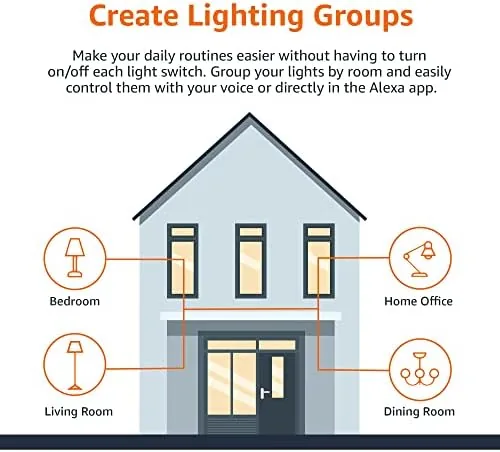
Against a premium hub bulb, the Amazon Basics unit wins overwhelmingly on price and on the absence of a hub, and it loses on color precision, ecosystem support, and the polish of the companion app. Against a no name WiFi bulb, it wins on build confidence and app reliability, since Amazon ships a tested product with a known app rather than a generic firmware clone. If you live in an Alexa home and want color on a budget, the Amazon Basics bulb is the best value of the three.
Who Should Buy It
Buy this bulb if you are all in on Alexa, if you want to outfit several lamps with color for less than the cost of a single premium bulb, or if you are starting a smart home and do not want to invest in a hub. It is also a great choice for rental bedrooms and offices where a permanent smart lighting install makes no sense, since the bulb screws out and travels with you.
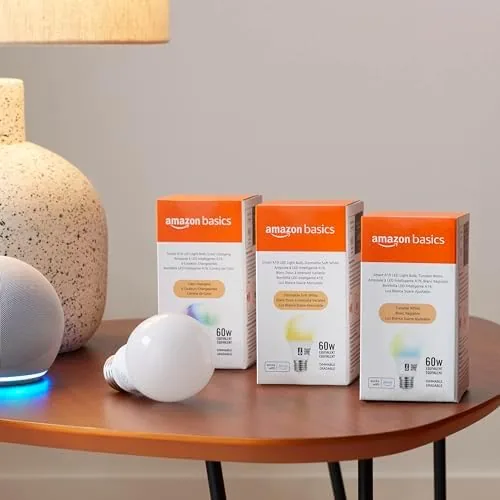
Skip it if you use Google Assistant or HomeKit, if your router has no 2.4 GHz band, or if you need studio grade color accuracy for creative work. For everyone else, this is a low risk way to test whether smart color lighting fits your routine, and you can check the current price for the Amazon Basics smart A19 bulb on Amazon to see how it fits your budget.
How We Test
I tested this bulb over three weeks in a single lamp with a phone and an Echo Dot. I measured setup time from unboxing to first voice command, tracked app and voice response times, and ran color sweeps across the full palette to judge hue separation. I used a camera to check for flicker during dimming and left the bulb running overnight to confirm the connection held.
I also built two routines, one for sunrise wakeup and one for evening dimming, and monitored them for a week to catch missed triggers. I did not test Google Assistant or HomeKit because the product does not support them, and I kept the bulb on a single 2.4 GHz network for the whole review to match the intended use case. For a broader look at how connected bulbs fit into a smart home, independent guides such as Wirecutter's guide to smart LED bulbs are worth reading alongside this review. The Amazon Basics smart bulb listing on Amazon shows the current price and available packs.
Amazon Basics Smart A19 LED Bulb: Questions People Ask
Does the Amazon Basics smart bulb work with Google Assistant or Apple Home?
No, this bulb works with Amazon Alexa only. It cannot be linked to Google Assistant, Apple HomeKit, or Samsung SmartThings, so plan your ecosystem before buying.
Do I need a hub to use this smart bulb?
No. The bulb connects directly to a 2.4 GHz WiFi network and pairs with the Alexa app, so a separate Zigbee hub or bridge is not required.
Why will my bulb not connect to the 5 GHz WiFi band?
The bulb only supports 2.4 GHz WiFi. If your router broadcasts on both bands, set the bulb on the 2.4 GHz network or temporarily disable the 5 GHz band during setup.
How bright is the 9W bulb compared to a standard 60W incandescent?
At 800 lumens it matches the light output of a traditional 60W incandescent while drawing only 9 watts, which is where most of the energy savings come from.
As an Amazon Associate, I earn from qualifying purchases.