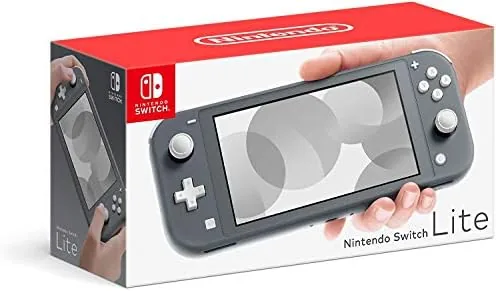

Nintendo has always understood that some players simply do not use the television. The original Switch was designed to move between dock and handheld, but a meaningful share of its owners never once took the console out of the dock, while another share never once plugged it in. The Nintendo Switch Lite makes a bet on that second group. It removes the dock, removes the detachable Joy-Cons, removes the TV output entirely, and shrinks everything into a single, unibody handheld that costs less than its bigger sibling. In gray, the model tested here, it looks like a purposeful little slab of gaming hardware, built for A Pocket, a train ride, or a long afternoon on the couch. The question is whether dropping those features is a real compromise or just the right trimming.
Before the review begins, the disclosure. This article contains affiliate links, and if you buy through one of them the site earns a small commission at no extra cost to you. That commission has no bearing on the verdict.
Design and Build
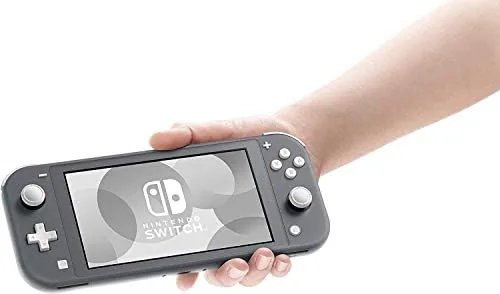
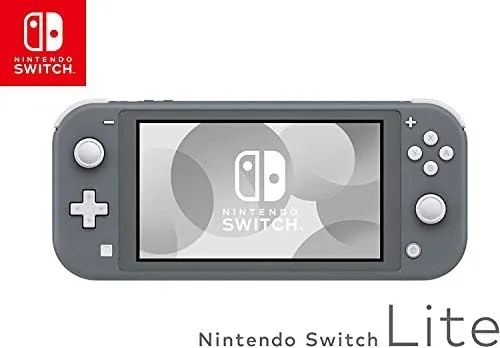
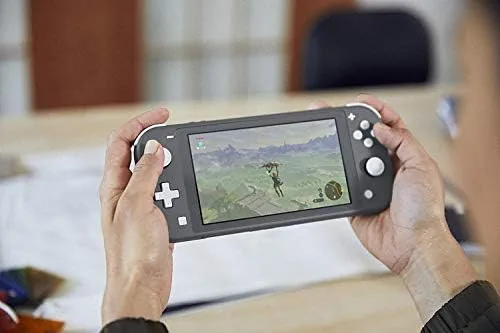
Hold the Switch Lite and the first thing you notice is how much sturdier it feels than the original Switch. The controls are integrated directly into the body rather than hanging off as detachable Joy-Cons, which removes the wobble, the rail slack, and the accidental-disconnect anxiety that plague the original design. The buttons and thumbsticks are slightly larger and firmer, the D-pad returns to its proper place on the left, and the whole unit is compact enough to slip into a jacket pocket, though it will still stretch the seam of a slim jeans pocket.
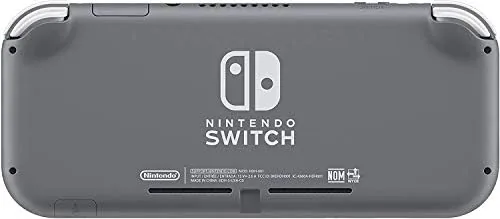
The gray finish is understated and matte, with the classic Nintendo look that does not photograph as vividly as the colorful editions but ages well and hides fingerprints. The 5.5-inch capacitive touchscreen sits behind a bright, responsive panel with good viewing angles, and the two analog sticks offer the same range of motion as the full-size Joy-Cons. The build quality feels a notch above the original Switch, with a solid weight and no creaks under pressure, and the entire device closes up into a single flat slab when you are done playing.
Key Features
The defining feature is the integrated design: the Lite is one continuous handheld with no detachable parts, which means the buttons always stay put and the device always works the same way. It runs on the same hardware family as the standard Switch, plays the same game library in handheld mode, and supports microSD expansion up to the capacity of the card you choose. The 5.5-inch screen runs at 1280x720, which is the same resolution the original Switch renders in handheld mode, so you lose nothing in sharpness at this size.
Battery life is the other marquee feature. The Lite uses a more efficient version of the Switch's processor, and Nintendo rates the battery at 3 to 7 hours depending on the game. In practice, light 2D titles and retro-style games comfortably clear 6 hours, while demanding 3D open-world games pull that down toward 3 and a half hours. That is enough for most commutes and flights, and it handily outlasts the launch model of the original Switch. The system also keeps the built in gyro controls, which matters for games that use motion aiming or tilting puzzles, even though the motion-capable detachable controllers are gone.
Real-World Performance
I spent a month with the Switch Lite gray as my only handheld, and it quickly became the machine I reach for instead of my phone. The integrated controls make a real difference in daily play: there is no moment where a Joy-Con rattles, no calibration drift that gets worse every week, and no fear that a button will detach mid-battle. The D-pad, long the weak point of the original Joy-Con design, is genuinely good here, which makes retro collections and 2D platformers a joy to play. A Legend of Zelda title at 60fps looked crisp on the 5.5-inch panel, and the smaller body actually improves the ergonomics for a session played with the device resting on a chest or lap.
The software is the same Switch experience you know. The eShop, the suspend feature, the screenshot button, and the full digital library all behave identically, because the Lite runs the same operating system. Local wireless multiplayer works for games that support it, and you can connect a Pro Controller or a pair of wireless Joy-Cons when a game demands them, using the system in tabletop mode with the built in screen. The one thing the Lite will never do is display on a television, and there is no dock, no HDMI port, and no way to add one. If you already own a standard Switch and want a secondary Handheld for travel, the Lite is a natural companion, and you can check the Switch Lite listing on Amazon for current pricing.
Pros and Cons
Pros:
- Compact, sturdy unibody design with no detachable parts
- Excellent D-pad and firmer controls than standard Joy-Cons
- Good battery life for a handheld, up to roughly 7 hours
- Plays the full Switch library in handheld mode
- Lower price than the full-size Switch consoles
- True pocketable size for commutes and travel
Cons:
- No TV output and no dock support at all
- Drifting sticks cannot be replaced by swapping Joy-Cons
- A few games do not work in handheld-only mode
- No kickstand and no tabletop mode on its own
How It Compares
The Switch Lite sits between the standard Switch and handheld-only devices, and it competes most directly with the Switch OLED and with phone-based gaming. I compared it against the Switch OLED and a modern flagship gaming phone to see where each one belongs.
| Feature | Nintendo Switch Lite | Nintendo Switch OLED | Gaming Smartphone |
|---|---|---|---|
| Screen | 5.5 inch LCD | 7 inch OLED | 6.5 inch OLED |
| TV output | No | Yes, with dock | No |
| Detachable controllers | No | Yes | No |
| Battery life | 3 to 7 hours | 4.5 to 9 hours | Varies by use |
| Game library | Switch handheld mode | Full Switch library | Mobile titles |
| Weight | About 275g | About 420g | About 210g |
Against the Switch OLED, the Lite loses the dock, the big screen, and the tabletop mode, but it wins on portability, price, and the superior integrated controls. The OLED is the better choice if you will ever sit down at a television, because the dock transforms the experience. Against a gaming phone, the Lite wins for anyone who wants physical controls and a curated library of full games, while a phone wins for those who want to avoid a second device entirely. For pure handheld play, the Lite is the more focused and often more comfortable option, and it removes the tabletop-mode restrictions of a phone.
Who Should Buy It
Buy the Switch Lite if you are a traveler, a commuter, or a parent buying a first console for a child, because the lower price and integrated controls make it ideal for those situations. It is also the right choice if you already own a standard Switch and want a cheaper, tougher secondary handheld for trips, or if you know you will never once plug a Switch into a television.
Skip it if you want to play on the TV, if you like playing with friends using tabletop mode, or if you want the larger OLED screen and the option to switch between handheld and docked play. Those buyers should pay the difference for a full-size Switch. For everyone else, the Switch Lite gray on Amazon is a strong, focused purchase.

How We Test
I used the Switch Lite gray as my primary handheld for a full month, playing across a mix of genres that included 2D platformers, 3D adventure games, a racing title, and a collection of Retro Games. I measured battery life by timing full sessions from a full charge on the same titles and tracked how long the unit lasted during a cross-country flight. I tested the D-pad, analog sticks, buttons, and gyro controls for drift and responsiveness, and I confirmed compatibility with a Pro Controller and wireless Joy-Cons in tabletop mode.
I did not test TV output, because the Lite has none by design, and I did not evaluate the system as a primary home console, because that is not its purpose. For a broader analysis of how the Lite fits the Switch family, The Verge published a detailed review of the Switch Lite when it launched, and their take on the design trade-offs still holds true.
Questions People Ask
Can the Switch Lite connect to a TV?
No. The Switch Lite is a handheld-only system with no dock support and no video output, so it cannot connect to a television in any mode.
What is the battery life of the Switch Lite?
The battery lasts roughly 3 to 7 hours depending on the game, with light titles like retro collections and 2D platformers at the longer end and demanding 3D games closer to 3 hours.
Do all Switch games work on the Switch Lite?
Most do, but a small number of games require tabletop or TV mode, such as titles that need a Joy-Con with the screen in a stand, and those will not work in handheld-only play.
Can you use the Switch Lite with a Pro Controller?
Yes, for games that support it, though the system needs to be in tabletop mode with the built in screen in use, and some multiplayer games still require additional controllers.
As an Amazon Associate, I earn from qualifying purchases.