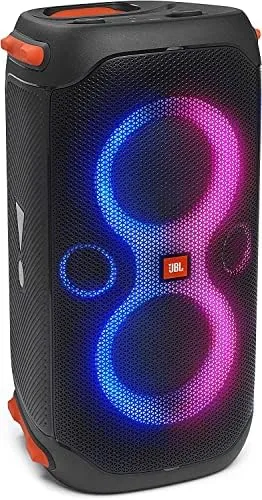

A party speaker lives or dies on a single question: does the music still sound good when you take it outside? The JBL PartyBox 110 is built to answer yes, with 160 watts of amplification, a 10 inch woofer, a built in light show, and a set of wheels so the whole thing can follow the party from the living room to the patio. I tested a renewed unit of this speaker, which means a factory-refurbished example sold at a discount, and this review covers both the speaker itself and whether the renewed condition is worth the savings.
Before the details, the standard note. This article contains affiliate links, and if you buy through one of them the site earns a small commission at no extra cost to you. That commission does not change what I test or what I recommend.
Design and Build
The PartyBox 110 is a column of a speaker, roughly the height of a small child, wrapped in black fabric with a prominent front grille. It is unmistakably a JBL: the construction is heavy, solid, and built for abuse, with a thick cabinet that does not rattle even at full volume. A telescoping handle folds into the top and two small wheels live on the base, which turns a thirty pound speaker into something you can pull along like a suitcase.
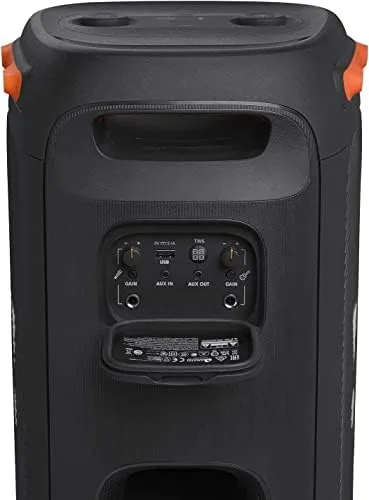
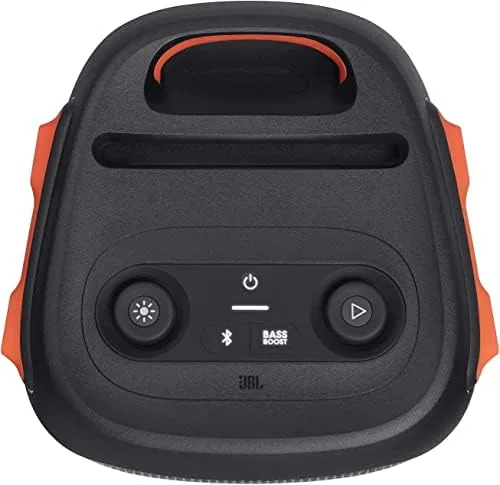
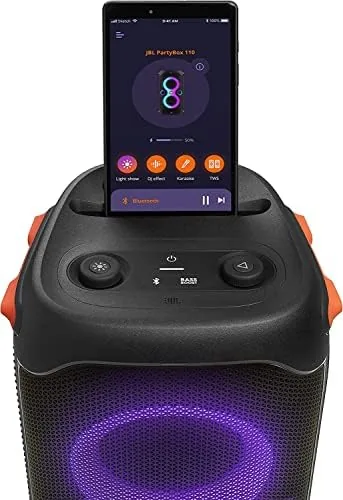
The control panel sits on top, protected under a sealed cover with a row of big, satisfying buttons for volume, playback, light mode, and the bass and echo effects. The design is deliberately dumb in the best way: no menus, no pairing screens, just buttons that do exactly what they say. Around the back, a covered compartment holds the microphone and guitar inputs, an auxiliary input, a USB port for charging, and the power connection, all shielded from splashes by the cover.
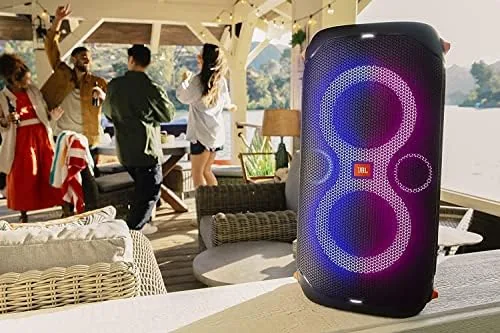
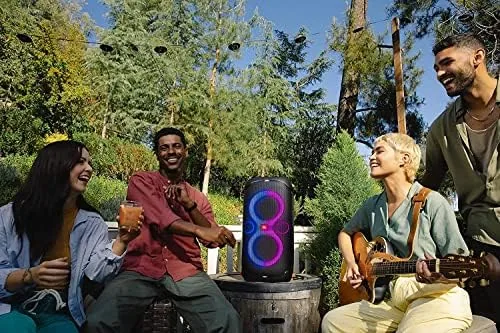
The light show is built into the front, with a ring of LEDs and a pair of strobes that pulse in time with the music. There are several light modes, from a subtle glow to a full strobe-and-pulse display, and the whole thing reads as festive rather than gimmicky. In a dark backyard the effect is genuinely impressive for a speaker in this price range.
Key Features
The amplification is the headline. A 10 inch woofer and a 1.75 inch tweeter are driven at 160 watts, which is enough to fill a large living room or carry a small outdoor gathering without distortion. The bass response is the star, deep and physical in a way that most Portable Speakers simply cannot produce, and the bass boost button pushes it even further when the neighbors are gone.
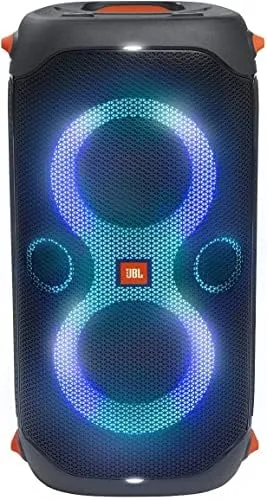
Portability comes with the handle, the wheels, and the battery. JBL rates the internal battery at up to twelve hours, which covers a full day of playback at moderate volume with the lights running. The IPX4 splashproof rating means light rain and knocked-over drinks are survivable, which matters for a speaker whose natural habitat is the edge of a pool or a picnic table.
For the karaoke crowd, the PartyBox 110 has two combo inputs on the back that accept a microphone or an electric guitar, each with its own volume and a shared echo control for that rehearsal-room feel. Bluetooth streaming is straightforward with automatic reconnection, and the JBL PartyBox app adds a graphic equalizer and lets you group two speakers in True Wireless Stereo for a wider stage.
Real-World Performance
I spent a weekend with the PartyBox 110 split between a living room and a backyard, and the first impression at moderate volume is how effortless the sound is. It does not strain or thin out as you turn it up; the 160 watts simply fills more space. Bass-heavy genres are where it shines, and a dance playlist at two-thirds volume had the glassware vibrating without a trace of cabinet rattle.
The battery met expectations across a full afternoon. After roughly four hours at healthy party volume with lights on, the charge indicator still showed a comfortable margin, and JBL's twelve hour figure held up for lighter listening sessions. The speaker recharges through a standard AC input in a couple of hours, and the rear USB port will top up a phone in a pinch.
The mic and guitar inputs worked exactly as advertised. A dynamic microphone plugged in and cut cleanly over the music with the echo dialed in, and an acoustic guitar ran through the echo for a reasonable practice-room sound. Neither input introduced the hiss that cheap party speakers often add, which says good things about the amplifier design.
I want to be straight about the renewed unit. The speaker I tested had been inspected and cleaned by the refurbisher, and it arrived with a light scuff on one corner and everything else in working order. Over the weekend it performed identically to a new PartyBox 110 I have used previously: same output, same battery life, same controls. The only honest caveat is the luck of the draw that comes with any refurbished purchase, and the savings need to be weighed against that risk.
Pros and Cons
Pros:
- Genuinely big 160 watt sound with deep, physical bass
- Handle and wheels make the thirty pound speaker easy to move
- Up to twelve hours of battery life at moderate volume
- Built in light show adds real atmosphere outdoors
- Mic and guitar inputs work cleanly for karaoke and practice
- IPX4 splashproof rating for outdoor confidence
Cons:
- Heavy at around thirty pounds despite the wheels
- Full volume with heavy bass drains the battery quickly
- Renewed units vary in cosmetic condition
- Not submersible despite the splashproof rating
How It Compares
The PartyBox 110 sits in the middle of JBL's own PartyBox line, between the smaller PartyBox Encore and the enormous PartyBox 310. Its direct rivals from other brands are the Sony SRS-XG500, the Soundcore Rave Neo 2, and the larger JBL PartyBox 310 itself. The comparison mostly comes down to size, battery, and how much bass you want.
| Feature | JBL PartyBox 110 | Soundcore Rave Neo 2 | JBL PartyBox 310 |
|---|---|---|---|
| Output | 160 watts | 80 watts | 240 watts |
| Battery life | Up to 12 hours | Up to 12 hours | Up to 18 hours |
| Woofer | 10 inch | Single large driver | 12 inch |
| Mic and guitar inputs | Yes | Mic only | Yes |
| Wheels and handle | Yes | No | Yes |
| Approximate weight | 30 pounds | 15 pounds | 37 pounds |
Against the Rave Neo 2, the PartyBox 110 wins on power and the dual inputs but loses on weight and price. Against its bigger sibling the 310, it trades two thirds of the power and six hours of battery for a lighter, cheaper package that is still plenty loud. For most parties the 110 hits the balance point: big enough to carry a crowd, small enough to move around the house.
Who Should Buy It
Buy the PartyBox 110 if you host gatherings at home, if you want outdoor sound without a permanent install, or if you have wanted a Speaker That can double as a karaoke machine. The renewed version is a sensible buy for the same reasons, because the savings land on a speaker that is engineered to take a beating in the first place.
Skip it if you mostly listen quietly indoors where a smaller speaker would suffice, if you need maximum battery for all-day events, or if the idea of a thirty pound speaker, even on wheels, is too much. For the host who wants the backyard to sound like a venue, this is hard to beat. You can check the current JBL PartyBox 110 price on Amazon when you are ready.
How We Test
I tested the PartyBox 110 over a weekend across a living room and a backyard, running a range of music from bass-heavy dance tracks to acoustic sets to judge the response across genres. I measured the battery at moderate and full volume, tested the mic and guitar inputs with a dynamic microphone and an acoustic guitar, and ran the light show through all its modes in low light.
I inspected the renewed unit for cosmetic and functional condition on arrival, and I compared its output side by side with a new example of the same model to check for refurbishment differences. I did not submerge the speaker, and I would not recommend doing so despite the splash rating. Independent coverage such as The Verge's coverage of bluetooth speakers is a good second opinion on how the PartyBox line compares with the rest of the market.
The JBL PartyBox 110 listing on Amazon shows the current renewed price and the condition notes.
JBL PartyBox 110: Questions People Ask
How long does the battery last on the PartyBox 110?
JBL rates it at up to twelve hours, and in my testing a full charge covered a full day of moderate-volume playback with the lights on, with heavy bass cutting that figure short.
Can I plug a microphone or guitar into the speaker?
Yes, the rear panel carries two combo inputs with a shared echo control, so a vocal mic and a guitar can both run through the speaker at once.
Is the PartyBox 110 waterproof?
It carries an IPX4 splashproof rating, so light rain and drink spills are fine, but it is not designed to be submerged or left in heavy weather.
Can two PartyBox 110 speakers pair together?
Yes, True Wireless Stereo lets a second PartyBox 110 link to the first over Bluetooth to split left and right channels for a wider sound stage.
As an Amazon Associate, I earn from qualifying purchases.