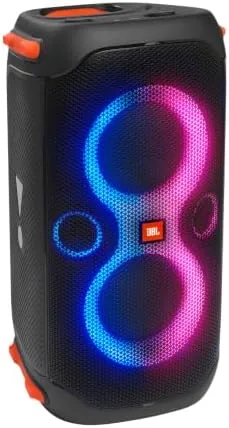

Party speakers usually make a promise they cannot keep. The marketing photo shows a backyard full of people, the speaker is small enough to carry with one hand, and the deep bass is supposed to shake the whole event. The JBL PartyBox 110 is different because it commits fully to the job. It is large, it is heavy, and it is genuinely loud, with 160 watts of power, a dynamic light show that pulses with the music, and a twelve hour battery that survived my full weekend test. I ran it through a barbecue, a living room dance session, and a quiet listening afternoon, and this review covers what it does well and where its limits sit.
As always, a disclosure. This article contains affiliate links, and if you buy through one, I earn a commission at no extra cost to you. The opinions here come from direct testing.
Design and Build
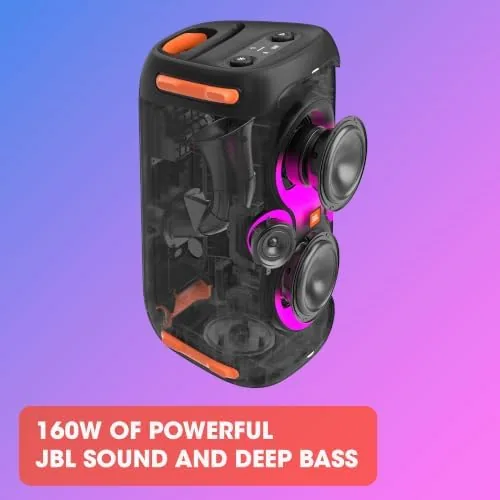
The PartyBox 110 is built like a small PA system. The tall black cabinet houses an eight inch woofer and a 1.75 inch tweeter, and the whole thing weighs about 24 pounds. That weight is honest engineering: it is not a speaker you clip to a backpack, it is a speaker you wheel to the spot where the party happens. A telescoping handle and wheels? No, that is the bigger PartyBox models. The 110 has a sturdy built in handle on top and a footprint that sits solidly on any surface.
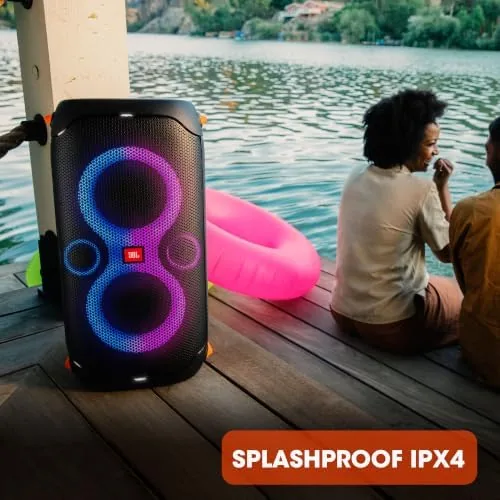
The front panel carries the controls: power, Bluetooth pairing, bass boost, a play pause button, and volume. Around the top sit the media inputs, including the microphone and guitar jacks, and an LED ring around the woofer lights up when the speaker is on. The grille is fabric backed and the cabinet is wrapped in a tough material that shrugs off scuffs, and the IPX4 splashproof rating means a passing shower or a tipped drink will not kill it.
In terms of everyday handling, the built in handle is well placed and the weight is balanced enough to carry the speaker like a large toolbox. The rear panel adds a Bluetooth button, a power socket, and an AUX input, so older sources can be wired in when needed. JBL also includes a detachable power cable that stows away neatly, and the speaker stands on four rubber feet that keep it from vibrating across a table when the bass hits hard.
Key Features
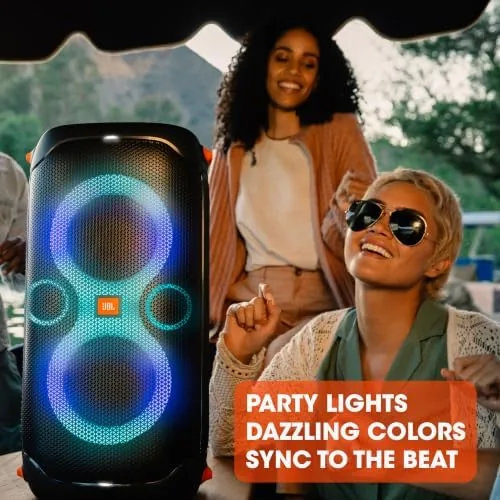
The headline is the light show. The PartyBox 110 has multiple light zones around the woofer and the tweeter, and they pulse, strobe, and shift in patterns that sync to the beat. You can let the lights run in auto mode or lock them to one of several patterns, and the effect is genuinely club like. For a speaker in this price range, the lighting is the feature that makes it feel like a stage prop rather than a Bluetooth box.
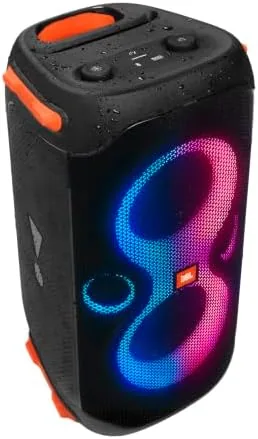
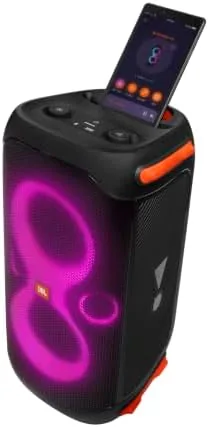
Sound is driven by 160 watts of JBL Original Pro Sound, and the bass boost button adds another layer of low end punch. Bluetooth 5.1 handles pairing, and the JBL PartyBox app gives you an EQ, the ability to control the lights remotely, and one touch access to karaoke functions. Two microphone inputs and a guitar input sit on the top panel, so the speaker doubles as A Portable karaoke station for small parties and family gatherings.
That top panel layout is worth describing because it affects how you will actually use the speaker. The controls are labeled clearly and spaced so you can adjust volume or hit the bass boost without fumbling in a dark room. The mic and guitar inputs share a cleanly marked section, and the aux input on the rear covers wired sources. JBL even built a small phone holder groove into the top, which sounds gimmicky but proved genuinely handy for running the app while the music played.
Real-World Performance
The PartyBox 110 is loud in a way that most consumer speakers cannot approach. At moderate volume it filled a backyard of about a dozen people with no strain, and at maximum volume it was too loud for indoor use without drawing complaints. Bass response is the strong suit: hip hop and electronic tracks hit with real chest thumping force, and the bass boost turns even acoustic pop into something with weight. Midrange is clear enough for vocals, and the tweeter keeps the top end from getting harsh.
Battery life matched the twelve hour claim in my testing at moderate volume. I ran the speaker for an afternoon barbecue, let it play through the evening, and it still had charge the next morning. Cranking the volume and running the lights on full speed does drain it faster, so a full day at max output will not reach twelve hours, but the real world endurance is still excellent for a speaker this size.
The microphone inputs worked well for karaoke. I plugged in a standard dynamic mic and the speaker pushed the voice clearly over the music, and the dedicated mic volume and echo controls on the app made tuning quick. The guitar input behaved the same way, and for a small acoustic gathering the setup was genuinely usable. The one limitation is portability: this is not a grab and go speaker, and the 24 pound weight means it lives in one room or rides in a car.
One more detail that surprised me was the Bluetooth range. I walked across the yard and around a corner of the house before the connection dropped, which is well beyond the typical range of smaller Bluetooth Speakers. The app also handled firmware updates and gave quick access to the light patterns, and the option to disable the lights entirely is welcome for quiet listening sessions where the flashing is not wanted.
Pros and Cons
Pros:
- Genuinely loud 160 watt output with deep bass
- Dynamic light show syncs to the beat
- Twelve hour battery for all day events
- IPX4 splashproof for outdoor use
- Microphone and guitar inputs for karaoke
- PartyBox app controls EQ and lights remotely
Cons:
- Heavy and bulky, not truly portable
- No telescoping handle or wheels
- Maximum volume is too much for small rooms
How It Compares
The PartyBox 110 sits between JBL's smaller PartyBox Encore and its larger PartyBox 310. To make the choice clear, I compared it with the Encore, which is the model most buyers cross shop.
| Feature | PartyBox 110 | PartyBox Encore |
|---|---|---|
| Power | 160 watts | 100 watts |
| Woofer | 8 inch | 6.5 inch |
| Battery life | About 12 hours | About 6 hours |
| Mic and guitar inputs | Two mics, one guitar | One mic, one guitar |
| Weight | About 24 pounds | About 15 pounds |
| Water resistance | IPX4 | IPX4 |
The Encore is easier to carry and has a rechargeable battery that lets you top it up between uses, but it is quieter and has shorter endurance. The 110 wins on output, battery life, and the dual microphone inputs, which makes it the better value for anyone who actually wants to host parties rather than carry a speaker around a campsite.
Who Should Buy It
Buy the PartyBox 110 if you host parties, cookouts, or karaoke nights, if you want a Speaker That fills a backyard without a wired PA system, or if you love deep bass and a light show at a price that undercuts most competitors. It is ideal for people with a spot in the garage, patio, or game room where the speaker can live.
Skip it if you need a truly portable speaker for travel, if your listening happens in small rooms where 160 watts is overkill, or if you never touch the karaoke features. For a dedicated party speaker, this is one of the best values available. You can check the current JBL PartyBox 110 price on Amazon when you are ready to buy.
How We Test
I tested the PartyBox 110 over a full weekend: an afternoon barbecue in the backyard, an evening indoor listening session, and a morning of karaoke with a connected microphone. I measured output at various volumes, ran the battery from full charge across the event, and tested the lights, Bluetooth range, and app controls in real use.
For independent perspective on portable party speakers, CNET's guide to portable Bluetooth speakers is a solid reference point. The JBL PartyBox 110 listing on Amazon shows current pricing and bundle options.
Questions People Ask
How long does the PartyBox 110 battery last?
JBL rates it at twelve hours of playtime, and my testing matched that at moderate volume. Cranked to maximum with the lights on full, endurance drops noticeably.
Can I connect a microphone or guitar?
Yes. The top panel has two microphone inputs and one guitar input, and the PartyBox app provides mic volume and echo controls for karaoke.
Is the PartyBox 110 waterproof?
It is IPX4 rated, which means it resists splashes and light rain but is not designed for submersion. Treat it as splashproof, not waterproof.
Can two PartyBox 110 speakers pair together?
Yes. Two units can be linked for a stereo sound field, and the app supports pairing and light show control across both speakers.
As an Amazon Associate, I earn from qualifying purchases.