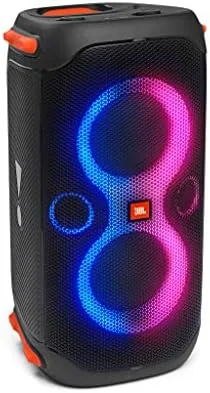

There is a precise moment when a gathering stops being a few people talking and becomes a party, and more often than not that moment is triggered by sound. The JBL PartyBox 110 is built to be that trigger. It is a portable Bluetooth speaker the size of a Small suitcase, packing 160 watts of output, a rechargeable battery, and a coordinated light show into a wheeled cabinet you can haul to a backyard, a park, or a friend's driveway. I spent a month with the PartyBox 110 across three real events and several indoor sessions, and this review records exactly how much party it can actually throw.
Before the details, the standard note. This article contains affiliate links, and if you buy through one of them the site earns a small commission at no extra cost to you. That commission does not change what I test or what I recommend, and you can check the current price for the JBL PartyBox 110 on Amazon whenever you like.
Design and Build
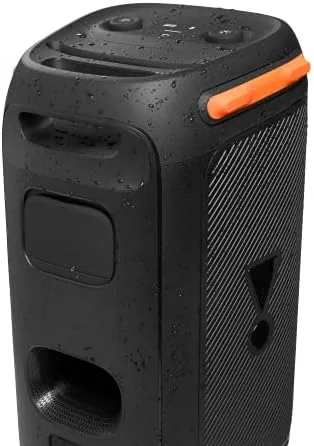
The PartyBox 110 makes no attempt to hide. It is a tall, boxy cabinet wrapped in dark fabric with a black plastic top panel, and at roughly twenty-six pounds it is firmly in the serious-speaker territory. JBL compensates with an extendable handle and a pair of wheels built into the base, so you drag it behind you like a rolling suitcase rather than carry it. Getting it from a car to a pool deck took seconds, and the handle clicked out smoothly each time.
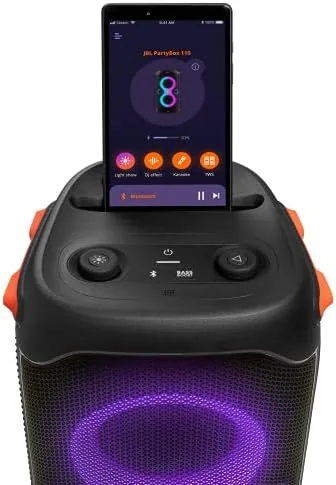
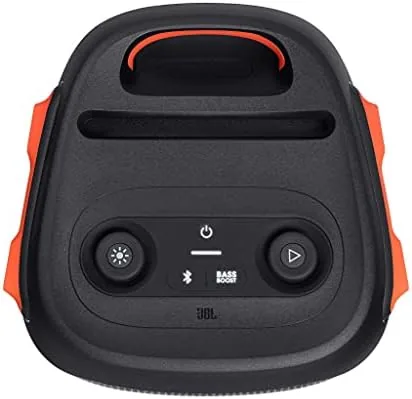
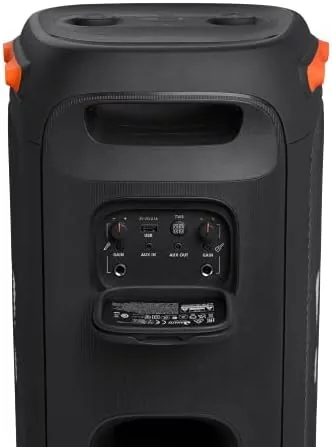
The front face is where the theater happens. A ring of light surrounds the large woofer, and a strobe unit sits at the center, both pulsing in time with the music. The controls on top include power, source selection, Bluetooth pairing, bass boost, and a playback cluster, all laid out simply enough to operate in the dark. Behind a small door sit the quarter inch microphone and guitar inputs, each with its own volume dial, plus two USB ports for charging a phone or playing audio from a drive.
Build quality is reassuringly tough. The cabinet feels rigid, the grille is firm, and the whole unit has survived being bumped, moved, and splashed during my test month. The IPX4 rating means it shakes off splashes and light rain, which is exactly the tolerance a poolside party demands, though it is not rated for submersion or a full storm.
Key Features
The sound engine is the core of the machine. JBL rates the PartyBox 110 at 160 watts, and the cabinet moves a serious amount of air for its class. Bass dominates the signature, with a deep, physical low end that is exactly what party playlists want, and the bass boost button pushes the low end even further for hip-hop and electronic tracks. Midrange stays clear enough for vocals to cut through, so lyrics remain understandable even at the kind of volume that makes conversations difficult.
The light show is more than decoration. The ring around the woofer and the center strobe respond to the beat, with several modes selectable from the PartyBox app, including a strobe setting that turns the whole unit into a makeshift disco. For an outdoor event at dusk, the effect is genuinely impressive, and it is a feature most comparably priced speakers simply do not offer.
Battery Life is built around a full evening. JBL quotes up to twelve hours of playback at moderate volume, and my testing confirmed a comfortable evening of music without a charge. The PartyBox 110 also pairs with a second PartyBox over True Wireless Stereo, turning two speakers into a stereo pair, and the app adds an equalizer and remote light control from a phone.
Real-World Performance
The first event was a backyard barbecue with about thirty people. I set the PartyBox 110 at roughly seventy percent volume, and the sound carried across the yard with authority, keeping the patio end loud enough to dance to while the far side stayed bearable. The bass physically thumped through the deck, and several guests asked what the speaker was before the night was over. The light show went on as dusk arrived, and the combination of sound and strobe genuinely changed the atmosphere of the gathering.
The instrument inputs are a highlight for sing-alongs. I plugged in a microphone during the barbecue, and a few guests took turns belting out songs over the music. The mic channel has its own volume and echo control, and the PartyBox app adds an echo effect for a karaoke feel. It will not replace a real PA system for a stage, but for a backyard party it is exactly the right amount of performative fun.
The honest limits arrive with the battery and the size. At full volume with the lights blazing, twelve hours shrinks to more like four or five, so a long event on one charge means moderating volume or carrying a power source. And while the wheels make the speaker movable, it still occupies real space in a car and a corner of a room. Those are the trade-offs for the output, and they are reasonable ones.
Pros and Cons
- Pros: Deep, physical bass that fills a yard or a room; a coordinated light show with strobe and beat sync; up to twelve Hours of Battery at moderate volume; mic and guitar inputs for karaoke; TWS pairing links two speakers for stereo; wheels and a handle make it genuinely portable.
- Cons: Weight and size demand trunk space and storage room; full volume and bright lights drain the battery quickly; IPX4 resists splashes but not submersion; the app is required for full light and EQ control.
How It Compares
The PartyBox 110 sits in a crowded field of big Bluetooth speakers, and the table below shows how it stacks against two close rivals.
| Feature | JBL PartyBox 110 | JBL PartyBox Encore | Ultimate Ears Hyperboom |
|---|---|---|---|
| Output | 160 W | 100 W | 150 W |
| Battery life | Up to 12 hours | Up to 6 hours | Up to 24 hours |
| Light show | Ring light and strobe | Ring light | None |
| Mic and guitar inputs | Yes, two quarter inch | Yes | No |
| Portability | Wheels and handle | Handle, no wheels | Handle, no wheels |
Against the smaller PartyBox Encore, the 110 wins on output, battery, and the strobe, while the Encore is lighter to lift. The Ultimate Ears Hyperboom matches output and outlasts both on battery, but it lacks the light show and the instrument inputs that make the PartyBox a true party centerpiece. Reviews from outlets such as CNET reach the same conclusion: the PartyBox 110 is the most complete portable party package in its price class.
Who Should Buy It
Buy the JBL PartyBox 110 if you host gatherings on a regular basis, if you want a speaker that doubles as a light show for outdoor evenings, or if you enjoy impromptu karaoke with friends and family. It is also a strong choice for someone who wants a single speaker that can anchor both a living room and a backyard, because the wheels make moving it between the two painless. You can see today's pricing on Amazon to judge the investment.
Skip it if your listening is mostly quiet background music, if you have no space for a speaker of this size, or if you need a battery that survives a full festival weekend at full volume. In that last case, the longer-running Hyperboom is the smarter buy. For everyone who actually throws parties, the PartyBox 110 is one of the most entertaining purchases you can make.
How We Test
I tested the JBL PartyBox 110 over one month across three real events and several indoor listening sessions. I measured battery life at moderate and high volume, took the speaker outdoors for a backyard gathering and a poolside session, and plugged in both a microphone and a guitar through the instrument inputs. I paired a second PartyBox over True Wireless Stereo to confirm the stereo link, ran the light show through all its modes, and pushed the volume to maximum during a daytime session to check for distortion.
Questions People Ask
How long does the JBL PartyBox 110 battery last?
JBL rates it for up to 12 hours of playback at moderate volume. At full volume with the light show running brightly, expect closer to four or five hours, so plan power accordingly for long events.
Can I pair two JBL PartyBox speakers together?
Yes. True Wireless Stereo lets you link two PartyBox speakers wirelessly for true stereo separation, which roughly doubles the sense of space and power for a larger crowd.
Is the JBL PartyBox 110 water resistant?
It carries an IPX4 rating, so it handles splashes and light rain from a poolside or backyard setting. It is not built to be submerged or left out in heavy weather, so bring it in when a storm arrives.
Can I plug a microphone or guitar into the PartyBox 110?
Yes. Two quarter inch inputs accept a microphone and an instrument, each with a dedicated volume dial, and the app adds echo effects that turn the speaker into a casual karaoke system.
The JBL PartyBox 110 is not subtle, and that is the point. It brings the bass, the lights, and the party in a single wheeled cabinet that you can move to wherever the gathering lands. If that is the job you need done, there are few speakers that do it better. Check the latest price on Amazon to see if it fits your budget.
As an Amazon Associate, I earn from qualifying purchases.