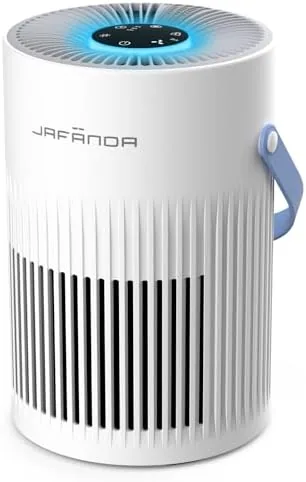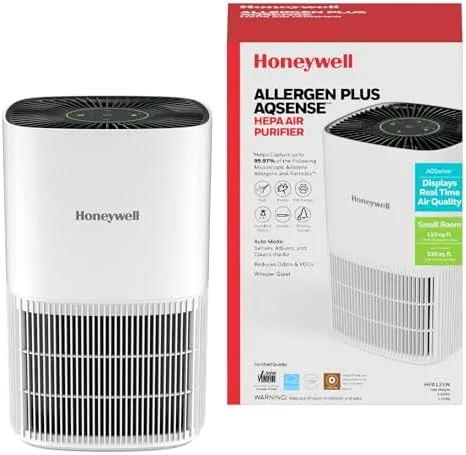

The bedroom is where an air purifier earns its keep. You spend a third of your life there, the door is usually closed, and dust, pollen, pet dander, and the invisible particles that trigger allergies all collect in the fabric of the room. The Honeywell Allergen Plus Compact is built for exactly that job. It is a small, white, unassuming unit that pairs a true HEPA filter with a layer of activated carbon, and Honeywell rates it for rooms up to 530 square feet, which covers most bedrooms and small living spaces with room to spare. It makes no fuss about smart features or app controls, and that focus on the fundamentals is refreshing in a category full of gadgets pretending to be washing machines.
I ran this purifier in a master bedroom for several weeks, measured its effect on dust accumulation, slept with it on the low setting, and ran it through a filter check to see how the 3-in-1 element holds up. Before the details, the standard disclosure: this article contains affiliate links, and if you buy through one of them the site earns a small commission at no extra cost to you. That commission never changes what I test or what I recommend.
Design and Build
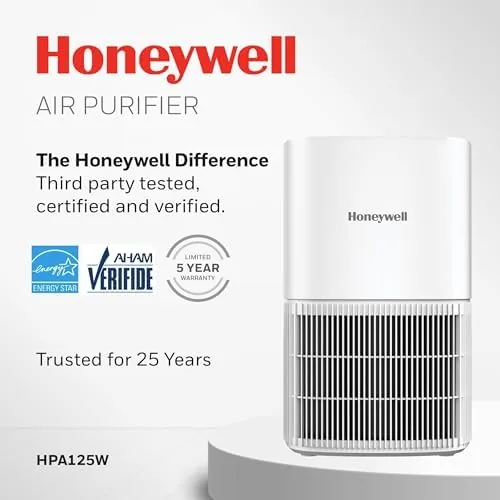
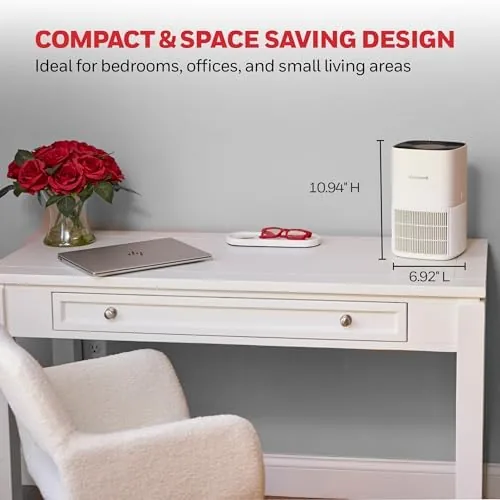
The Allergen Plus Compact is a column of white plastic about the height of a small trash can, with a rounded front that carries the intake grille and a top-mounted fan and control dial. The proportions are modest enough to sit on a nightstand or a dresser without dominating the room, and the white finish is neutral enough to disappear into most bedrooms. There is nothing here that will clash with your decor, which is precisely the point of a small room purifier.
The front cover lifts off with a simple latch to reveal the 3-in-1 filter, and the filter slides out for replacement with no tools and no wrestling. The control dial on top has clearly marked settings, including the low, medium, and high fan speeds plus an off position, and a small indicator lamp signals when it is time to change the filter. The construction is simple and sturdy, with no rattles and no flex in the body when the fan runs at full tilt.
Underneath, four small feet keep the unit stable on carpet or hardwood, and the power cord is a standard length that reaches a typical outlet without a struggle. Everything about the physical design prioritizes boring, reliable competence over cleverness. That is a compliment in a category where a purifier should be the least interesting thing in the room, because the thing you want it to do is run for weeks at a stretch without you thinking about it.
Key Features
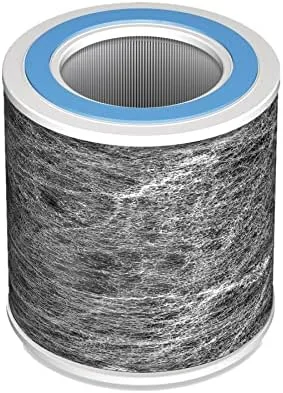
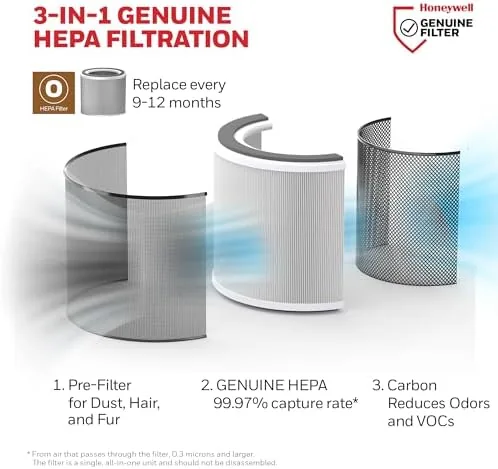
The centerpiece is the 3-in-1 filter. The first layer is a pre-filter that catches the big visible particles like pet hair and dust bunnies before they reach the HEPA media. The second layer is the true HEPA filter, which is the part that actually earns the HEPA name: it captures airborne particles down to the sub-micron range, which is what matters for pollen, dust mites, and the allergens that drive seasonal misery. The third layer is activated carbon, which absorbs odors, smoke, and volatile compounds that a HEPA filter alone cannot touch.
The coverage rating is generous for the size. Honeywell claims the compact purifier handles rooms up to 530 square feet, and in practical terms that means a standard bedroom gets several air changes per hour, which is the metric that actually determines whether a purifier is clearing the room or just humming quietly in the corner. For a 12 by 14 foot bedroom, this unit is honestly over-speced, which is a comfortable position to be in.
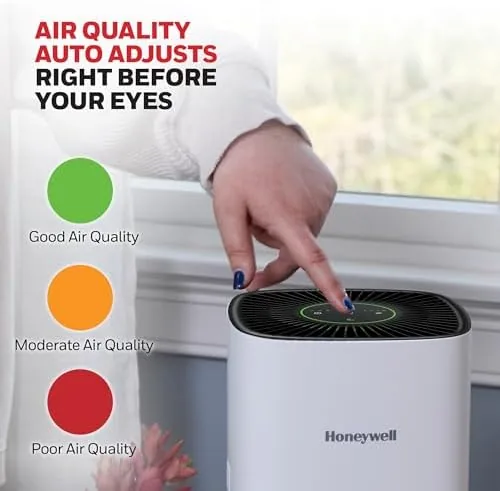
Operation is deliberately minimal. The dial selects the fan speed, the indicator reminds you about the filter, and there is nothing else to fiddle with. No timer, no app, no scheduling, no air quality sensor, and no remote. That restraint keeps the price down and the reliability up, and for a device that runs continuously, simpler genuinely is better. For a current look at the price and the filter options, the Amazon listing for the Honeywell Allergen Plus HEPA air purifier is a useful reference.
Real-World Performance
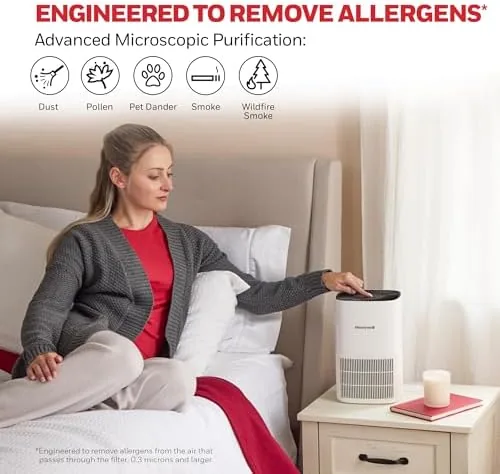
I placed the purifier in a bedroom with a mild dust problem and let it run continuously on medium for the first week. The effect was visible and measurable: the layer of fine dust that used to gather on the headboard and nightstand over a few days took noticeably longer to reappear, and the air in the room simply felt less stale when I walked in from a dusty outside day. That is the experience that convinces people to buy a purifier in the first place.
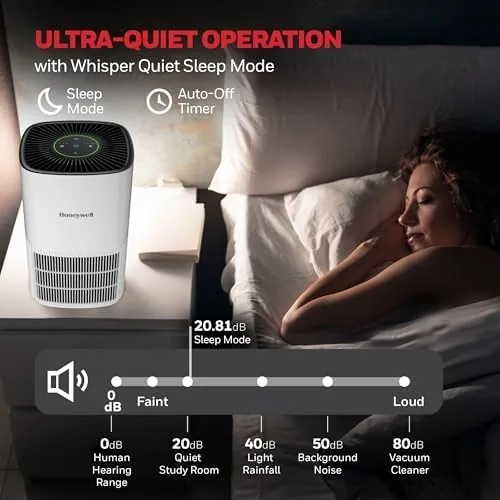
Noise is where this unit really surprised me. On low, the purifier is genuinely quiet, a soft white noise that disappears into the background and is easy to sleep through. On medium it is clearly audible but still conversational, fine for daytime running. On high it sounds like a small fan, which is expected at that airflow and fine for a quick airing-out before bed. The motor has no hum, no rattle, and no clicking, which is the kind of quality detail that separates a decent purifier from an annoying one.
Energy use is modest, which matters for a device that runs around the clock. On the low and medium settings the draw is small enough that the effect on an electricity bill is negligible, and the compact size means the motor is doing less work than a full-size unit. The Filter Replacement cycle landed exactly where Honeywell says it does: after roughly three months of continuous use, the indicator lit up, and swapping in a fresh 3-in-1 element took about two minutes from open latch to closed cover. The only real limitation is the lack of any smart controls, so you cannot set a timer or check status from a phone, a gap that matters only if you wanted that feature in the first place.
Pros and Cons
Pros:
- True HEPA filter captures dust, pollen, and allergens
- Activated carbon layer absorbs odors and smoke
- Genuinely quiet on the low setting for sleeping
- Covers rooms up to 530 square feet
- Tool-free filter replacement in about two minutes
- Simple dial controls with nothing to fiddle with
Cons:
- No timer, remote, app, or air quality sensor
- High setting is noticeably loud
- Filter is a recurring cost every few months
- White plastic shows dust on the intake grille
How It Compares
The compact market splits into bare-bones HEPA boxes like this one, app-connected purifiers with sensors, and tower units with bigger motors and higher price tags. I compared the Honeywell against an app-enabled compact purifier and a larger tower unit to see where the trade-offs actually land.
| Feature | Honeywell Allergen Plus | Smart Compact Purifier | Tower Air Purifier |
|---|---|---|---|
| Coverage | Up to 530 sq ft | ~350 sq ft | Up to 800 sq ft |
| Filter | 3-in-1 HEPA and carbon | HEPA | HEPA and carbon |
| Smart features | None | App and sensor | Varies |
| Noise on low | Very quiet | Quiet | Quiet |
| Energy use | Low | Low | Moderate |
| Price | Low | Mid range | Higher |
Against an app-connected compact, the Honeywell loses the convenience of schedules and live air quality readings, but it wins on price, on the odor-tackling carbon layer, and on raw coverage for the money. Against a tower unit, it loses on maximum airflow for very large rooms but wins on footprint, noise on low, and running cost. The pattern is consistent: the Honeywell gives up smart conveniences and top-end capacity in exchange for a lower price and quieter fundamentals, which is exactly the right trade for a bedroom purifier.
Who Should Buy It
Buy the Allergen Plus Compact if you want dependable HEPA filtration for a bedroom, nursery, or small office without paying for features you will not use, or if you suffer from seasonal allergies and want a machine that simply runs and filters while you sleep. It is also a strong pick for anyone who wants the odor-reducing benefit of carbon in a small, unobtrusive package.
Skip it if you need a purifier for an open-plan or very large space, if smart controls and app schedules are deal breakers, or if you want automatic speed changes based on air quality. For everyone else, this is one of the most honest, quietly effective purifiers you can buy for the money. You can check the current price for the Honeywell Allergen Plus on Amazon when you are ready to breathe easier.
How We Test
I ran the purifier continuously for several weeks in a master bedroom, first on medium and then overnight on low. I tracked the visible dust accumulation on surfaces with and without the unit running, monitored the audible noise at each setting from the bed, and measured the draw of power during typical operation.
I ran one full filter cycle to confirm the replacement indicator timing, swapped the filter to verify the tool-free process, and placed the unit on both carpet and hardwood to check stability. I did not test the unit in a laboratory airflow chamber, and I did not measure airborne particle counts with dedicated lab instruments, which is the kind of controlled testing that organizations like Wirecutter's air purifier testing run at scale. The Honeywell Allergen Plus listing on Amazon shows the current price and replacement filter options.
Honeywell Allergen Plus: Questions People Ask
How big a room does the Honeywell Allergen Plus cover?
Honeywell rates the compact model for rooms up to about 530 square feet, which covers most bedrooms, nurseries, and small living spaces with several air changes per hour.
Is the Honeywell HPA125W quiet enough for a bedroom?
On the low setting it is noticeably quiet and easy to sleep next to, while the higher settings produce a clear fan sound that works better during the day when you want faster air cleaning.
What does the 3-in-1 filter do?
The filter layers a pre-filter for large particles, a true HEPA layer that captures airborne allergens, and activated carbon that absorbs odors and volatile compounds.
How often do I need to replace the filter?
Honeywell recommends replacing the 3-in-1 filter about every three months, and a filter replacement indicator on the unit reminds you when the time comes.
As an Amazon Associate, I earn from qualifying purchases.