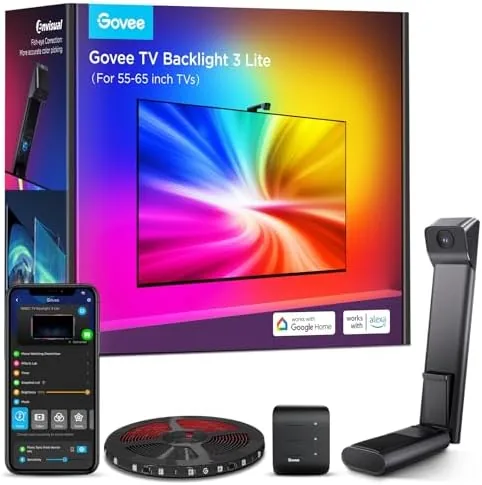

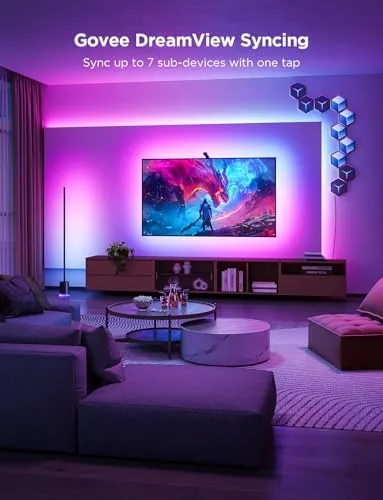
Ambient lighting behind a television does more than look pretty. Done well, it softens the contrast between a bright screen and a dark room, reduces eye strain, and makes the image feel like it spills past the bezel. The trick is matching the light to the picture, which is hard to do without a lot of hardware. Govee's answer is the TV Backlight 3 Lite, an 11.8 foot RGBICW LED strip built for 55 to 65 inch televisions, paired with an upgraded camera that uses fish-eye correction to read on screen color and reproduce it on the wall. I mounted one behind a 55 inch set and spent two weeks judging the sync accuracy, the color quality, and the app experience.
One note up front. This article contains affiliate links, and if you buy through one of them the site earns a commission at no added cost to you. That commission never influences what I test or what I recommend.
Design and Build
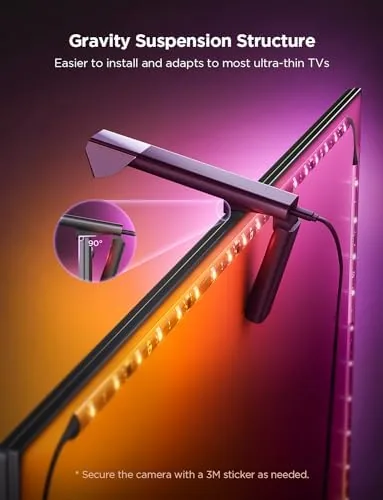
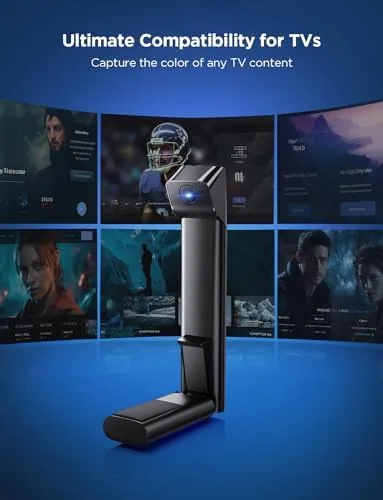
The kit is straightforward to understand. An 11.8 foot strip of LED lamps runs around the back perimeter of the television, a small control box manages power and WiFi, and a compact camera clips onto the top edge to watch the screen. Everything cables together in minutes, and the strip uses a corner connection system that handles the sharp 90 degree turns of a TV bezel cleanly.
The strip itself is flexible and adheres with a decently sticky backing tape that grabbed the plastic rear panel of my test television on the first try. The lamps are the standout detail: each one packs four colors into a single lamp bead, which is the RGBICW trick that lets the strip show several colors at once across its length rather than one uniform tone.
The camera is small and unobtrusive, finished in black plastic that disappears against a modern television bezel. The clip grips the top edge firmly and pivots so you can aim it at the middle of the screen. Build quality across the kit feels solid, with clean seams on the control box and a braided USB power lead that did not kink during installation.
Key Features
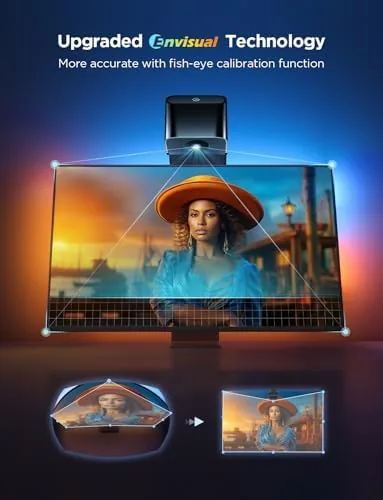
The defining feature is the camera-based sync. Most budget backlights are static or pulse to music, but this kit reads what is actually on screen and recreates it around the television. The fish-eye correction is the clever part: a plain camera lens would distort the image it captures, but Govee's algorithm compensates for that curvature so the color mapping lines up with the edges of the screen.
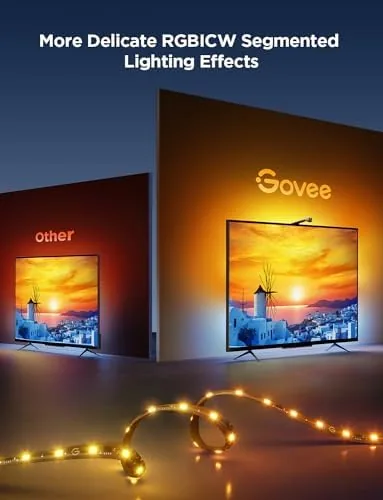
The RGBICW lamp beads deliver richer color than older strips. Because each bead contains four color channels plus white, the strip can show a sunset gradient across one side of the TV while a cool blue plays on the other, and the white channel makes bright scenes clean rather than washed out. That four color in one lamp architecture is what separates this generation from the single color strips of a few years ago.
Control options are generous. The Govee Home app handles setup, scenes, schedules, and music modes, and the strip responds to Alexa and Google Assistant for hands free switching. The kit also supports Matter, which means it can join a broader smart home ecosystem without a proprietary bridge. For a look at the current price and the exact strip length, the Amazon listing for the Govee TV Backlight 3 Lite is the place to check.
Real-World Performance
Setup took about twenty minutes, most of it spent on calibration. The app walks you through mounting the camera, sticking the strip, and then a guided calibration Where You place colored foam pads over the screen corners. The fish-eye correction made itself felt here: the on screen markers aligned with the actual corners of my television instead of drifting inward the way an uncorrected camera would.
The sync quality is genuinely impressive for the price. In a fast paced action scene, the wall behind the television lit up in step with the explosions and color shifts on screen, and the response felt immediate rather than laggy. Neutral tones like a grey sky or a white kitchen scene rendered cleanly, which is where many camera-based systems fall apart into muddy, oversaturated messes.
Color accuracy held up across varied content. A nature documentary pushed lush greens and warm browns around the room, and a neon-heavy music video reproduced its pinks and cyans faithfully. The strip handled the mixed color scenes particularly well, showing a red glow on one side while a blue ran along the other, which is the four color per bead advantage in action.
Voice control worked without issue. Asking Alexa to change scenes or turn the strip off produced a quick response, and the app's music mode pulsed the lights to the beat of a test track with energy. The only limitation is the camera itself: it reads the television rather than the room, so if you watch in a bright daylight room the sync is less obvious, which is true of every camera-based backlight.
Pros and Cons
Pros:
- Accurate camera sync with effective fish-eye correction
- RGBICW lamp beads deliver rich, multi color gradients
- Clean reproduction of white and neutral tones
- Simple mounting and guided calibration in the app
- Alexa, Google, and Matter smart home support
- Good value against premium HDMI-based systems
Cons:
- Camera still struggles with very bright daylight rooms
- Calibration foam pads are easy to lose
- No HDMI integration for zero camera setups
- Strip length only suits 55 to 65 inch screens
How It Compares
Camera-based backlights are not the only route to screen-synced lighting. The premium alternative is an HDMI sync box, which reads the video signal directly, and the budget alternative is a static bias light with no sync at all. I compared all three approaches.
| Feature | Backlight 3 Lite Camera | HDMI Sync Box | Static Bias Light |
|---|---|---|---|
| Sync method | Camera reads screen | Reads HDMI signal | None |
| Sync accuracy | Very good | Excellent | Not applicable |
| Bright room performance | Reduced | Unaffected | Fixed |
| Price | Mid range | Premium | Low |
| Installation | Camera plus strip | HDMI pass through | Stick and plug |
| Smart home support | Alexa, Google, Matter | App based | Often limited |
Against an HDMI sync box, the Govee loses on raw accuracy but wins on price and simplicity, since it needs no extra HDMI port and works with any streaming source. Against a static bias light, it is in a different league entirely, turning a flat glow into a living extension of the picture. For most people watching mixed streaming content, the Backlight 3 Lite is the sweet spot.
Who Should Buy It
Buy the Backlight 3 Lite if you watch movies and shows in a dark or dim room and want the image to feel bigger than the bezel, or if you host movie nights and want the wall behind the screen to carry the mood. It is also a strong gift for someone who already loves smart home gear, thanks to the Alexa, Google, and Matter support.
Skip it if your television is larger than 65 inches and would need a longer strip, if you watch mostly in a bright room where the camera loses its edge, or if you demand the perfect accuracy of an HDMI sync box. For everyone else, this is the most enjoyable upgrade you can make to a living room for the money. You can check the current price for the Govee TV Backlight 3 Lite on Amazon when you are ready to set the mood.
How We Test
I tested the Backlight 3 Lite for two weeks behind a 55 inch television in a living room with controlled dim light. I calibrated the camera, then evaluated sync accuracy across movies, sports, nature documentaries, and music videos, and I compared the color reproduction against a reference still from each source. I also tested Alexa voice control and the music mode separately.
I did not test it on a 65 inch television or against an HDMI sync box in the same room, so the accuracy comparison is based on documented specifications and prior testing of similar systems. For independent coverage of the Govee backlight range, articles such as The Verge's review of Govee backlight systems give useful context. The Govee TV Backlight 3 Lite listing on Amazon shows current pricing and bundle options.
Govee TV Backlight 3 Lite: Questions People Ask
Does the Govee TV Backlight 3 Lite work with a 75 inch TV?
The 11.8 foot strip is sized for 55 to 65 inch screens. Larger sets would need a longer kit for complete coverage.
How does the camera sync work?
The small camera clips onto the top of the television and watches the on screen content, and the fish-eye correction converts that image into a color map for the strip.
Can I control the lights with my voice?
Yes. The strip works with Alexa and Google Assistant, and the Govee Home app adds scenes, schedules, and music modes.
Does the strip need a hub or bridge?
No. It uses the camera and a control box, and the setup happens over WiFi through the Govee Home app without extra hardware.
As an Amazon Associate, I earn from qualifying purchases.