
Every entertainment center eventually develops a tangle. A television, a sound bar, a streaming box, and a game console can produce six cables or more, and at least one of them always has to travel up A Wall to reach the screen. Mounted TVs are the worst offenders, because the power cord and the HDMI cable hang from a point that no piece of furniture can hide. The Delamu Cord Hider is designed for exactly that problem: a self-adhesive raceway that runs up the wall, hides the wires inside a neat white channel, and disappears into the room.
This review covers the 157 inch version, which Delamu also markets as a full kit for typical TV installations. I mounted it on a real wall, cut it to length, and lived with the result for a month. Before the details, the standard note: this article contains affiliate links, and if you buy through one of them the site earns a small commission at no extra cost to you. That commission does not change what I test or what I recommend.
Design and Build
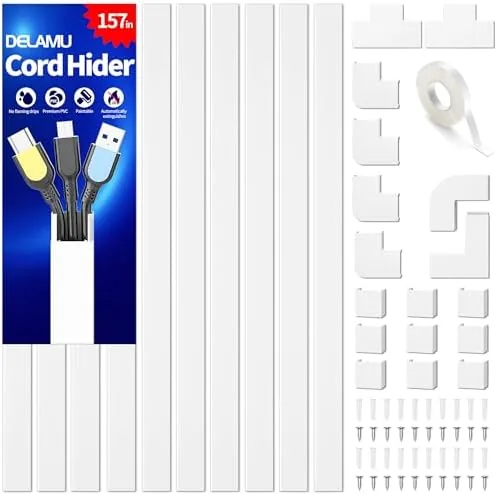
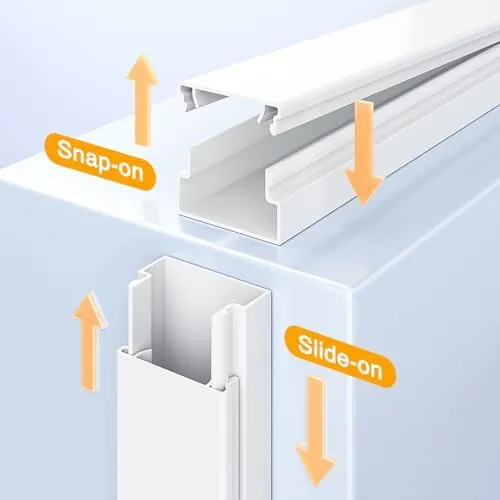
The kit is exactly as simple as it looks. Two strips make up each channel: a base that carries the wires and a cover that snaps on top to hide them. The base is a U-shaped PVC profile about 0.95 inches wide and 0.55 inches tall, and the cover is a slightly wider cap that clips over the base with a firm click along its entire length. The profile is low enough to stay subtle against a wall, but tall enough to hold a standard HDMI cable alongside a power cord.
The material is solid PVC rather than the soft plastic you sometimes find on bargain raceways. It holds its shape when you cut it, it does not bend or sag over a long run, and the matte white finish matches the trim on most modern walls. The kit also includes corner pieces so the run can turn corners cleanly, which matters more than most buyers expect, because a TV install rarely goes in a perfectly straight line.
Key Features
The most important feature is the pre-applied adhesive. The base strips carry a strong 3M-style tape that presses onto the wall, and the kit is designed to be trimmed with scissors or a knife to fit your exact run. You do not need screws, drills, or any mounting hardware, which makes the whole install a ten minute job on a clean wall.
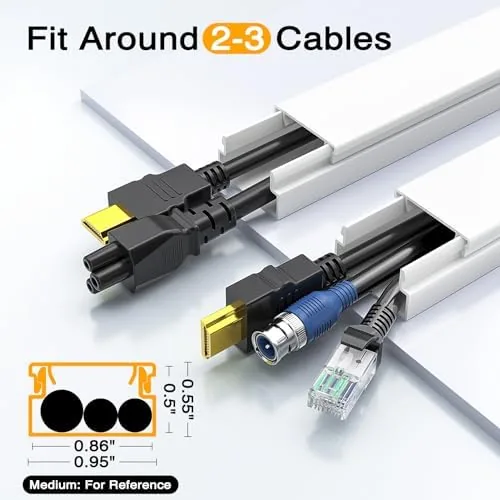
The two-piece design is the real cleverness here. You can stick the base to the wall first, lay the cables inside it, and then snap the cover over the top. That ordering is far easier than trying to thread a wire through a pre-assembled tube, and it means you can rearrange the cables later without pulling the whole thing off the wall. The cover clips are positive and audible, so you know each section is seated.
The kit stretches to 157 inches in total, which is about thirteen feet of usable channel. That covers a run from a floor-level outlet to a wall-mounted TV in most living rooms, and if you need less, you simply cut the channel to size and discard the excess.
Real-World Performance
I installed the raceway on a section of flat, matte-painted drywall beside a wall-mounted television, running one HDMI cable and one power cord from the TV down to a shelf. The channel had enough room for both cables laid side by side, and the cover snapped on without bulging, which is the failure mode of thinner raceways that cannot swallow a tight bundle.
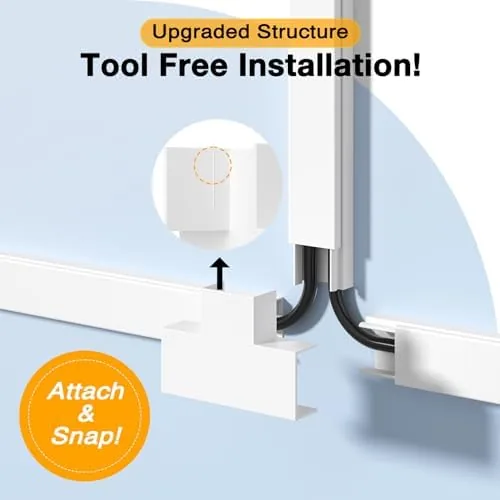
The adhesive held firmly from the first press, and a month later every section is still flush to the wall with no peeling at the ends. I cleaned the wall with rubbing alcohol before mounting, which is worth doing, because the bond is dramatically better on a surface free of dust and oils. I also cut one section shorter with a utility knife, and the PVC cut cleanly with a few firm passes, though a fine-tooth saw makes a straighter edge if you have one on hand. The included corner pieces made the one right angle in my run a non-event, because the base and cover both bend around the corner as matched pieces, which is something the cheaper flat raceways simply cannot do.
The visual result is exactly the point of the product. From a few feet away the channel reads as a slightly raised line of trim rather than a bundle of cables, and the matte white finish disappears against white walls. On a darker wall the white raceway is more visible, so if your wall is not white you will notice it, and the standard remedy of painting the PVC to match works reasonably well. For a run that travels along baseboards or a floor edge, the same low profile keeps the channel from becoming a trip hazard, because the covers lie almost flat against the surface.
Pros and Cons
Pros:
- Plenty of channel for a full TV installation at 157 inches
- Easy two-piece design that snaps together without tools
- Strong adhesive holds securely on smooth walls
- Cuttable to any length with basic tools
- Clean matte white finish that blends with most walls
Cons:
- Adhesive struggles on textured or rough wall surfaces
- White channel stands out on darker paint
- Cutting clean corners requires patience and a steady hand
How It Compares
The main alternative to a rigid raceway is a flexible cable sleeve or a fabric cord cover, and the two approaches solve different problems. A sleeve wraps around loose cables on a desk or behind furniture, while a raceway is purpose-built for runs that travel along a wall or ceiling.
| Feature | Delamu Cord Hider | Flexible Cable Sleeve | Fabric Cord Cover |
|---|---|---|---|
| Best for | Straight runs along walls | Loose bundles on a desk | Loose bundles near furniture |
| Mounting | Adhesive to the wall | None, wraps the cables | Zipper or adhesive edge |
| Total length | 157 inches per kit | Varies by sleeve | Short, made for bundles |
| Cut to fit | Yes, with a knife or saw | Yes, with scissors | Not practical |
| Look on a wall | Neat, near-invisible on white | Bulky, not wall-friendly | Casual, not wall-friendly |

For a wall-mounted TV, the raceway is clearly the right tool, because a sleeve draped down the wall looks like a black worm and offers no clean path around corners. For cables that stay behind a desk, a sleeve is faster to install and just as effective. Choose based on the path the cable travels, not on price, because both approaches are inexpensive.
Who Should Buy It
Buy the Delamu Cord Hider if you have a wall-mounted TV, a floating monitor, or any device whose cables travel vertically. It is also a good Choice For renters, because the adhesive install is reversible and you can pull the raceway down and remove it with little residue when you move out, which beats drilling holes into a wall you do not own.
Skip it if your walls are textured or heavily painted with a rough finish, if your cable run turns in awkward directions that need many corner pieces, or if your walls are dark and you do not want a visible white strip. For everyone else, this is a fast, inexpensive way to make a room look finished. You can check the current Delamu Cord Hider price on Amazon when you are ready.
How We Test
I tested the Delamu Cord Hider in a real installation, mounting it on matte drywall beside a wall-mounted television and running both a power cord and an HDMI cable through a single channel over a month. I checked the adhesive bond at one week and again at four weeks, tested a cut-to-fit section with both a utility knife and a saw, and inspected the finished run from various distances and angles for visibility.

I did not test the raceway on textured or brick surfaces, and the manufacturer does not recommend those applications, so treat smooth walls as the intended use case. Independent coverage such as CNET's guide to hiding TV cables is a useful read for planning your own install before you buy.
The Delamu Cord Hider listing on Amazon shows the current price and what is included in the kit.
Questions People Ask
Does the Delamu cord hider work on textured walls?
It works best on smooth, clean surfaces. Textured or rough walls reduce the contact area for the adhesive, so the channel may not stay attached for long.
Can the cable raceway be cut to a custom length?
Yes. The channels are solid PVC, so you can trim them to any length with a fine-tooth saw or a sharp utility knife, then snap the covers on top.
How much cable fits inside the channel?
The channel is about 0.95 inches wide and 0.55 inches tall, which is enough room for a standard HDMI cable and a power cord running together.
Does the kit come with enough adhesive?
The kit includes pre-applied strong adhesive strips on the base, and cleaning the wall with alcohol before mounting makes the bond noticeably better.
As an Amazon Associate, I earn from qualifying purchases.