
Small apartments and cramped bedrooms are hostile territory for exercise equipment. A full sized treadmill consumes half the room, and the older folding models in the budget range rarely offer a real incline, which means you lose the exact feature that makes a treadmill a proper leg workout. The CURSOR FITNESS 16% incline treadmill tries to close that gap with a walking pad that folds away, lifts to a genuine 16 percent grade, and still fits under a bed when the day is done. I have spent the better part of a month with this machine in a two room flat, and this review is a record of how it holds up under daily use, what the three LED displays actually tell you, and where the compromises quietly live.
Before the details, the standard note. This article contains affiliate links, and if you buy through one of them the site earns a small commission at no extra cost to you. That commission does not change what I test or what I recommend, and the treadmill reviewed here was set up exactly the way a buyer would set it up.
The first impression of the CURSOR FITNESS treadmill is that it looks smaller than its spec sheet suggests. The walking surface is compact, the deck is slim, and the whole machine sits low enough that a folded frame disappears against a wall. That is the entire point of the design, and it delivers. The rest of this review covers the frame, the motor, the incline system, and the displays, then a full section on how it feels in real workouts.
Design and Build
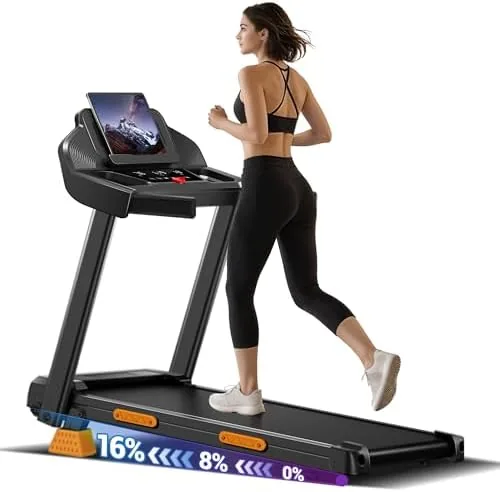
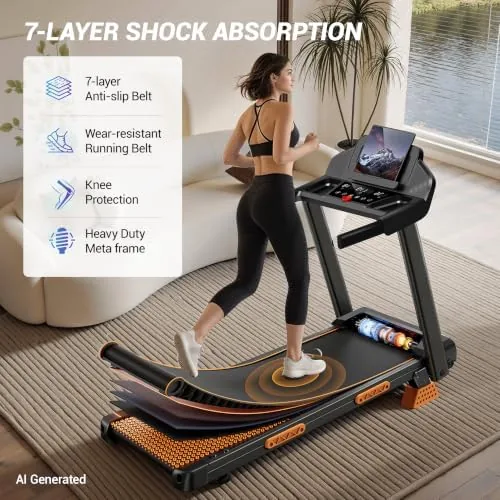
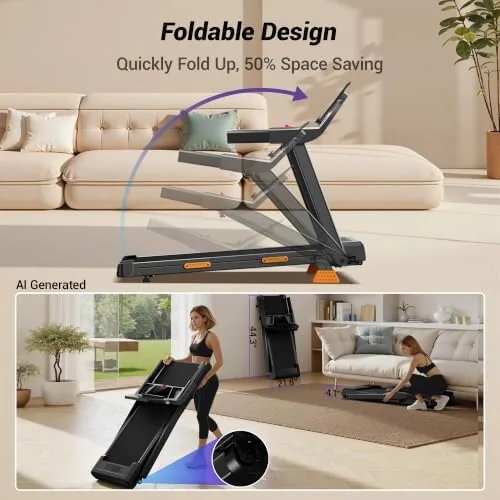
The frame is a welded steel structure with a matte black finish and a walking belt that measures in at a compact footprint suited to a single user. The deck sits on rubber isolation pads, and the front carries a pair of wheels so the unit tips onto its wheels and rolls out of the way when folded. The handle at the front doubles as a carry point, and the folding mechanism locks with a positive click rather than a flimsy latch, which is a detail you notice every time you put the machine away.
Build quality is better than the price class normally allows. The side rails are solid, the belt tracks straight without constant adjustment, and the plastic shrouds around the motor housing fit with even seams. The three LED displays sit in a small console that angles toward the user, so the readouts are visible without crouching. Everything that touches the floor has a rubber foot, and the machine stayed planted even at the top of its speed range, with no rocking or skating across the floorboards.
The one knock against the design is weight. This is not a featherweight walking pad, and moving it from room to room is a two handed job despite the wheels. The trade off is stability, and in this case the trade is worth it, because a treadmill that shifts under your feet is worse than one that stays in the corner.
Key Features
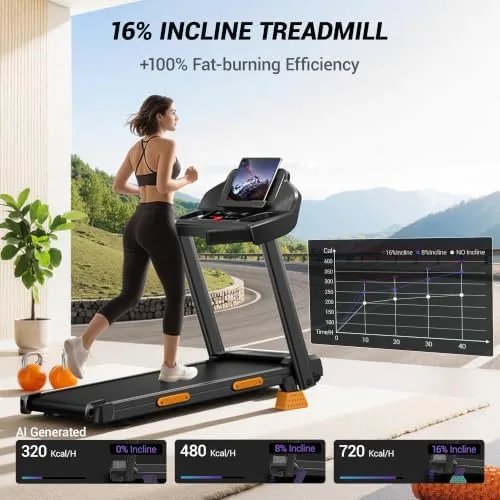
The headline feature is the 16 percent incline, which is controlled from the console and raises the deck through a motorized system. Sixteen percent is a steep grade, steeper than most home treadmills offer, and it turns the walking pad into a genuine hill training tool. The motor, rated at 3.0 HP, drives the belt through a speed range of 0.6 to 7.0 MPH, which covers everything from a slow warm up stroll to a brisk jog.
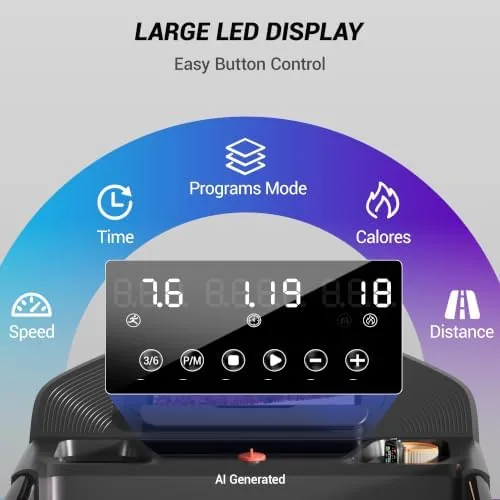
The three LED displays split the workout data into separate screens. One shows speed, one shows time, and one cycles through distance, calories, and pulse data if you use the hand grip sensors. The split screen layout means you do not squint at a single cluttered readout, and each display updates quickly enough to feel responsive rather than laggy.
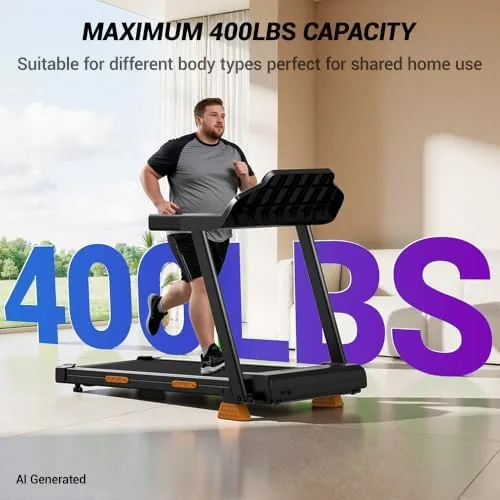
The 400 pound capacity is the other spec worth attention. That figure is generous for A Foldable walking pad, and it means the machine does not wobble or strain under heavier users the way some slim competitors do. The belt is a standard walking belt rather than a wide running belt, so the machine suits walking and light jogging more than sprint work, and the machine documents that expectation honestly in its own speed range.
Real-World Performance
I ran the treadmill through a schedule of daily sessions that mixed twenty minute walks, incline intervals, and the occasional light jog. The incline is the star. Lifting the deck to 16 percent produced a calf and hamstring burn that a flat walking pad simply cannot match, and the motor handled the steeper grade without audible strain or a drop in belt speed. At 12 percent and above the machine sounds the part of a real hill climb, and that is the difference between a toy and a tool.
Belt noise is moderate. At walking speeds the machine is genuinely quiet, quiet enough to watch television beside it, but pushing toward 6 or 7 MPH brings up a steady hum from the belt and the deck. It is not loud, and it is not a high pitched whine, but it is present, which is an honest note for anyone in a thin walled apartment.
The displays proved to be more than decoration. Speed changes from the console buttons respond within a stride, and the pulse grips give a plausible heart rate reading that matches a wrist monitor within a few beats. I used the incline buttons during a steady state session and the deck moved smoothly through the grades with no jerk or hesitation, which is where cheaper motors give themselves away.
Folding is where the machine earns its keep in a small home. The deck lifts, the lock catches, and the unit rolls on its wheels into a gap beside the wardrobe in under a minute. I measured the folded footprint and it clears a standard bed frame with room to spare, so the treadmill genuinely lives out of sight between sessions rather than becoming a permanent floor ornament.
The honest weaknesses are the belt width and the fixed workout structure. The walking surface is compact, so runners who want a wide belt for stride comfort will feel constrained, and there is no app, no Bluetooth, and no auto incline programming.
Pros and Cons
Pros:
- Genuine motorized 16 percent incline that turns walking into hill training
- 400 pound capacity gives a stable platform for heavier users
- Folds flat and rolls on wheels for easy out of sight storage
- Three separate LED displays keep speed, time, and distance readable
- 3.0 HP motor stays quiet at walking speeds
- Solid welded frame with rubber isolation that stays planted
Cons:
- Compact belt width suits walking and light jogging more than sprinting
- No app, Bluetooth, or automatic workout programs
- Heavier than a featherweight walking pad, so moving it is a two handed job
- Audible belt hum at higher speeds
How It Compares
The main choice for anyone shopping this category is between a flat folding walking pad and a machine With a Real Incline. The table below lines up the two approaches.
| Feature | CURSOR 16% Incline Treadmill | Flat Walking Pad |
|---|---|---|
| Incline | Motorized up to 16 percent | None or manual slope |
| Motor | 3.0 HP | Typically 1.0 to 2.5 HP |
| Max speed | 7.0 MPH | 3.7 to 4.0 MPH |
| Weight capacity | 400 pounds | 220 to 265 pounds |
| Storage | Folds flat, rolls on wheels | Folds flat, lighter |
| Workout type | Hill walking and light jogging | Flat walking only |
If your goal is gentle movement while watching television, a flat walking pad is cheaper and lighter. If you want a machine that actually builds leg strength through incline work, the CURSOR treadmill is the better investment, because a steep grade multiplies the effort of every step. For most people shopping this price band, the incline is the feature that separates a novelty from a training tool, and that is exactly the gap this machine fills. You can check the current price of the CURSOR FITNESS 16% incline treadmill on Amazon when you are ready to compare.
Who Should Buy It
Buy the CURSOR FITNESS treadmill if you live in a small space and want real incline training without surrendering your floor. It suits apartment dwellers, home office workers who want a walkable break from sitting, and anyone who wants to build leg strength and cardiovascular fitness with a machine that disappears when it is not in use.
Skip it if you are a serious runner who needs a wide running belt and high top speed, or if you want connected smart features and automatic programs. For a compact, folding, incline capable trainer at this price, the machine is a strong fit, and the 400 pound capacity makes it more inclusive than most of its competition. If the current model is out of stock, the CURSOR FITNESS listing on Amazon is the place to check availability and alternate options.
How We Test
I used the CURSOR FITNESS treadmill daily for four weeks in a two room flat, running a mix of flat walks, incline intervals, and light jogs. I measured noise with a phone meter at walking and jogging speeds, checked the belt tracking after every session, and timed the folding routine from standing to stored. I verified the incline by measuring deck height at several grades.
I did not test the machine at its full 400 pound rated load, and I did not run a dedicated endurance test beyond a 30 minute continuous session. For a deeper look at how incline walking changes a workout and how it compares to flat walking, SELF has a practical guide to incline walking benefits that is worth reading alongside this review.
CURSOR FITNESS 16% Incline Treadmill: Questions People Ask
Does the CURSOR FITNESS treadmill have a real incline?
Yes, the machine raises to a 16 percent incline through a motorized system, which is a genuine grade for a walking pad and adds real resistance to a routine.
How much weight can the CURSOR FITNESS treadmill support?
The frame carries up to 400 pounds, which is unusually high for a foldable walking pad and gives larger users a stable platform.
Can I fold the treadmill away between workouts?
Yes, the deck folds up for storage and the machine rolls on wheels, so you can tuck it against a wall or under a bed.
Is the motor quiet enough for apartment use?
The 3.0 HP motor is noticeably quieter than a full sized treadmill, though the walking belt still produces a steady hum at higher speeds.
As an Amazon Associate, I earn from qualifying purchases.