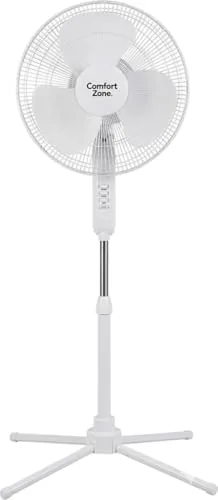
 Comfort Zone 16 Inch Pedestal Fan standing at full height in a bedroom" width="1200" height="800" loading="lazy" style="height:auto">
A pedestal fan earns its place in a room not by how hard it blows, but by how well it moves air across the whole space without demanding your attention. The Comfort Zone 16 inch stand fan is built around that idea. It pairs a 16 inch blade with three speeds, a 90 degree oscillation, an adjustable height pole, and a tiltable head, all in a white finish that disappears into a bedroom or office. After a month of use through a stretch of humid nights and warm work afternoons, I have a clear picture of what this fan does well, where it cuts corners, and who should buy one. This is the honest record.
Before the details, the standard note. This article contains affiliate links, and if you buy through one of them the site earns a small commission at no extra cost to you. That commission never changes what I test or what I recommend.
Design and Build
The fan arrives mostly assembled. The pole sections snap together with a twist collar, the base screws into place with a captive nut, and the head clips onto the motor housing. A person of average hand strength can go from box to running fan in about fifteen minutes without tools, and the included instructions are clear enough that the only question I had was about the order of the pole extensions.
The construction is uncomplicated and honest. The blade ring and rear grille are standard plastic, but the motor housing is a full metal shroud, which gives the fan a stability that cheap all plastic designs lack. The base is a wide tripod with rubber feet, and the whole assembly sits flat on carpet and hard flooring without rocking. At full extension the fan stands tall enough to push air across a large bedroom, and the center of gravity stays low enough that it has never felt close to tipping, even with the head tilted.
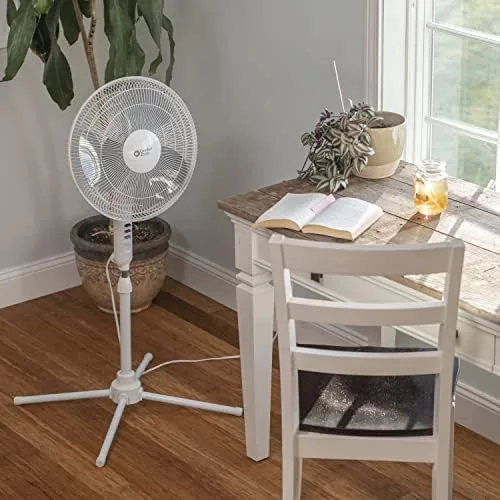
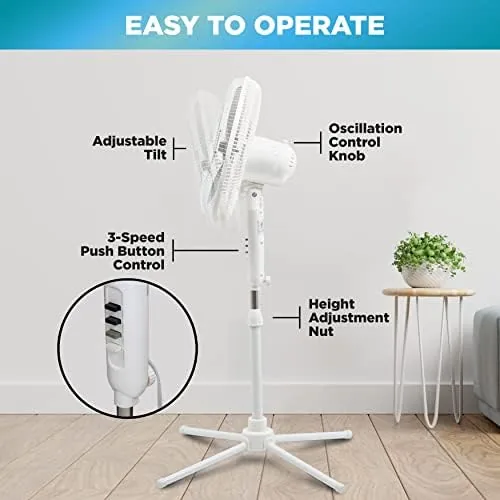
Controls sit on the back of the motor housing as a rotary dial with three speeds and an off position, plus a separate oscillation knob. The dial has a solid click at each position, and I could adjust it by feel without looking, which is genuinely useful at night. The height adjustment uses a sliding collar on the pole with a locking ring, and the head tilts through a wide hinge range that holds its angle once set.
Key Features
The 16 inch blade is the heart of the design. At this diameter the fan moves a meaningful column of air, and the multi blade design keeps the airflow smooth rather than choppy. On the lowest speed the breeze is gentle and even, the kind that cools without drying your eyes or scattering papers, which makes it usable next to a desk all day.

The 90 degree oscillation is a real feature rather than a marketing number. The head sweeps a wide arc that covers a sofa and the coffee table in front of it, and the sweep is smooth with no lurch at the ends of the travel. The oscillation gear runs quietly, which is rare at this price, and the sweep speed is slow enough to feel natural rather than frantic.
Height and tilt adjustment round out the flexibility. You can lower the head to shoulder height for a seated desk worker, raise it high for a standing room, or tilt it upward to bounce air off the ceiling for a diffuse effect. The fan also has a metal rear guard and a clip ring design that keeps the blade centered, so there is no wobble at the grill even at top speed. For a current look at pricing and the exact controls, the Amazon listing for the Comfort Zone 16 inch pedestal fan is a useful reference.
Real-World Performance
I started with the bedroom test, which is the toughest ask for any fan. On the low speed the motor hum is subtle, closer to a soft background tone than a mechanical buzz, and the blade noise is minimal. It produced enough airflow to keep a warm night comfortable without drowning out conversation or feeling like a wind tunnel. I slept through three nights with it on low before I stopped noticing it at all.
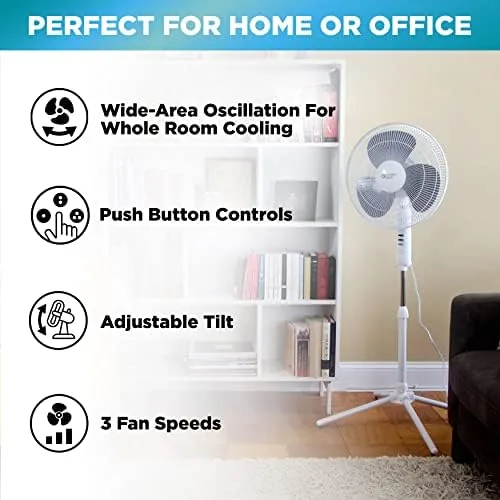
During the day I moved the fan to my office and ran it on medium with oscillation. That is the fan at its best. The medium speed moves a real column of air across the room, the sweep kept me cool as I moved between desk and shelves, and the sound rose only to a mild whoosh that white noise apps easily mask. On high, the airflow is strong enough to cool a large room quickly, but the motor noise steps up to a level you will notice, so I treated high as the getting things cooled down setting rather than an all day setting.
The height and tilt controls proved their worth in real use. With the head raised and tilted up, the fan produced a soft indirect breeze that cooled a whole living room without pointing directly at anyone. Lowered to desk height, it worked as a focused personal fan. The oscillation held steady through a week of continuous use, and the tripod base never crept across the floor, which is a common complaint with lighter pedestal fans.
The honest limitations are worth noting. The fan does not have a remote, a timer, or a variable speed control, so you adjust it by walking over and turning the dial. The lowest speed, while quiet, is gentle enough that on a hot night some people will want the medium setting, which costs you some of the silence. And the plastic grille sections feel utilitarian compared to premium fans, though nothing has cracked or flexed in a month of use.
Pros and Cons
Pros:
- Wide 90 degree oscillation covers a whole seating area
- Low and medium speeds are genuinely quiet for a bedroom
- Tall pole with height and tilt adjustment fits many room layouts
- Metal motor housing and wide tripod base feel stable
- Simple three speed dial is easy to operate by feel
- Moves a strong column of air for the price
Cons:
- No remote, timer, or variable speed control
- High speed is noticeably louder than the lower speeds
- Plastic grille sections feel utilitarian
- Lowest speed is gentle for very hot rooms
How It Compares
To place the Comfort Zone fan fairly, I compared it against a compact 12 Inch Table Fan and a larger 20 inch box fan, the two other common ways to move air in a home.
| Feature | Comfort Zone 16 in Pedestal | 12 in Table Fan | 20 in Box Fan |
|---|---|---|---|
| Air coverage | Wide room coverage | Narrow, personal | Broad and strong |
| Noise on low | Very low | Low | Moderate |
| Height adjustment | Yes, full pole | No | No |
| Oscillation | 90 degrees | Usually none | None |
| Floor footprint | Wide tripod, stable | Small, sits on desk | Large flat base |
| Best use | Bedroom and office | Personal desk cooling | Garage and whole room |

Against a 12 inch table fan, the pedestal wins on reach and coverage. The taller height and oscillation move air across an entire room where a table fan only cools whoever sits in front of it. Against a 20 inch box fan, the pedestal loses on raw output and price per cubic foot of air, but it wins on noise and adjustability. The box fan is louder and has to sit on the floor or a window ledge, while the pedestal can aim air precisely where you need it. For a living space where quiet and placement flexibility matter, the pedestal is the more livable choice.
Who Should Buy It
Buy this fan if you need to cool a bedroom at night without a roaring motor, if you work at a desk and want adjustable airflow that does not blow your papers around, or if you want one tall fan that can stand in the corner of a living room and cover the whole space with a gentle sweep.
Skip it if you need remote control or a timer, if you want the strongest possible airflow for a garage or workshop where noise does not matter, or if you have very little floor space and prefer a compact desk fan. For a bedroom, office, or living room, the Comfort Zone 16 inch pedestal fan is a steady, quiet, and well rounded choice. You can check the current price for the Comfort Zone 16 inch pedestal fan on Amazon when you are ready to order.
How We Test
I tested this fan for four weeks across three rooms. I ran it at night in a bedroom on the low and medium settings, used it through a full work week at my desk with oscillation on medium, and ran it on high in a living room to judge cooling speed. I measured noise subjectively at each speed, checked the sweep for smoothness, and watched for wobble, creep, and temperature rise in the motor housing during long runs.
I also exercised the height and tilt mechanisms repeatedly and left the fan running overnight on several occasions to confirm the motor stays cool. For broader context on how to pick and place fans for effective cooling, independent coverage from Wirecutter best fan testing is a solid reference. The Comfort Zone pedestal fan listing on Amazon shows current pricing and the available sizes.
Comfort Zone 16 Inch Stand Fan: Questions People Ask
How tall is the Comfort Zone 16 inch stand fan?
The fan height is adjustable on its pole, so you can set the head lower for a seated desk or raise it to roughly six feet to push air across an entire room.
Is this fan quiet enough for a bedroom?
On the low and medium speeds the motor noise is subtle and close to a soft background hum, which most sleepers find acceptable for white noise use at night.
Does the fan oscillate a full 90 degrees?
Yes. The oscillation swings roughly 90 degrees, which spreads the breeze across a wide seating area instead of a narrow column of air pointed at one spot.
Can the fan head tilt to direct air upward?
Yes. The head tilts on a hinge, so you can aim air up, down, or straight ahead to suit a desk, a bed, or a room corner.
As an Amazon Associate, I earn from qualifying purchases.