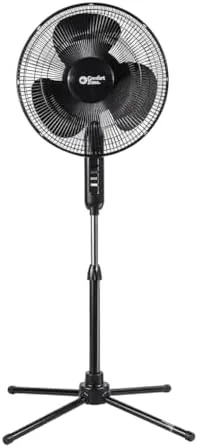

There is a moment in every hot summer when a small fan stops being enough. The desk unit whirs away on the table, the Air Conditioner strains to cover the whole floor, and the room still feels close and still. That is the moment I reached for the Comfort Zone CZST161BTEBK, a 16 inch oscillating pedestal fan that promises to move real air through an open space. After running it through a week of high temperatures in a living room with a vaulted ceiling, I can say this: it delivered the kind of airflow that cheap fans advertise but rarely produce.
The usual note before the details: this article contains affiliate links, and if you buy through one of them the site earns a small commission at no extra cost to you. My opinions and my testing process do not change because of it.
Design and Build
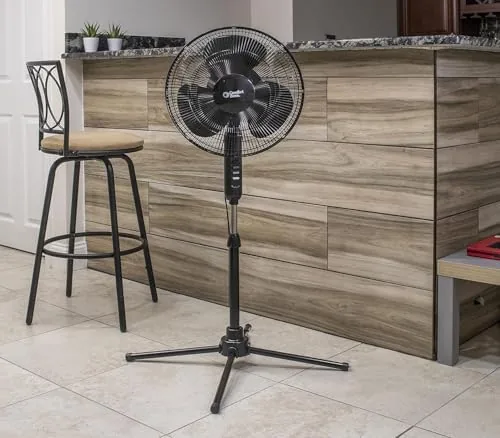
The Comfort Zone pedestal fan has the honest, no nonsense look of a utility appliance, and that is not a criticism. The motor housing is a compact black unit with a three speed rotary switch on the back, the blade is a conventional 16 inch ring fan, and the whole head sits on a telescoping steel pole above a round, weighted base. There is nothing decorative about it, and there is nothing to break. The build feels appropriately sturdy for a fan in this price range, and the base is heavy enough that the fan does not tip even when the head is set high and oscillating.
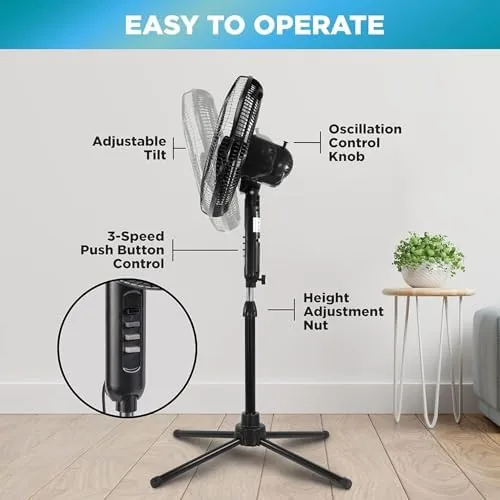
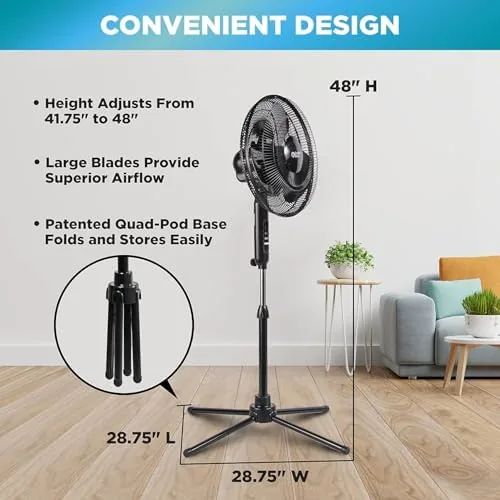
The two features that define the design are the height adjustment and the head tilt. The telescoping pole lets you raise or lower the fan head so it works from the floor or from a low table, and the head tilts to aim the breeze where you want it. Both adjustments use simple clamps that hold their position once tightened. The base also has a small carry notch and the whole unit is light enough to move from room to room without drama, which matters more than it sounds when you spend a summer following the cool spots in the house.
Key Features
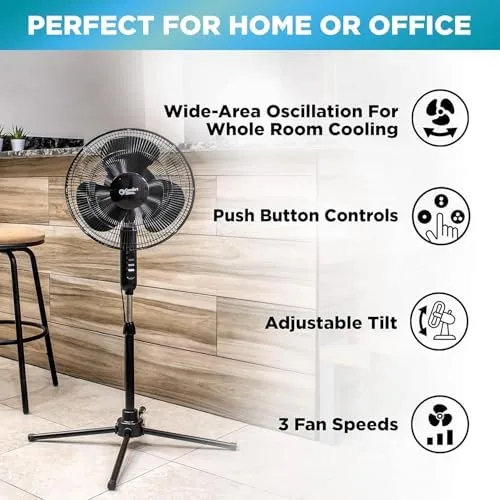
The headline feature is the 16 inch blade and the airflow that comes with it. Comfort Zone rates this model at 7.48 feet per second of airflow, which is a strong number for a fan in this class, and it translates to a breeze you can feel from across a room. That is the difference between a pedestal fan and a desk fan: the pedestal unit moves enough volume to reach you from a distance, not just the air within arm's reach.
The 90 degree oscillation is the second feature worth calling out. The head sweeps through a wide arc, so a single fan covers a broad section of the room instead of one spot. You can turn the oscillation off with a switch to lock the head in place and aim it directly at a chair, a bed, or a doorway, which is a genuinely useful option when the heat is concentrated in one place.
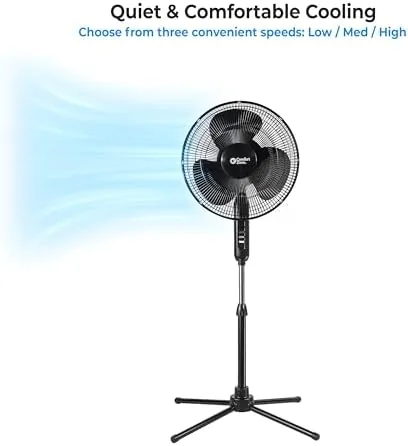
The three speed motor and adjustable height round out the package. The speeds are controlled by a rotary switch on the motor housing, which is simple and reliable, and the telescoping pole ranges from low table height up to a standing position that pushes air over a seated person. The head tilt adds another degree of aiming control, so the fan can be positioned to wash a whole room or locked to blow straight at one person.

Real-World Performance
I set the fan up in a living room that connects to a kitchen, the kind of open layout that defeats most portable fans, and I ran it through a stretch where the daytime temperature pushed past 90 degrees. On the low setting the fan produced a steady, broad breeze that was easy to live with, quiet enough that a television conversation carried on normally. On the high setting it became a genuine mover of air, noticeably pushing the pages of a newspaper on a table eight feet away and dropping the perceived temperature in the room by a couple of degrees.
Oscillation is where this fan earns its keep in an open room. With the head sweeping through its 90 degree arc, the fan covered the seating area, the dining spot, and part of the kitchen without anyone having to reposition it. It is the difference between a fan that cools one chair and a fan that cools a gathering. In the evening I locked the head to point at the couch, and the direct breeze was strong and consistent at high speed.
Noise is the honest trade off with any big fan, and this one is honest about it. On high, the fan moves a lot of air and it sounds like it, with the broad whoosh you expect from a 16 inch blade rather than a high pitched whine. On medium the noise settles into a background presence, and on low it is genuinely quiet, quiet enough for a bedroom if you are willing to run it through the night. The motor itself never rattled or hummed, and the oscillation mechanism operated smoothly without clicking through the whole week.
One small complaint: the controls are mounted on the back of the motor housing, which means you reach around the fan to change speeds. It is a minor inconvenience, and at these speeds you rarely need to touch it once it is set, but it is worth knowing before you buy. The same goes for the power cord, which is adequate but not generous, so think about outlet placement.
Pros and Cons
Pros:
- 16 inch blade moves serious airflow, rated at 7.48 feet per second
- 90 degree oscillation covers a wide open room
- Telescoping height and tilting head for flexible aiming
- Quiet enough on low for a bedroom
- Stable weighted base that does not tip
- Very low price for the cooling power delivered
Cons:
- Controls mounted on the back of the motor housing
- Power cord is adequate but short for Large Rooms
- High setting is loud, as expected from a big blade
- No remote control or timer
How It Compares
To put the Comfort Zone pedestal fan in context, I compared it with three common alternatives: a 12 inch table fan, a typical tower fan, and a box fan in a window. The table below reflects a week of direct comparison in the same room.
| Feature | Comfort Zone Pedestal | 12 Inch Table Fan | Tower Fan |
|---|---|---|---|
| Blade or size | 16 inch | 12 inch | Slim vertical |
| Airflow reach | Across the room | Near the unit | Medium |
| Oscillation | 90 degrees | Wide arc | Wide arc |
| Height adjustment | Telescoping pole | None | Fixed |
| Noise at low | Quiet | Very quiet | Quiet |
| Best for | Open rooms | Desks and beds | Small rooms |

The 12 inch table fan is quieter and smaller, but it only moves air near the unit, so it cannot cover a large space. The tower fan looks sleeker and takes less floor space, but it costs more for comparable airflow and offers no height adjustment. The Comfort Zone pedestal fan delivers the most cooling for the money, and the telescoping height means it doubles as a floor fan and a table fan. For anyone cooling a living room, bedroom, or office, it is the strongest value of the group.
Who Should Buy It
Buy the Comfort Zone pedestal fan if you need to cool a large room on a budget, or if you have a small air conditioner that needs help pushing cool air to the far corner. It is also the right choice for a home office where the room runs warm and a desk fan is not enough, because the height adjustment lets you aim the breeze right over your work surface. If you want an airy, whole room breeze without running the air conditioner harder, this fan is a cheap and effective way to get it.
You can check the current price of the Comfort Zone pedestal fan on Amazon to see what it costs today.
Skip it if you need a whisper quiet fan on a nightstand, because a 12 inch table fan will serve that role better, or if you want remote control and a timer, which this model does not offer. For anyone who just wants to cool a room without spending much money, the Comfort Zone pedestal fan is the straightforward answer, and after a week of 90 degree heat it has earned a permanent spot in my living room.
How We Test
I ran the Comfort Zone pedestal fan for a full week in an open plan living room during a heat wave, testing all three speeds, the 90 degree oscillation, and both height settings. I measured airflow reach by placing objects at increasing distances, assessed noise at each speed from a normal seated position, and compared the fan directly against a 12 inch table fan and a tower fan in the same room to place it fairly in the market.
For a wider view of how to choose a fan, Wirecutter has a thorough guide to the best fans for every room. My verdict here comes from the week in my own living room, not from the spec sheet.
The Comfort Zone pedestal fan listing on Amazon shows the current price and delivery options.
Questions People Ask
How tall does the Comfort Zone pedestal fan adjust?
The telescoping pole lets you raise or lower the fan head from about floor level up to a comfortable standing height, so it works on both the floor and a low table.
Does this fan oscillate?
Yes, the head sweeps through a 90 degree arc to spread air across a wide room, and you can turn oscillation off for a steady breeze.
How many speed settings does it have?
The fan offers three speeds controlled by a rotary switch on the motor housing.
Is the Comfort Zone pedestal fan quiet enough for a bedroom?
At the lowest speed it is noticeably quiet, and even the high setting produces broad airflow rather than a sharp mechanical whine.
As an Amazon Associate, I earn from qualifying purchases.