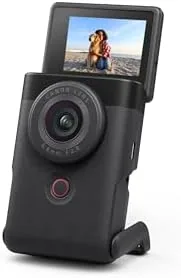

The phone has made most cameras feel redundant, but vlogging is the one place a dedicated camera still earns its space. A phone sits flat against your hand, blocks the view, and needs a tripod and a separate mic before it produces decent talking head video. Canon's answer to that is the PowerShot V10, a compact camera barely bigger than a phone battery bank, built around a 1 inch CMOS sensor, 4K video recording and live streaming, a flip out LCD, and a built in stereo mic. I carried the V10 for two weeks of vlogs, walks, and live streams, and this is the honest account of whether it replaces a phone for creators.
Before the details, the standard note. This article contains affiliate links, and if you buy through one of them the site earns a small commission at no extra cost to you. That commission never changes what I test or what I recommend.
Design and Build
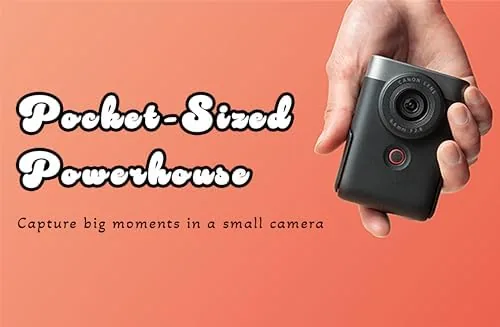
The V10 is a vertical oriented camera designed to be held in one hand, with the lens, screen, and controls arranged so that it sits naturally like a small book. It is small and light enough to drop into a jacket pocket, which is the whole point of the design, and the body has a solid, squared feel with a rubberized grip strip that keeps a secure hold during one handed shooting. The layout puts the record button and shutter where the thumb rests, so you can start a shot without hunting for controls, and the simple menu system is Friendly enough that a first time camera buyer will not need a manual.
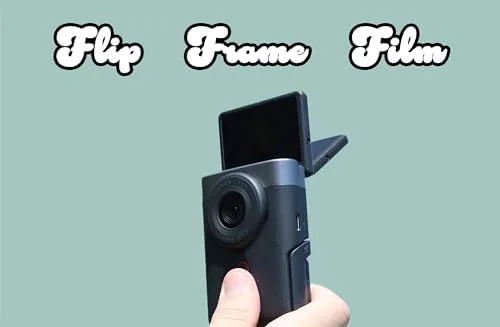
The flip out LCD is the defining physical feature. It rotates out to the side and faces forward so you can see yourself while recording, which is the core requirement of a vlogging camera, and the screen is bright enough to compose shots in daylight. There is no viewfinder, which is expected at this size, and the whole camera runs on a built in battery rather than a removable pack, a trade off worth knowing before you buy.
Key Features
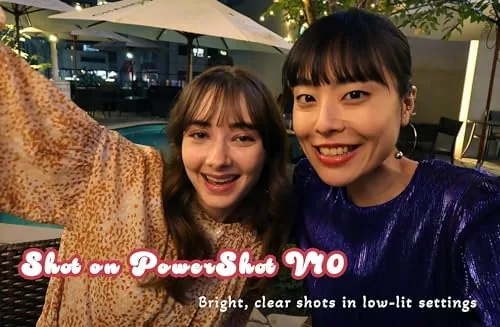
The 1 inch CMOS sensor is the headline, and it is a serious step up from the tiny sensors in most pocket cameras. It captures more light and detail, which shows in cleaner video and better low light performance than the phone it competes against in a creator's pocket. The V10 records 4K video and supports direct live streaming over USB, so a single cable turns the camera into a streaming rig for platforms like YouTube.
The built in wide angle lens covers a flattering field for handheld selfies, and the flip out LCD, built in stereo microphones, and image stabilization round out a package designed specifically for one person creating video alone. The design leans into a vertical friendly layout, but it records both horizontal and vertical formats depending on how you hold and configure it.
Real-World Performance
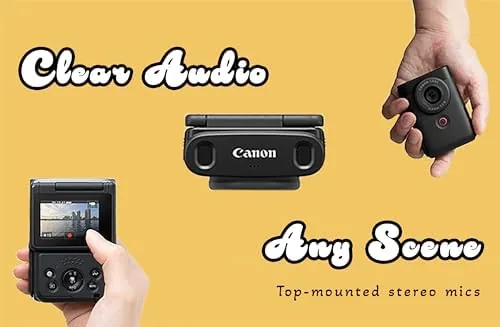
Out of the box, the V10 does the one thing it is built for extremely well: solo talking head video. I recorded daily vlogs with the screen flipped forward, and the camera produced clean, detailed 4K footage with skin tones that looked natural and a stable exposure that handled indoor lighting without constant correction. The built in stereo mics picked up my voice clearly at arm's length, with background noise held in check, though a dedicated mic would still improve sound in windy or loud environments.
The stabilization is decent but not magical. Handheld walking shots came out steady enough for casual vlogs, with far less shakiness than a phone held at arm's length, but fast movement or long strides still introduced visible bounce. For seated or standing talking head work, the stabilization was completely sufficient, which covers the primary use case for most vloggers. The horizontal and vertical formats both rendered correctly, and switching orientation in the menu was quick enough that I did it on the fly between scenes without stopping the flow of a shoot.
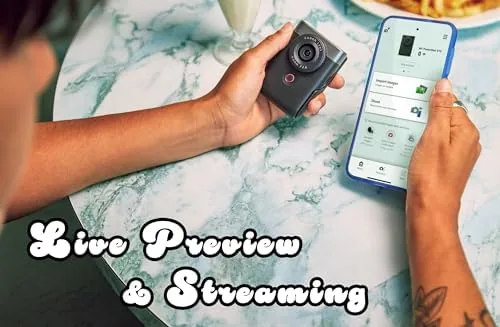
Live streaming worked exactly as advertised. I connected the camera to a laptop with the included USB cable and streamed to YouTube without a capture card, and the setup process was straightforward, with the camera appearing as a webcam class device. The image quality over the stream was a clear step above a laptop webcam, and the flip screen let me frame the shot while talking.
The limits are real and worth stating plainly. Battery life is modest, giving roughly 40 to 60 minutes of continuous recording before the built in cell needs a charge, so long shoots demand a spare or a power source. The fixed wide angle lens means there is no zoom range, and low light performance, while better than a phone, still shows noise in dim rooms. For the current price and bundle options, the Amazon listing for the Canon PowerShot V10 is the place to check.
Pros and Cons
Pros:
- 1 inch sensor produces clean, detailed 4K video
- Flip out LCD makes solo framing effortless
- Built in stereo mics sound clear at arm's length
- Direct live streaming without a capture card
- Genuinely pocket sized and light to carry
- Stabilization steadies handheld talking head shots
Cons:
- Battery life is modest for long sessions
- Fixed wide lens offers no optical zoom
- Low light performance shows noise in dim rooms
- Built in battery cannot be swapped on the go
How It Compares
A vlogging camera competes against two obvious alternatives: a smartphone with accessories and a mirrorless camera. I compared the V10 against both to show where a pocket camera earns its place.
| Feature | Canon PowerShot V10 | Smartphone Setup | Mirrorless Camera |
|---|---|---|---|
| Sensor size | 1 inch | Small, varies | Large APS-C |
| Flip screen | Built in, rotates out | Needs front screen trick | Built in, rotates |
| Microphone | Built in stereo | Needs external mic | Often needs external mic |
| Live streaming | Built in, USB | Native apps | Needs capture card |
| Pocket size | Yes | Yes | No, bag carry |
| Price | Moderate | Depends on phone | High |
Against a smartphone, the V10 wins on the camera experience: the 1 inch sensor, the forward facing flip screen, and the built in stereo mics combine to produce talking head video with less setup and better quality than a bare phone. The phone wins on zoom, app ecosystem, and unlimited battery strategies. Against a mirrorless camera, the V10 wins on portability and simplicity, since you can produce a full vlog with one small device and no accessories, while the mirrorless wins on lens choice, low light, and battery longevity. For a first vlogging camera, the V10 is the balanced pick, because it removes every barrier between an idea and a finished video: no rig, no lenses, no cables, and no learning curve beyond a few menus.
Who Should Buy It
Buy the V10 if you are starting a vlog or streaming channel and want better quality than a phone without learning a full camera system, or if you travel light and want a camera that fits in a pocket. It is ideal for talking head content, daily vlogs, and casual live streaming.
Skip it if you need optical zoom, plan long continuous shoots without a power source, or shoot mostly in very low light. For everyone else, this is a focused and affordable entry into real camera video. Check the current price for the Canon PowerShot V10 on Amazon when you are ready to upgrade your content.
How We Test
I used the PowerShot V10 for two weeks across daily vlogs, handheld walking shots, indoor talking head sessions, and two live streams to YouTube. I judged video detail, exposure, color, and audio at arm's length, and I pushed the stabilization on walking shots to find its limits.
I tested battery endurance through continuous recording until the camera shut off, and I shot a dim indoor scene to assess low light behavior. I did not test the camera with an external microphone or interchangeable lenses, since neither applies to this fixed lens model. For broader perspective on the vlogging camera category, Wirecutter's guide to vlogging cameras is a useful independent reference.
Questions People Ask
Is the Canon PowerShot V10 better than using a phone for vlogging?
For most vloggers, yes. The 1 inch sensor, flip out LCD, and built in stereo mic give a genuine camera look and workflow that a phone does not match without accessories.
Can the V10 stream live video directly?
Yes. The V10 supports direct live streaming over USB to platforms such as YouTube, which makes it a one piece solution for mobile creators.
How is the battery life for vlogging sessions?
Battery life is modest, roughly 40 to 60 minutes of continuous recording, so serious vloggers should carry a spare battery or use a power source for long shoots.
Does the V10 have image stabilization?
Yes. It includes image stabilization that steadies handheld shots noticeably, though walking shots still show more movement than a gimbal or a larger stabilized camera.
As an Amazon Associate, I earn from qualifying purchases.