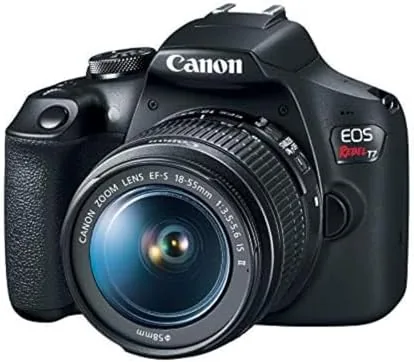

Every photographer remembers the camera that taught them. For a large share of hobbyists that camera is a Canon Rebel, and the EOS Rebel T7 continues the tradition with the same formula that made its ancestors famous: a big APS-C sensor, a familiar body, and a kit lens that covers the basics. The formula has aged, and in 2026 there are mirrorless cameras and smartphones that tempt a new buyer. That is exactly why I spent several weeks shooting with the Rebel T7, because the real question is not whether it is the newest camera, but whether it is still the right camera for someone starting out.
One note before the details. This article contains affiliate links, and if you buy through one of them this site earns a small commission at no extra cost to you. The commission does not change what I test or how I judge it, and every camera I review is treated the way I would treat a purchase made with my own money.
Design and Build
The Rebel T7 looks and feels like a DSLR should. The pentamirror hump, the deep grip, and the button layout are instantly familiar to anyone who has held a Canon camera, and the body is light enough at just over a pound that it does not drag on a strap during a full day out.
The controls are the biggest strength for a beginner. A mode dial on top selects between the automatic scene modes and the creative modes, and a guided menu system explains each setting in plain language when you are unsure. The buttons are large and well spaced, so you can change settings with gloves on in cold weather, a detail photographers notice.
Build quality is typical for the price. The body is mostly polycarbonate over a steel chassis, which keeps weight down, and the grip is deep enough for larger hands. It is not weather sealed, so a drizzle means the rain cover, but that is true of essentially every camera in this class.
Key Features
The 24.1 megapixel APS-C CMOS sensor is the heart of the Rebel T7. APS-C is larger than the sensors in phone cameras, and that size difference delivers better low light performance, more background blur, and a wider usable exposure range. For a beginner the practical result is photos that simply look more like photographs.
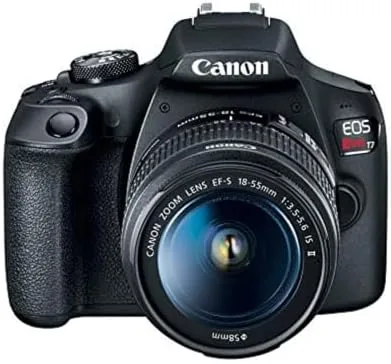
Around the sensor sits a sensible kit. The EF-S 18-55mm f/3.5-5.6 IS II lens covers wide to short telephoto, the range that handles landscapes, group shots, and portraits. The Image Stabilizer makes handheld shots noticeably steadier in dim light. Full HD video records at up to 30 frames per second, and built in Wi-Fi with NFC transfers photos to a phone through the Canon Camera Connect app.
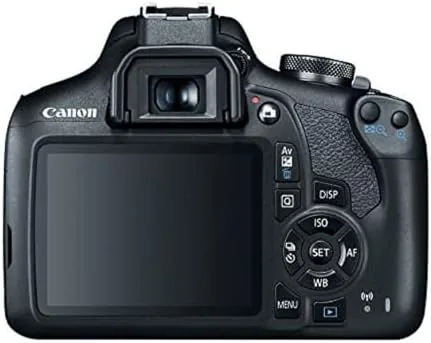
The nine point autofocus system is the feature that shows the camera's age, but it is also more than adequate for what beginners shoot. A center cross type point is accurate in decent light, and for portraits and moving children it keeps up. The optical viewfinder shows a bright, real time view that mirrors nothing but the scene, which is one of the pleasures of a DSLR.
Real-World Performance
I shot the Rebel T7 in daylight, in a dim kitchen, and at an evening event over several weeks. In good light the results are excellent for the price. The 24 megapixel files hold plenty of detail for cropping, and the default color rendering is the warm, natural Canon look that has won the brand so many fans.
Low light is where the Rebel T7 shows its age. The sensor's ISO ceiling of 6400, expandable to 12800, means you start seeing grain well before you would on a newer sensor, and the autofocus hunts more in dim rooms. I set the shutter low, braced against a wall, and got usable shots, but a beginner should expect to add a cheap prime lens or a flash for indoor work. In practical terms, shoot your brightest scenes in the morning and early afternoon, and reserve evenings for outdoor light, where the optical viewfinder still shines.
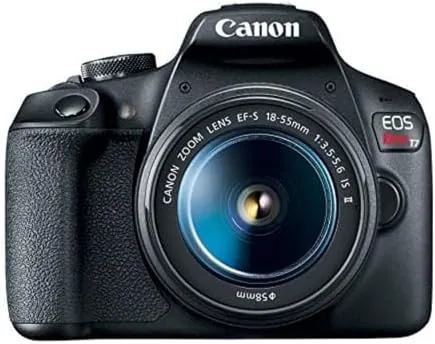
The kit lens is the other compromise. It is sharp in the center when stopped down, but it is not bright, and the slow maximum aperture forces higher ISO indoors. That is the classic trade of a starter kit, and the fix is the thirty five or fifty millimeter prime lens that every Rebel owner eventually buys. On the wide end the lens is fine for groups and landscapes, and the Image Stabilizer quietly earns its keep whenever the light drops below comfortable.
Battery life is a genuine positive. The LP-E10 battery is small, but the optical viewfinder sips power, and Canon's CIPA rating of roughly five hundred shots per charge held up in my testing. I shot a full day at the beach and returned with charge to spare, and even with Wi-Fi transfer and long review sessions the battery never caught me short. Spare batteries are inexpensive and pocket sized, so a backup in the bag removes the only real battery worry you could have.
Pros and Cons
Pros:
- 24.1 megapixel APS-C sensor delivers real image quality
- Optical viewfinder with fast, intuitive controls
- Guided menus make it genuinely beginner friendly
- Excellent battery life for a day of shooting
- Wi-Fi and NFC transfer photos straight to a phone
Cons:
- Aging processor shows in low light noise and autofocus
- Kit lens is slow in dim interiors
- No 4K video and a fixed, low resolution screen
How It Compares
The Rebel T7's real competition in 2026 is a mirrorless camera in the same budget, and the comparison decides whether the DSLR still makes sense.
| Feature | Canon EOS Rebel T7 | Budget Mirrorless Camera |
|---|---|---|
| Sensor | 24.1 MP APS-C CMOS | 20 to 26 MP APS-C |
| Viewfinder | Optical, real time view | Electronic or screen only |
| Autofocus | Nine point, center cross type | Hundreds of phase detect points |
| Video | Full HD at 30 fps | 4K on many models |
| Battery life | About 500 shots per charge | Often 300 to 350 |
| Kit lens | 18-55mm f/3.5-5.6 IS | Compact zoom or kit prime |
The mirrorless camera wins on autofocus speed, video, and portability, but it costs more for the same sensor quality, and its battery life is worse. The Rebel T7 wins on price, battery, and the simple joy of an optical viewfinder. For a beginner on a tight budget who mainly wants stills, the Rebel T7 still has a clear argument. For video or fast action, save longer and go mirrorless.
Who Should Buy
Buy the Rebel T7 if you want to learn photography on a real camera without a mirrorless price tag, if you prefer an optical viewfinder, or if you value long battery life over the newest features. It is a forgiving camera to make mistakes on, and that is what a first DSLR should be.
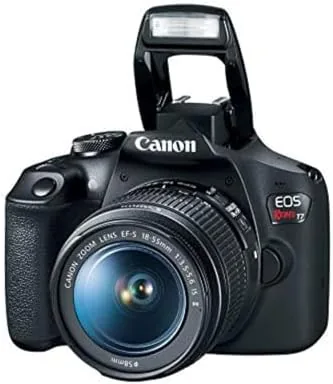
Skip it if 4K video matters, if you shoot a lot in low light, or if you already own a modern phone and only want a casual camera. If you want a dependable classroom to learn in, the Canon EOS Rebel T7 kit on Amazon is worth checking for its current price.
How We Test
I shot the Rebel T7 for several weeks across three lighting conditions: bright daylight, a dim indoor kitchen, and an evening event. I used the kit lens for most shots and added a fifty millimeter prime for comparison. I evaluated autofocus speed and accuracy, image detail, low light noise, battery endurance, and how smoothly the Wi-Fi transfer worked with the app.
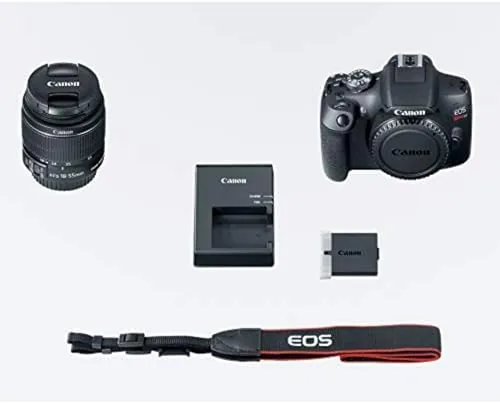
I did not test video beyond confirming the Full HD modes record cleanly, and I did not attempt weather resistance. For an independent long term perspective on entry level cameras, the testing done by Wirecutter is a useful second opinion.
The Canon EOS Rebel T7 listing on Amazon shows the current price for the body and lens kit.
Canon EOS Rebel T7: Questions People Ask
Is the Canon EOS Rebel T7 good for beginners?
Yes, its guided menus, scene intelligent auto mode, and straightforward controls make it one of the most approachable DSLRs you can buy. The automatic modes handle the details while you learn, and the manual modes are there when you want them.
Does the Rebel T7 shoot 4K video?
No, it records Full HD 1080p at 30 frames per second, which is fine for YouTube and family clips, but 4K shooters need a newer model.
How good is the autofocus?
The nine point autofocus system with a center cross type sensor is dependable in decent light and fast enough for portraits and everyday subjects. It hunts more in dim rooms, where a prime lens or flash helps.
Can photos be transferred to a phone?
Yes, the built in Wi-Fi and NFC pair with the Canon Camera Connect app for quick image transfer and remote shooting. The connection is a little slower than the newest cameras, but it works reliably.
As an Amazon Associate, I earn from qualifying purchases.