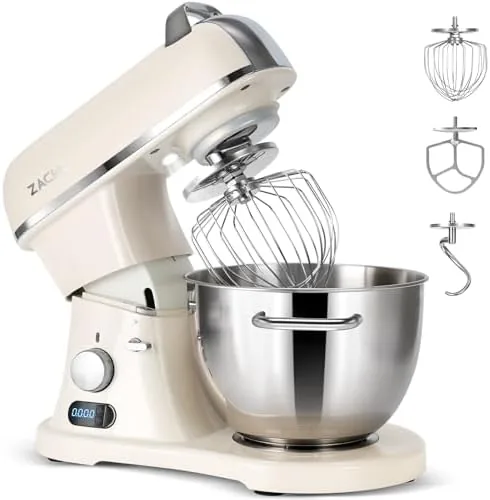

There comes a moment in every ambitious baker's life when a home stand mixer starts to feel like a toy. The dough is stiff, the motor strains, and the bowl that once seemed huge suddenly cannot hold enough for the batches you want to make. The 8.4QT commercial stand mixer is built for that moment. With an 800W motor, an aluminum die cast body, and a stainless steel 8 liter bowl, it skips the household grade and reaches for something closer to a bakery. I ran one through a month of heavy baking to find out whether the power is real and whether a machine this serious still belongs in a home kitchen.
Before the details, the usual note. This article contains affiliate links, and if you buy through one of them the site earns a small commission at no extra cost to you. That commission does not change what I test or what I recommend, and I reviewed this mixer exactly as any cook would, without special treatment from the seller.
Design and Build
The first impression is weight, and that is a good sign. The mixer is built from aluminum die cast, which makes the body heavy, rigid, and completely stable on the counter. There is no plastic flex in the neck, no wobble in the bowl lock, and none of the cheapness that shows up in budget mixers the moment the motor works hard. This is a machine that will sit exactly where you put it and stay there.
The finish is practical rather than pretty. The exterior is a clean commercial grade surface that wipes down easily and does not show fingerprints the way gloss does, and the controls are a straightforward set of speed options that anyone can read at a glance. The stainless steel bowl is the centerpiece, and it is properly large, with the honest capacity to handle double batches and several loaves of bread at once.
The build also signals durability. The mixer is built to the standard of NSF/ANSI 8-2023, a commercial food equipment standard that covers construction and hygiene, and that certification is a meaningful statement about how it is made. You are not buying a mixer that will shrug after a year of Sunday baking; you are buying one that treats a busy kitchen as its natural habitat.
Key Features
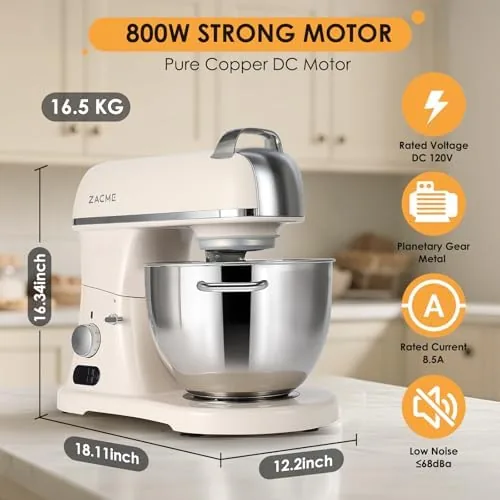
The motor is the headline, and it earns the attention. The 800W unit drives the bowl and the attachments with enough torque to knead stiff dough without the strain that makes smaller mixers walk across the counter or smell hot. The aluminum die cast frame keeps everything rigid under that load, so the machine stays planted and quiet while it works.
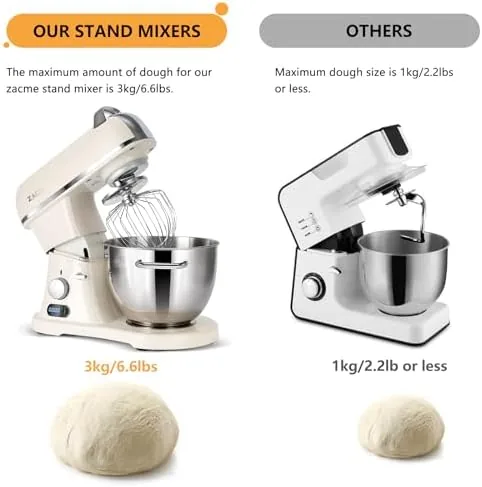
The bowl is the second feature, and it is genuinely large. At 8.4 quarts it holds roughly 8 liters, which transforms what you can make in a single batch. Double batches of cookie dough, three loaves of bread, meringue for a family size dessert, all fit without overflowing. If you bake for a crowd, for a bake sale, or for a small business on the side, the capacity alone justifies the machine.
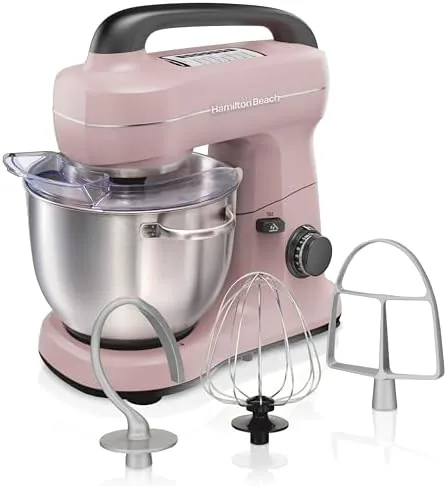
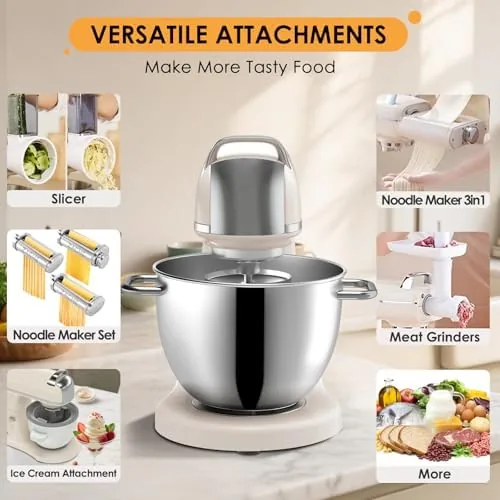
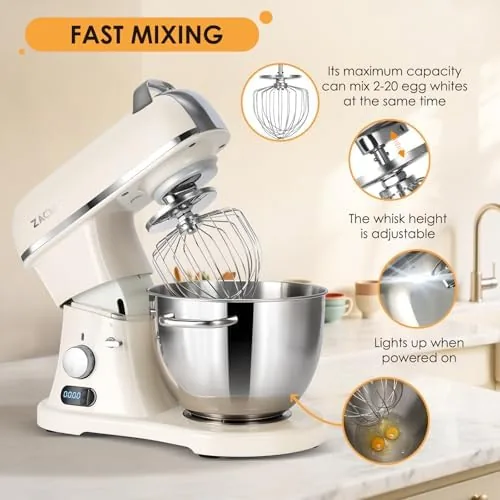
The included attachments cover the fundamentals. A dough hook handles kneading, a whisk whips cream and egg whites to stiff peaks, and a flat beater creams butter and sugar or mixes batters. There is no adapter required for any of them, and each locks into the drive with a firm click. For the occasional use that needs more, the design accepts the standard range of commercial attachments.
Real-World Performance
I put the mixer through the jobs that break lesser machines, and it did not flinch. First came a stiff whole wheat bread dough, the kind that makes a home mixer groan. The 800W motor kneaded it for a full ten minutes without straining, and the aluminum body stayed cool to the touch the whole time. The dough came together smooth and elastic, and the mixer never walked across the counter once.
Whipping was just as strong. I whipped heavy cream to stiff peaks in under three minutes, then did the same with egg whites for a meringue, and both came out perfectly stable. The whisk reaches deep into the large bowl, so there is no pocket of unmixed cream at the bottom, a failure mode that plagues smaller machines with proportionally tall bowls.
Batch capacity changed the way I cooked. I made a double batch of cookie dough that filled the bowl to a comfortable level, and a bread recipe that yielded three loaves from a single run. In each case the mixer handled the volume with room to spare, and the cleanup was simpler than I expected, because the stainless bowl and the attachments wash quickly and the heavy base just wipes clean.
Two honest notes keep this review balanced. The machine is large, and it needs permanent counter space rather than a cabinet you will dig it out of every weekend. And the power has a learning curve, because at higher speeds the 800W motor is genuinely strong, and a careless hand can over whip a batter faster than a smaller mixer would allow. Neither is a flaw so much as a consequence of buying serious equipment.
Pros and Cons
Pros:
- 800W motor handles stiff dough without strain
- Aluminum die cast frame stays rigid and planted
- 8.4 quart bowl fits double batches and multiple loaves
- Built to the standard of NSF/ANSI 8-2023
- Stainless bowl and attachments are easy to clean
Cons:
- Large and heavy, needs permanent counter space
- Power takes a little practice to control
- Overkill for casual bakers with small kitchens
How It Compares
The most useful comparison is against a familiar household mixer and a bigger prosumer option, because most bakers are choosing between those two worlds. The table below keeps the three machines honest on the features that decide the purchase.
| Feature | 8.4QT Commercial | Household 5QT Mixer | Prosumer 7QT Mixer |
|---|---|---|---|
| Motor power | 800W | 275W to 300W | 500W to 600W |
| Bowl capacity | 8.4 quarts | 5 quarts | 7 quarts |
| Construction | Aluminum die cast | Mostly plastic | Die cast metal |
| Heavy dough | Handles with ease | Strains on stiff dough | Handles most doughs |
| Best for | Volume and heavy baking | Everyday small batches | Regular home baking |
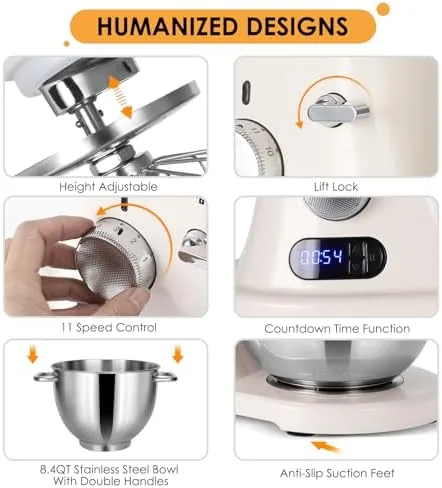
Against a standard household mixer the difference is night and day, because the 800W motor and the metal frame make short work of the dough that stalls a plastic machine. Against a prosumer mixer the gap narrows, and the decision comes down to batch size and price. If you bake for a household, a 7 quart machine may be enough. If you bake for a crowd or a small business, the 8.4QT earns its place.
Who Should Buy It
Buy this mixer if you bake for more than a few people, if you sell baked goods from home, or if you have been fighting the limits of a smaller machine for years. It is also the right pick for a serious bread baker who works with stiff doughs every week and is tired of nursing a struggling motor.
Skip it if you bake occasionally in small batches, if your counter space is tight, or if a compact machine matches the volume you actually produce. For everyone who outgrew their old mixer, this is the upgrade that removes the last excuse. You can check the current 8.4QT stand mixer price on Amazon when you are ready to compare.
How We Test
I tested the mixer over a month of real baking, running it through stiff bread doughs, cookie and cake batters, and a long meringue session to stress the motor and the bowl capacity. I timed each job, checked the motor temperature after long runs, and confirmed the machine stayed planted on the counter at every speed. I also washed the bowl and attachments repeatedly to confirm the cleanup story.
I did not run the mixer continuously for a full commercial shift, and I did not test it against every attachment on the market. For a wider view of how commercial grade mixers perform, coverage such as Serious Eats stand mixer guide is a solid reference, and the 8.4QT stand mixer listing on Amazon shows the current price and the included parts.
Questions People Ask
Can this mixer handle heavy bread dough?
Yes. The 800W motor and the aluminum die cast frame knead stiff dough for long periods without overheating, stalling, or walking across the counter.
How large is the stainless steel bowl?
The 8.4 quart capacity holds roughly 8 liters, which fits double batches of cookies, several loaves of bread, and large meringues in a single run.
Does the mixer meet NSF standards?
The manufacturer states the mixer meets the standard of NSF/ANSI 8-2023, which covers construction and hygiene requirements for commercial food equipment.
What attachments come with the mixer?
It ships with a dough hook, a whisk, and a flat beater, which covers kneading, whipping, and general mixing out of the box, with a standard range of extras available.
The 8.4QT stand mixer listing on Amazon includes the current price and the full accessory list.
As an Amazon Associate, I earn from qualifying purchases.