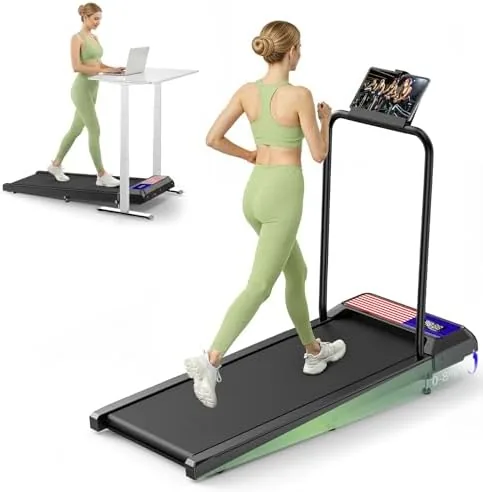

Sitting is the modern workplace problem. Eight hours at a desk, another hour commuting, and a person ends the day with thousands of steps fewer than their body expects. A walking pad is the practical answer for millions of remote and office workers, because it slides under a standing desk and turns slow, steady movement into a daily habit. The walking pad treadmill with handle bar takes the formula one step further with a genuine 8 percent incline, a compact 15 by 35.4 inch belt, a 2.5 HP motor, and a 265 pound capacity, all wrapped in a frame that fits under a desk when the workday is done. I have spent a full working week with this machine beneath a standing desk, and this review is a record of how it walks, how quiet it is, and whether the handle bar earns its place.
Before the details, the standard note. This article contains affiliate links, and if you buy through one of them the site earns a small commission at no extra cost to you. That commission does not change what I test or what I recommend, and the walking pad reviewed here was used exactly the way a buyer would use it.
The first impression of the walking pad is that it is genuinely compact. The deck is slim, the handle bar folds down, and the whole machine fits in the gap under a standard desk without turning your legs into a jumble of cables and steel. The rest of this review covers the build, the belt, the incline system, and then a full section on how the machine behaves during a real working week.
Design and Build
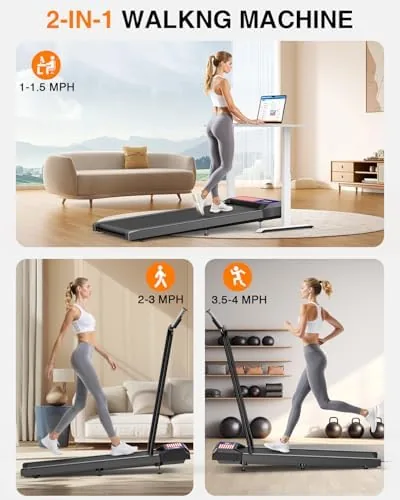
The walking pad is built around a steel frame with a slim profile and a matte finish. The belt measures 15 inches wide by 35.4 inches long, which is a true walking belt rather than a narrow strip, and the deck sits low to the ground so you step onto it comfortably. The handle bar rises from the front of the deck and folds down flat when you want to tuck the machine away, and the frame includes wheels at the front so it tips and rolls like a small hand truck.
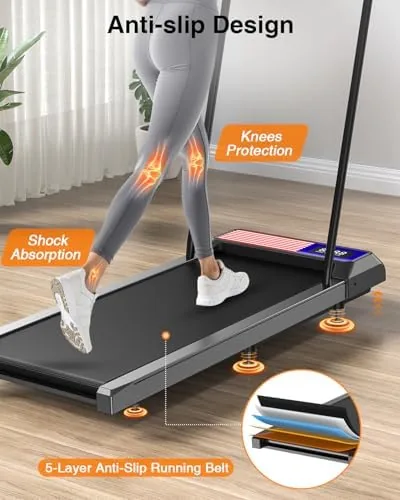
Build quality is solid for the class. The belt tracks straight without drifting, the deck feels stable underfoot, and the rubber feet keep the machine planted on hard floors. The handle bar is the standout addition: it gives you something to grab when you first step on, when you are adjusting your pace, or when you simply want to steady yourself during a meeting, and it makes the machine feel more like a treadmill and less like a conveyor belt.
The control panel sits at the front of the deck and shows speed and distance with a simple set of buttons. It is deliberately basic, with no app and no heart rate grips, and that simplicity is part of the appeal for an office machine. The one design note is that the panel is only easy to reach when the handle bar is up, which is fine for desk use but worth remembering if you plan to run without the handle.
Key Features
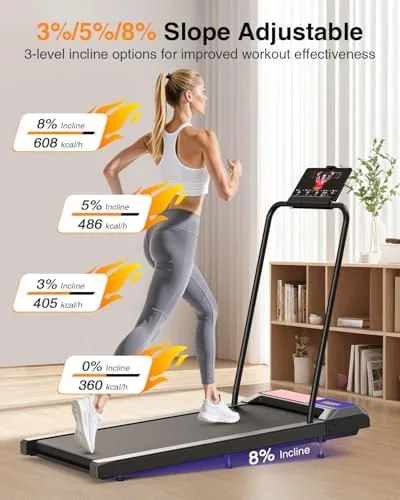
The headline feature is the 8 percent incline. Unlike the motorized inclines on full sized treadmills, this one is set manually by lifting the front of the deck onto a support, which tilts the belt to a fixed 8 percent grade. Eight percent is a meaningful slope, enough to noticeably increase the effort of walking, and the fixed setting suits desk use because there is nothing to fiddle with mid session.
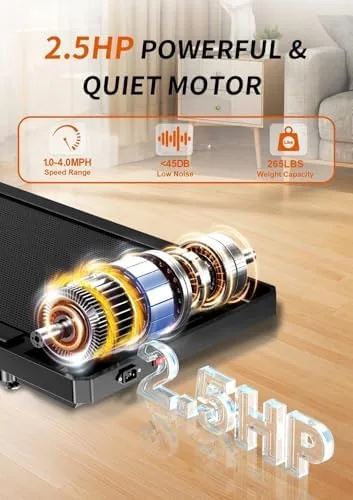
The 2.5 HP motor drives the belt through a speed range of 0.6 to 4.0 MPH. That range is tuned for walking rather than running, which is exactly right for an under desk machine, and the low end of the range is slow enough for a gentle shuffle while you type. The 265 pound capacity covers the vast majority of users, and the 15 inch wide belt gives your stride room to stay natural rather than feeling squeezed.
The portability features complete the package. The handle bar folds flat, the deck is light enough to stand upright against a wall, and the wheels let you roll the machine between rooms. For a home office the machine can live under the desk all day, which is the whole point of the design, and the compact footprint means it does not steal space from the rest of the room.
Real-World Performance
I used the walking pad through a full week of eight hour workdays, walking at between 1.5 and 2.5 MPH for a few hours each day while answering email, joining video calls, and doing focused writing. The machine performed exactly as advertised. The belt moved smoothly at every speed, there was no hesitation when I adjusted the pace, and the deck stayed stable even when I shifted my weight from side to side.
The incline is the feature that justifies the handle bar model. Raising the deck to 8 percent turned my afternoon walk from a gentle warm down into a genuine leg workout, and after a week I could feel the difference in my calves and hamstrings. The manual incline is not as convenient as a motorized version, since you have to stop to change it, but for a fixed desk setup you set it once and leave it, which is all the machine promises.
Noise was the big question for an office machine, and the walking pad answered it well. At walking speeds the 2.5 HP motor is quiet, and the belt produces a soft rolling sound that fades into the background of a typical room. I took a video call while walking at 2 MPH and the other participants could not hear the machine, which is the strongest endorsement a desk treadmill can earn. At the top speed of 4.0 MPH there is more noise, but that speed is the running edge of the machine's range and not where most people will use it.
The honest limitations are speed and belt length. The 4.0 MPH ceiling means this is a walking machine, not a jogging treadmill, and taller walkers with a long stride will feel the 35.4 inch belt length at faster paces. The fixed incline also means you cannot vary the grade mid walk without stopping. None of these are flaws for the machine's stated purpose, but they define who should buy it.
Pros and Cons
Pros:
- Genuine 8 percent incline for a real leg workout
- Quiet 2.5 HP motor that does not disturb video calls
- Compact footprint that fits under a standing desk
- Handle bar adds stability and comfort
- Folds flat and rolls on wheels for easy storage
- 265 pound capacity and a true 15 inch wide belt
Cons:
- Top speed of 4.0 MPH limits the machine to walking
- Incline is manual, so you must stop to change it
- 35.4 inch belt feels short for taller walkers at speed
- No app, heart rate monitoring, or connected features
How It Compares
The main comparison for this walking pad is against a basic flat walking pad without a handle bar, and the differences come down to incline, stability, and price. The table below lines up the two.
| Feature | Walking Pad with Handle Bar | Basic Flat Walking Pad |
|---|---|---|
| Incline | Manual 8 percent | None |
| Handle bar | Yes, folds down | No |
| Speed range | 0.6 to 4.0 MPH | 0.6 to 3.7 MPH |
| Motor | 2.5 HP | 1.0 to 2.5 HP |
| Weight capacity | 265 pounds | 220 to 265 pounds |
| Workout type | Flat and incline walking | Flat walking only |
If you only want gentle movement and the absolute lowest price, a flat walking pad works. If you want an incline for a real workout and the stability of a handle bar, the extra cost of this model is justified, because the incline turns a mindless stroll into something that actually contributes to your fitness. For the desk worker who wants results, not just steps, this machine is the better buy. You can check the current price of the walking pad treadmill with handle bar on Amazon when you are ready.
Who Should Buy It
Buy this walking pad if you work at a standing desk and want to build movement into the workday, if you want an incline for a genuine leg workout, or if you need a machine that disappears when the day is over. It suits remote workers, office employees with sit stand desks, and anyone who wants a gentle but effective way to hit daily step goals.
Skip it if you want to jog or run, if you need a motorized incline you can change mid session, or if you want connected features like app tracking. For a desk worker who wants quiet, effective walking with a real incline, this machine is a strong fit, and you can check the latest price and availability by visiting the walking pad listing on Amazon.
How We Test
I used the walking pad for a full week of eight hour workdays under a standing desk, walking for several hours each day while working. I tested every speed in the 0.6 to 4.0 MPH range, ran a video call while walking to measure noise, checked belt tracking daily, and tested the incline on both flat and sloped settings.
I did not run the machine at its full 265 pound rated load, and my noise observations are based on a typical home office rather than a controlled acoustic test. For a broader look at the benefits and limits of Under Desk Treadmills, Wired has a practical guide to treadmill desks that is a useful companion to this review.
Walking Pad Treadmill with Handle Bar: Questions People Ask
Can I use this treadmill under a standing desk?
Yes, the compact deck and low speed range from 0.6 to 4.0 MPH suit desk walking, and the handle bar lets you steady yourself when you stand up.
How does the 8 percent incline work?
The front of the belt lifts on a hinge to set a fixed 8 percent grade, which increases effort without changing the pace.
Will the motor disturb coworkers or family?
The 2.5 HP motor is quiet at walking speeds and the belt noise is moderate, so it works in a home office without drowning out calls.
Is the belt big enough for a comfortable stride?
The 15 by 35.4 inch belt fits a natural walking stride for most users, though taller walkers will notice the length limit at speed.
As an Amazon Associate, I earn from qualifying purchases.