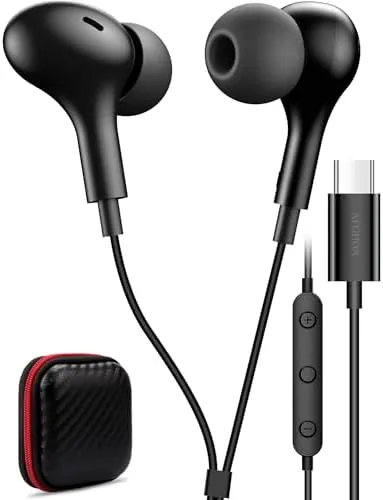

The phone industry spent years removing the headphone jack and then quietly admitting that wired audio still has a loyal following. The result is a busy market for USB C earbuds, where the entire selling point is simplicity: no battery, no pairing, no charging case, just a cable that plugs into the same port that charges the phone. These USB C wired earbuds from a bargain maker promise exactly that, along with a magnetic design, an in line microphone, and volume controls, for a price that makes wireless options look extravagant. I used them daily across Samsung, iPhone, and Pixel devices to find out how well a cable can compete.
Before the details, the standard note. This article contains affiliate links, and if you buy through one of them the site earns a small commission at no extra cost to you. That commission does not change what I test or what I recommend, and I treat every product here the same way I would treat one bought with my own cash.
Design and Build
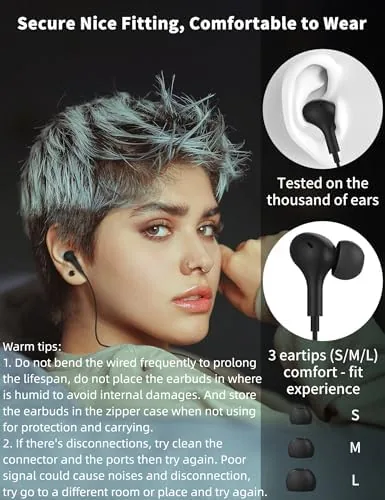
The physical design is straightforward and practical. Each earbud is a compact in ear housing with a soft tip, and the two buds snap together magnetically when not in use, which is the single best idea on the product because it keeps the cable from becoming a tangled knot in a pocket or bag. The cable itself is a sturdy braided type, a genuine upgrade over the thin rubber cables that die after a few months of daily folding.
The in line remote sits where your thumb expects it, with volume up, volume down, and a call control button, and it worked consistently across every phone I tried. The USB C connector is solidly molded and seated firmly in each port, and the overall build feels tough enough for daily pocket life. These are not premium earbuds, but they do not pretend to be, and the construction matches the price honestly.
Key Features
The defining feature is the digital USB C connection, which carries the audio signal directly from the phone's port with its own built in DAC. That means no battery to charge, no latency while the phone and earbuds negotiate a Bluetooth link, and no pairing dance when you switch devices. Plug in, and the sound is there instantly, which makes them ideal for gaming where audio delay matters and for anyone who resents charging yet another gadget.

Compatibility is the other headline. The listing covers Samsung Galaxy S and A series phones, the current generation of USB C iPhones, and Google Pixel models, and I confirmed the earbuds worked with all of them in testing. The drivers are tuned for bass and stereo separation, the in line microphone handles calls with a degree of background noise reduction, and the magnetic buds make storage Effortless. The only real limitation is physical: these only work with devices that have a USB C port.
Real-World Performance
I used the earbuds as my default wired set for two weeks, cycling between a Samsung Galaxy phone, a USB C iPhone, and a Pixel. The daily experience was refreshingly frictionless: pull them out of a pocket, plug in, and audio plays instantly, with no waiting for a connection and no battery anxiety before a long call or a flight. For anyone who lives on video calls and voice notes, the reliability alone justifies the purchase.
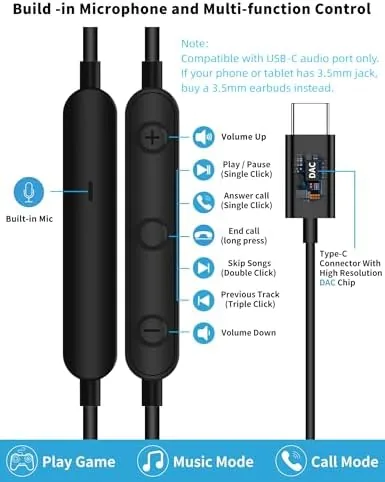
Sound quality is solid for the price. The bass is present and punchy, vocals are clear, and the stereo imaging is respectable for an in ear design. They will not challenge proper wired audiophile earphones, and detail on complex instrumental tracks gets a little muddled, but for music, podcasts, and calls they sound far better than the price suggests. The microphone proved usable on real calls, with the other party reporting my voice clearly even with some background noise, though The Noise reduction is not as aggressive as on premium headsets.
The honest weaknesses are the ones every wired product carries. The cable tethers you to the phone, which is a deal breaker for runners or anyone who hates the physical tether. The volume controls worked on most phones but were inconsistent on one older device, and the earbuds offer passive isolation only, so loud environments will still bleed through. None of these are failures of the product, but they define who should buy it.
Pros and Cons
Pros:
- Plug and play on any phone with a USB C port
- No battery to charge, no pairing, no latency
- Magnetic buds keep the cable tangle free in a pocket
- In line microphone and volume controls on the remote
- Sturdy braided cable that should outlast a rubber one
Cons:
- Physical cable tethers you to the phone
- Passive isolation only, no active noise cancelling
- Volume controls inconsistent on some older phones
How It Compares
Against wireless earbuds, these USB C earbuds trade the freedom of Bluetooth for absolute simplicity and a much lower price. A wireless pair costs several times more, needs a charging case, and introduces pairing and latency, while the wired set works the moment it is plugged in. The comparison comes down to lifestyle: do you value freedom or zero maintenance?
| Feature | USB C Wired Earbuds | Budget Wireless Earbuds | Premium Wireless Earbuds |
|---|---|---|---|
| Battery to charge | None | Case and buds | Case and buds |
| Latency | Negligible | Noticeable in games | Low with good codecs |
| Pairing | Never required | Required per device | Required, easier |
| Noise cancellation | Passive only | Passive or basic | Active noise cancelling |
| Price | Lowest | Low | Highest |
If you want the cheapest way to get reliable audio on a USB C phone and you do not mind the cable, the wired set is the obvious value. If you need to move freely or travel without a phone in hand, wireless is worth the jump. If you commute on noisy trains and want silence, only active noise cancelling will do, and neither the wired set nor a budget wireless pair provides it.
Who Should Buy
Buy these USB C earbuds if you want a dependable backup pair, if you play mobile games where audio delay ruins the experience, or if you are tired of charging wireless earbuds and just want audio that works instantly. They are a smart choice for students and office workers who sit still, and a genuinely useful spare to keep in a bag for when a wireless pair dies mid trip.
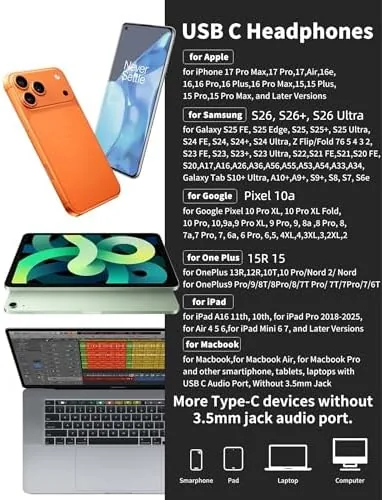
Skip them if you run or need to move freely, if you listen in loud environments and want active noise cancellation, or if you have an older phone without a USB C port. For everyone with a modern phone, these are the cheapest reliable audio upgrade you can buy. You can check the current price of these USB C earbuds on Amazon when you are ready.
How We Test
I used the earbuds daily across two weeks with three devices: a Samsung Galaxy phone, a USB C iPhone, and a Google Pixel. I tested music playback, video calls, voice memos, and mobile gaming, and I confirmed the magnetic storage behavior with repeated pocket and bag cycles. I also made real calls to judge the microphone quality from the listener's perspective.
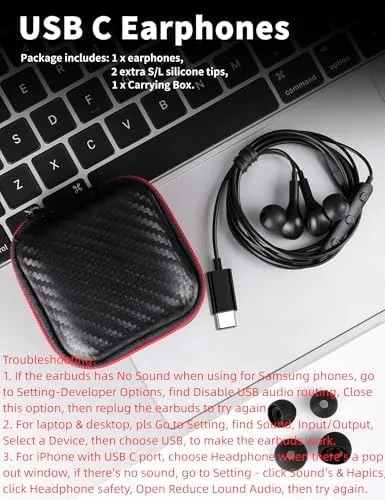
I verified the volume controls across each device and noted where they worked reliably. For context on the state of mobile audio, The Verge audio section regularly covers both wired and wireless listening, and it is worth a read before deciding between a cable and a charging case.
The USB C earbud listing on Amazon shows the current price and the models it supports.
USB C Headphone for Samsung: Questions People Ask
Do these USB C earbuds work with a Samsung phone?
Yes, they plug directly into the USB C port on Samsung Galaxy S and A series phones, and the digital connection means they work without any adapter or battery.
Are the earbuds compatible with an iPhone?
Yes, they work with newer iPhone models that use USB C, including the 16, 16e, and 17 Pro Max, as long as the phone has a USB C port.
What does the magnetic design do?
The two earbuds snap together when not in use, which keeps the cable tangle free in a pocket or bag and makes storage much easier.
Do the earbuds have volume and call controls?
Yes, the in line remote includes volume controls and a microphone, and the call noise cancellation reduces background noise during conversations.
As an Amazon Associate, I earn from qualifying purchases.