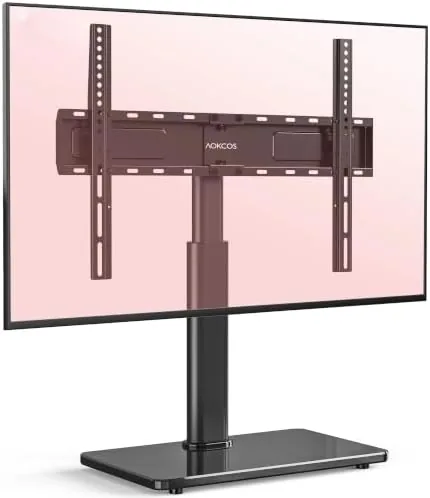

Wall mounting a television is a project. It demands stud finding, leveling, drilling, and usually a second pair of hands, and it commits you to one spot in the room forever. A table top stand sidesteps all of that, and the Swivel universal TV stand for 32 to 75 inch televisions is built around exactly that idea. It uses a heavy tempered glass base, a steel mounting plate, eight height positions, and a tilting and swiveling head to park a television at the right viewing angle without touching a wall. I mounted a 65 inch set on this stand and ran it through several weeks of everyday viewing, and this review records what the stand does well and where it asks for patience.
Before the details, the standard note. This article contains affiliate links, and if you buy through one of them the site earns a small commission at no extra cost to you. That commission never changes what I test or what I recommend.
Design and Build
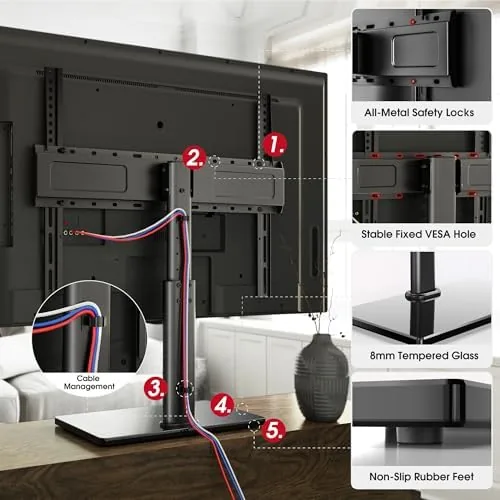
The stand arrives as a flat pack of steel rails, a glass base plate, and hardware, and assembly takes about twenty minutes with the included Allen key. The tempered glass base is the visual anchor. It is wide, clear, and heavy enough to feel planted, and the black steel column and mounting head match the frame of most modern televisions. The whole assembly reads as furniture rather than a temporary gadget, which matters when it sits in a living room rather than a workshop.
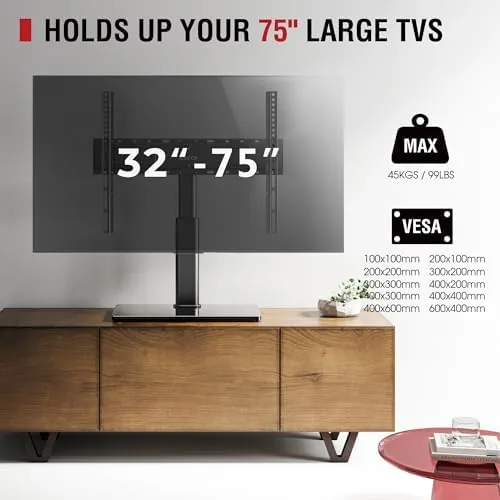
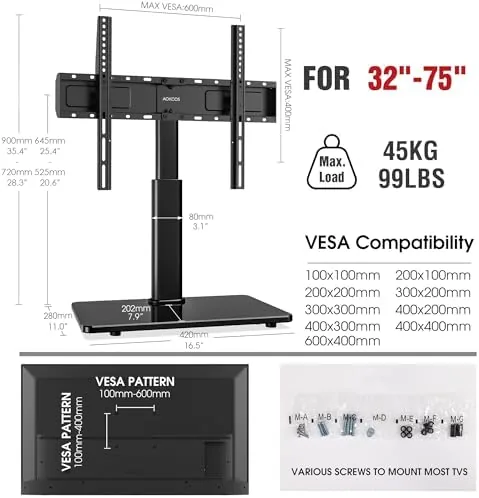
The mounting plate uses two vertical rails that slide against the back of the television, and the four VESA screws hold the plate in place. The design supports VESA patterns up to 600x400 mm and a maximum television weight of 99 pounds, which covers the vast majority of 32 to 75 inch sets on the market today. The rails feel stiff, and there is none of the flex you find on cheaper stands that use thin brackets and plastic spacers.
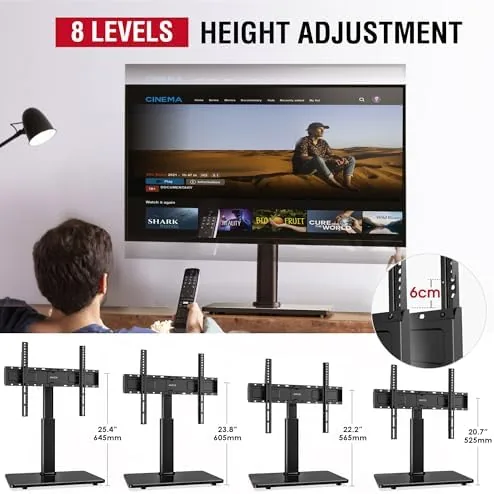
Height adjustment is the headline feature, and it works through eight preset levels on the column. You unbolt the head, move it to the next set of holes, and rebolt it, which is a deliberate process rather than a tool free slide. That is fine for the rare setup change, and it gives you a lot of freedom to set the center of the screen at eye level whether the stand sits on a low media console or a taller cabinet.
Key Features
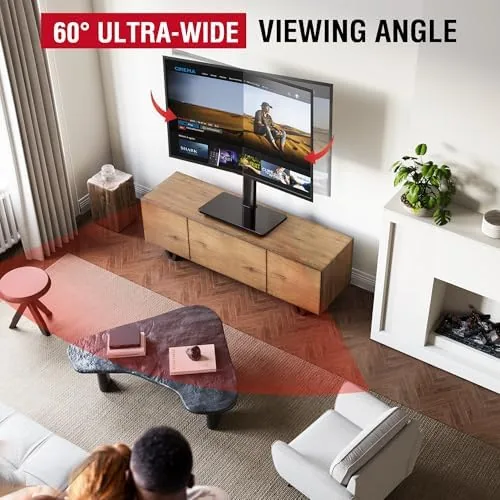
The swivel function is the reason most people buy this stand over a fixed table top mount. The television pivots left and right at the head, which lets you angle the screen toward a couch or dining table without moving the base. The pivot is smooth and holds its position rather than sagging, and the range is generous enough to cover a wide seating area.
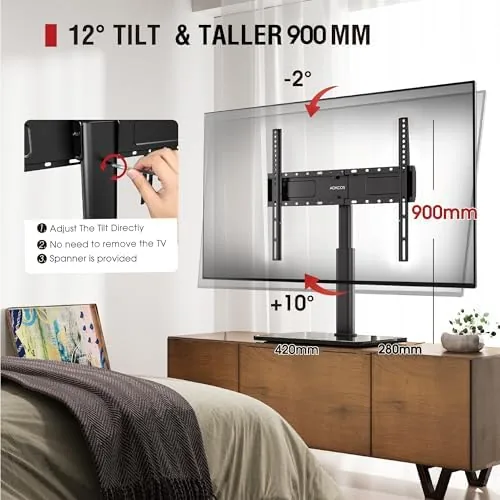
Tilt is the second adjustment, and it moves up and down at the mounting head. Tilt down is useful when the stand sits high, and tilt up helps when you view from a low seat or from a kitchen counter. The tilt mechanism uses friction joints that stay where you set them, and I did not see the screen slowly drop overnight the way some friction mounts do.
The tempered glass base deserves its own mention. Beyond looking clean, it spreads the load of a heavy television across a wide footprint, and small rubber pads on the underside grip the furniture surface so the stand does not slide when you swivel the screen. For the exact dimensions and current pricing on this stand, the Amazon listing for the Swivel universal TV stand is a useful reference.
Real-World Performance
I tested the stand with a 65 inch OLED that weighs around 55 pounds with its original feet removed. The VESA 400x300 pattern on the television lined up cleanly with the 600x400 capacity of the plate, and the four M6 screws seated into the threaded inserts without a struggle. The television lifted onto the head easily with two people, and the stand took the weight without a hint of forward lean.
Everyday stability was the strongest result. I pushed on the top edge of the screen from the side and from the front, and the glass base held the whole assembly steady with no rocking or tipping. The swivel stayed smooth through dozens of rotations, and the tilt held a small downward angle for glare control during afternoon viewing without creeping back to center.
The height range proved genuinely useful. On a low 18 inch media console, I set the column to the middle levels and brought the center of the screen close to seated eye level. A few days later I moved the stand to a taller cabinet for a kitchen viewing angle, and the eight levels gave me enough range to find the right position again without propping anything under the base.
One thing to respect is the weight of the base. The tempered glass plate is substantial, which is what makes the stand stable, but it also means the stand is not a product you move casually every week. Plan the position before you assemble, and the stand will reward that planning. For a breakdown of how this stand compares with other table top options, independent guides such as Wirecutter's comparison of television mounts explain the trade offs between wall mounts and floor stands.
Pros and Cons
Pros:
- No wall mounting, drilling, or permanent installation required
- Fits televisions from 32 to 75 inches with VESA patterns up to 600x400 mm
- Holds up to 99 pounds with a wide tempered glass base for stability
- Eight height levels position the screen at true eye level
- Smooth swivel and tilt adjustments that hold their position
- Straightforward assembly with included hardware
Cons:
- Height changes require unbolting the mounting head
- Heavy glass base is not meant to be moved frequently
- Not suitable for televisions heavier than 99 pounds
- Requires two people for a comfortable installation
How It Compares
Table top television stands split into three rough camps: fixed low stands, motorized and articulated mounts, and manually adjustable models like this one. I compared the Swivel stand against a basic fixed table top stand and a Full Motion wall mount to see where each earns its place.
| Feature | Swivel Table Top Stand | Fixed Table Top Stand | Full Motion Wall Mount |
|---|---|---|---|
| Wall drilling | None | None | Required |
| Swivel range | Wide | None | Very wide |
| Height adjustment | Eight levels | None | Limited |
| Move between rooms | Difficult, heavy base | Easy | Not possible |
| Weight capacity | Up to 99 lbs | Varies | Varies |
| Price | Mid range | Low | Higher |
Against a fixed table top stand, the Swivel model wins on every viewing angle. A fixed stand locks the screen at one height and one facing, while this stand swivels, tilts, and rides through eight height positions. Against a full motion wall mount, the table top stand loses the ability to pull the screen off the wall and the clean floating look, but it wins on ease of installation and on renting situations where drilling is not allowed.
For anyone who rents, lives in a space with no convenient studs, or simply wants the freedom to reposition a screen at eye level, the Swivel stand is the better balance. You can check the current price for the Swivel universal TV stand on Amazon when you are ready to set up.
Who Should Buy It
Buy this stand if you want a large television off the furniture and at eye level without committing to wall mounting, if you rent and cannot drill, or if your viewing position is off to one side and needs the swivel to aim the screen. It is also a strong pick for a bedroom or home office where the television sits on a dresser or desk and the height range matters.
Skip it if you already have a television with a solid factory stand and no viewing angle problems, if your set is a compact model you move between rooms, or if you want the floating look that only a wall mount provides. For everyone else, this is a genuinely stable and versatile piece of furniture grade hardware.
How We Test
I assembled the stand from the flat pack and timed the process, then mounted a 65 inch OLED with a 55 pound weight across two setups. I checked stability by pushing the top of the screen from several directions, verified the swivel and tilt held position after repeated movement, and moved the stand to a taller cabinet to test all eight height levels.
I did not test the stand with a television over 99 pounds, and I did not test it on carpeted surfaces, where the glass base needs the weight of the television to keep it grounded. I verified the VESA claim against common patterns including 400x300, 400x400, and 600x400 mm spacing. The Swivel TV stand listing on Amazon shows the current price and shipping options.
Swivel Universal TV Stand: Questions People Ask
What size televisions does this TV stand support?
It fits televisions from 32 to 75 inches with VESA mounting patterns up to 600x400 mm, and it supports sets weighing up to 99 pounds, which covers most modern panels in that size range.
Does the stand allow tilt and swivel adjustment?
Yes. The mount tilts up and down to control glare and swivels side to side at the head, so you can adjust the viewing angle without moving the glass base.
Does the tempered glass base keep the television stable?
Yes. The heavy tempered glass base gives the stand a wide, planted footprint, and rubber pads on the underside grip the surface so the screen does not slide while you swivel it.
Do I need to wall mount my television with this stand?
No. The stand sits on a table or entertainment center and requires no wall mounting, drilling, or permanent installation, which makes it ideal for rentals and rooms where drilling is not an option.
As an Amazon Associate, I earn from qualifying purchases.