
Before the details, the standard note. This article contains affiliate links, and if you buy through one of them the site earns a small commission at no extra cost to you. That arrangement does not change what I test or how I report it.
Design and Build
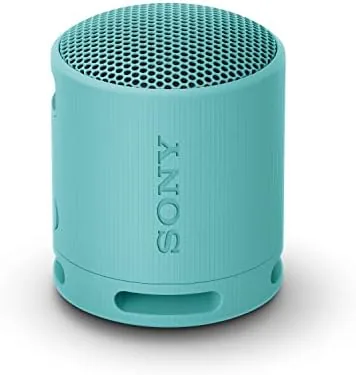
The SRS-XB100 is a small, fabric-wrapped cylinder in a rich blue that manages to be both calming and easy to find. It measures about four inches across and weighs roughly 274 grams, which means it disappears into a tote bag but still feels solid in the hand. A passive radiator sits on top, a rubberized ring protects the base, and a covered USB-C port on the rear keeps charging universal.
The build quality is where Sony shows its experience. The fabric grille is dense and tightly woven, the controls on top are tactile and responsive, and the whole shell feels like it will outlast several generations of phone upgrades. The blue finish does not show scratches easily, and the grille rinses clean after a day outside.
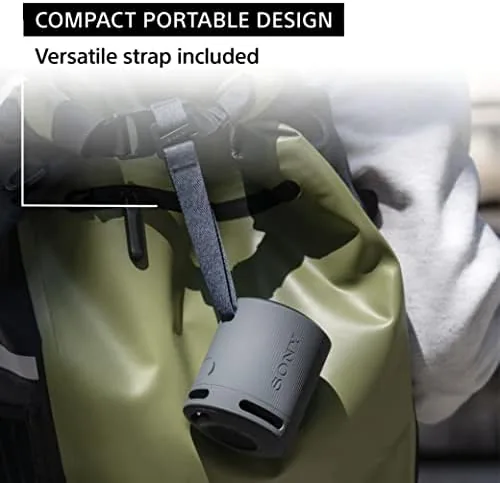
The strap is the detail that changes how you use the speaker. It is a sturdy fabric loop on the side that clips over a backpack handle, a bike bar, a shower hook, or a porch nail. I stopped treating the speaker as a device that needs a flat surface and started treating it as something that could hang wherever I was, which is a bigger lifestyle change than it sounds.
Key Features
The XB100 uses Sony's X-Balanced driver, an elongated diaphragm that moves more air than a round driver of the same diameter. That geometry is the reason a speaker this small produces real bass instead of a thin approximation. A sound diffusion processor spreads the output around the room so the speaker sounds full from any angle, which matters when you hang it on a hook rather than aiming it at a seat.
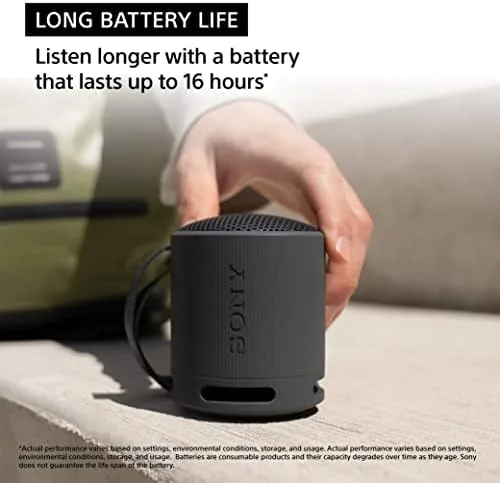
Battery life is rated at up to 16 hours, and the USB-C port supports a fast top up that restores about two hours of playback in ten minutes. For travel that combination is transformative: the speaker survives a weekend away, and a quick charge over breakfast covers a full day of use.
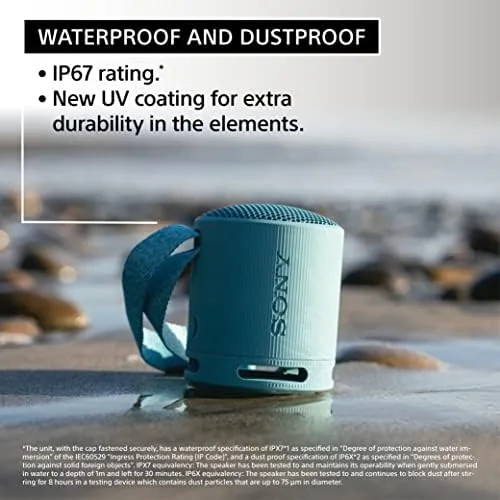
The IP67 rating covers both water and dust. The speaker is fully sealed against dust ingress and can sit in up to one meter of fresh water for 30 minutes, so it is equally at home on a dusty trail and in a steamy shower. Bluetooth multipoint keeps two devices connected, and hands free calling comes through the built in microphone.
Real-World Performance
Inside, the blue XB100 filled my living room with music that had genuine weight behind it. The low end on electronic tracks was far deeper than the speaker's size suggests, and the midrange stayed clear enough for vocals and dialogue. At normal listening volume the sound was full and balanced, and the diffusion processing meant I never had to point the speaker at my seat to hear it properly.

On the road the XB100 proved why the strap and battery matter. I clipped it to my backpack on a day out and played a playlist for hours without once thinking about the charge level. When I stopped at a hotel, the speaker hung from the bathroom towel bar during showers and sat on the desk during work calls, and the hands free microphone handled both sides of those conversations cleanly.
Outdoors the speaker shrugged off conditions that would worry most electronics. It spent an afternoon on a dusty picnic table, got caught in a brief sprinkle, and came back to the car covered in trail dust. Each time I wiped it down or rinsed it, and each time it kept playing exactly as it had before. The IP67 rating is not a label for the spec sheet; it changes where you are willing to take the speaker.
The limits are honest. At maximum volume the speaker compresses rather than fills a large space, so it is not the tool for a crowded backyard party. And the sound is tuned for everyday enjoyment rather than analytical listening, which is exactly what a travel companion should be.
One more detail deserves mention, the battery indicator and the pairing behaviour. When the XB100 reconnects to a device it has seen before, the pairing is instant, and the small LED state changes are easy to read at a glance. That reliability is the sort of thing you only appreciate after a speaker has failed you once, and it is part of why this unit earned a permanent place in my everyday rotation.
Pros and Cons
Pros:
- 16 hour battery that genuinely lasts through multi day trips
- IP67 rating for both water and dust protection
- X-Balanced driver delivers surprising bass depth
- Versatile strap for bags, hooks, and bars
- Light weight at about 274 grams
- Distinct blue finish that is easy to spot
Cons:
- Maximum volume is limited for large outdoor gatherings
- No companion app for custom sound tuning
- Bass heavy tuning favors music over podcasts
How It Compares
The travel speaker market is crowded, so I compared the XB100 against two frequent rivals, the JBL Clip 5 and the Tribit StormBox Micro 2, in the table below.
| Feature | Sony SRS-XB100 | JBL Clip 5 | Tribit StormBox Micro 2 |
|---|---|---|---|
| Battery | 16 hours | 12 hours | 12 hours |
| Water rating | IP67 | IP67 | IP67 |
| Carry method | Strap loop | Built-in clip | Strap loop |
| Weight | 274 g | 239 g | 270 g |
| Multipoint | Yes | No | No |
| Bass emphasis | Strong | Moderate | Strong |
The XB100 leads on battery and multipoint, while the JBL Clip 5 wins on weight and its integrated clip. The Tribit matches the bass emphasis but falls short on runtime. Travel audio guides such as the one from WIRED regularly praise the XB100's combination of durability and sound for exactly this kind of use. You can check the current SRS-XB100 price on Amazon to weigh the options.
Who Should Buy It
Buy the Sony SRS-XB100 if you travel with any regularity and want a speaker That Survives the trip and the weather while sounding far bigger than it is. It suits hikers, cyclists, commuters, and anyone who has tired of speakers that need careful handling. The blue model is easy to spot on a shelf or a trail, and the listing on Amazon shows the full color range.
Skip it if your priority is maximum loudness or deep app control. For the traveler who wants sound, battery, and durability in one small package, this is one of the strongest options available.

How We Test
I used the blue SRS-XB100 as my only speaker for two weeks, moving it between my living room, bathroom, a day hike, and a short hotel stay. I played music and podcasts at volumes from quiet background to maximum, and I drained the battery through several full cycles to compare real runtime with the 16 hour claim. I used the quick charge feature to confirm it restored usable playtime in about ten minutes.
For durability I exposed the speaker to dust, a light sprinkle, and damp surfaces, and I confirmed multipoint pairing worked between my phone and laptop. I also made hands free calls to judge microphone quality. For broader context on portable speaker performance, the roundups from Tom's Hardware are a reliable independent source.
Sony SRS-XB100: Questions People Ask
How long does the Sony SRS-XB100 battery last?
The 16 hour rating held true in my testing, and the USB-C port charges it fully in a couple of hours or gives a quick top up in ten minutes.
Is the SRS-XB100 dustproof?
Yes, the IP67 rating means the speaker is fully sealed against dust as well as water, so it survives the beach, the workshop, and outdoor trips.
Can the SRS-XB100 make hands free calls?
Yes, it has a built in microphone for hands free calls and supports multipoint, so two devices can stay connected at once.
How portable is the SRS-XB100 for travel?
It weighs about 274 grams and has a strap loop, so it hangs from a backpack, clips to a bike, or tucks into a carry on without trouble.
The Sony SRS-XB100 in blue is the speaker I reached for automatically after two weeks, because it was always charged, always where I needed it, and always sounded better than its size promised. It is the rare device that improves your routine by being easy to forget about in the best way. You can find the latest pricing and color options at Amazon.
As an Amazon Associate, I earn from qualifying purchases.