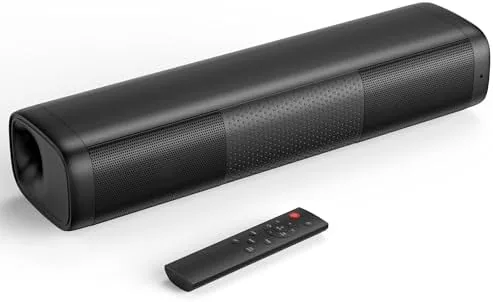

Built in speakers on a budget TV or a laptop are the weakest link in any media setup. They sit at the rear, they face the wall, and they fight for room with a tinny speaker driver that was never given the space to sound good. The fix usually involves a sound bar, but full size bars demand a full size counter, and they look absurd under a 24-inch monitor. The Saiyin 11.7-inch sound bar takes the opposite approach. It is compact enough for a desk or a small TV stand, runs on a proper AC adapter instead of a weak USB port, and packs 48 watts of peak power into a frame under a foot wide. I ran it on a bedroom TV, a desktop PC, and a gaming setup for two weeks, and this is the honest record of its performance.
Before the details, the standard note. This article contains affiliate links, and if you buy through one of them the site earns a small commission at no extra cost to you. That never changes what I test or recommend.
Design and Build
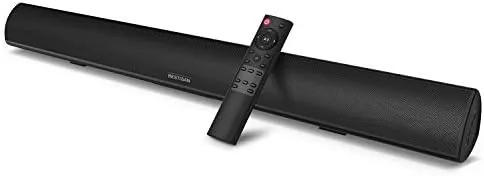
The Saiyin presents as a slim, understated bar with a fabric wrapped front panel and a low profile that does not block the bottom of a TV screen or the front of a monitor. It measures just over 11.7 inches across, which makes it one of the smallest real sound bars on the market, and it feels heavier than its size suggests, a sign that the manufacturer did not cheap out on the enclosure or the drivers inside.
The top edge carries a row of physical buttons for power, volume, source, and play pause, and they click with a firm, tactile response rather than wobbling under a finger. A small LED indicates the active input, with different colors for Bluetooth, optical, and auxiliary. The build is clean and finished, with no sharp seams or flimsy plastic, and the rubber feet grip a desk firmly enough that a vibrating bass note will not walk the bar off its spot.
The back panel houses the connections: an optical input, a 3.5mm auxiliary input, a DC power jack for the included AC adapter, and the pairing button for Bluetooth. There is no HDMI and no subwoofer output, which is a fair trade at this size and price, but it is worth knowing before you buy if you wanted a separate sub. The included remote is small but functional, covering volume, mute, and input switching from across the room.
Key Features
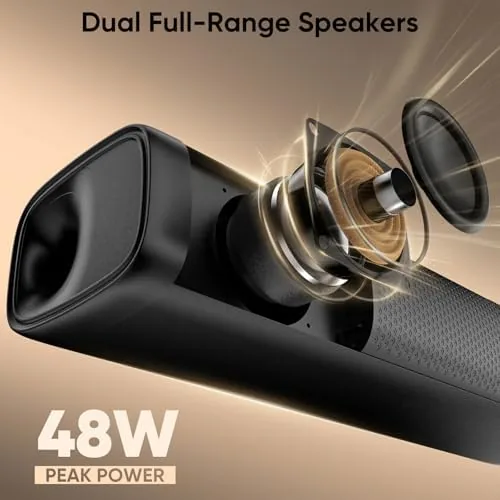
The AC adapter is the feature that quietly matters most. Many compact sound bars draw power from a USB port, which limits output and can cause dropouts when a TV or PC changes its power state. The Saiyin runs on a dedicated wall adapter, so the 48 watts of peak power have a steady supply, and the bar turns on with a real power switch rather than a standby that flaky USB power can confuse.
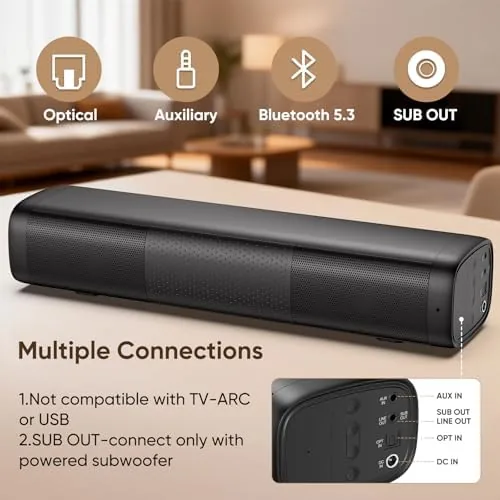
Bluetooth 5.3 is the headline wireless feature. The newer standard brings a stable connection with lower latency than older versions, which matters for video where you notice lip sync problems immediately. Pairing is simple: hold the button, select the bar from your phone or PC, and it remembers the device for next time. The optical input provides a clean digital path for a TV that lacks a headphone jack, and the auxiliary input covers everything from an old laptop to a handheld console.
The compact footprint is the design philosophy in one sentence. A bar this small fits under a monitor, on a shelf, or in front of a small TV without rearranging the room, and it weighs little enough to move between a desk and a living room in seconds. For a current look at the price and the full input list, the Amazon listing for the Saiyin 11.7-inch sound bar is a useful reference.
Real-World Performance
My first test was a week on a bedroom TV. I connected the bar through the optical cable, and the difference from the TV speakers was immediate. Dialogue, which had sounded like it was coming through a telephone, gained clarity and body, and action scenes had enough punch to fill a small room without distortion. At around 60 percent volume the bar was comfortably loud, and at full volume it stayed controlled rather than harsh, which is a common failure point for small drivers.

I moved the bar to a desktop PC next and ran it through the auxiliary input while gaming. The 48 watt output handled game audio cleanly, with footsteps and environmental sounds separated well enough to locate enemies without headphones. The low latency over the wired connection made it the better choice for gaming over Bluetooth, and the compact size meant it did not crowd my mouse pad or push my monitor into an awkward angle.
Bluetooth performance was solid with a phone and a tablet. Streaming music had a clear, pleasant balance with no dropouts at a normal listening distance, and the latency was low enough for watching videos without visible lip sync drift. Bass is the honest limitation: a bar this size cannot produce deep low end, so bass heavy tracks lose their thump and movie explosions lack the chest feel of a dedicated subwoofer. The midrange and treble carry the load well, which is exactly where dialogue and voice live, so the compromise lands in the right place for a compact bar.
The only real complaint was the remote range, which started to miss presses beyond about fifteen feet and at an angle. The physical buttons on the bar work perfectly, so it is a minor issue, but worth noting if you plan to sit far from the unit.
Pros and Cons
Pros:
- Genuinely compact at 11.7 inches for desk or small TV
- 48W peak power from a real AC adapter, not USB
- Bluetooth 5.3 pairs quickly and holds a stable connection
- Optical and auxiliary inputs cover most sources
- Clear dialogue and controlled output at full volume
- Light enough to move between desk and living room
Cons:
- Bass depth is limited by the compact drivers
- No HDMI or subwoofer output for a fuller setup
- Remote range falls off beyond about fifteen feet
- Not a match for a full size bar in a large living room
How It Compares
A compact sound bar competes with three alternatives: built in TV or monitor speakers, a pair of desktop speakers, and a full size sound bar. I compared the Saiyin against all three to see where it earns its place.
| Feature | Saiyin 11.7-Inch Bar | Built-in Speakers | Full Size Sound Bar |
|---|---|---|---|
| Footprint | 11.7 inches wide | None added | 30 to 40 inches wide |
| Peak power | 48 watts | 2 to 10 watts | 100 to 300 watts |
| Bluetooth | Bluetooth 5.3 | Rarely | Varies |
| Inputs | Optical, aux | Internal only | HDMI, optical, aux |
| Dialogue clarity | Good | Weak | Very good |
| Bass | Limited | Minimal | Strong |

Against built in speakers, the Saiyin wins everywhere that matters, with real power, clear dialogue, and wireless convenience. Against desktop speakers, the bar wins on footprint and its TV friendly optical input, while a quality 2.1 speaker pair still wins on stereo separation and bass. Against a full size sound bar, the Saiyin wins on price, footprint, and the flexibility to sit on a desk, while the larger bar wins on raw power, bass, and HDMI connectivity. For a bedroom TV, a monitor desk, or a compact gaming corner, the Saiyin is the most practical choice of the group.
Who Should Buy It
Buy this sound bar if you have a small TV, a desktop PC, or a compact gaming setup with weak built in speakers, and you want a real upgrade without rearranging the room. It is perfect for bedrooms, dorms, small apartments, offices, and anyone who wants to move the same bar between a desk and a TV.

Skip it if you need home theater bass for a large living room, if you want HDMI eARC connectivity for a modern TV, or if you expect a full size bar experience in a compact shell. For everyone else, this is an affordable and genuinely effective compact bar. You can check the current price for the Saiyin sound bar on Amazon when you are ready to give your TV or desk proper audio.
How We Test
I tested this sound bar over two weeks in three setups: a bedroom TV on optical, a desktop PC on auxiliary, and a phone on Bluetooth. I measured output headroom by pushing volume to maximum across different content, checked latency for video sync, and evaluated dialogue clarity and bass response across music, movies, and games.
I ran a full battery of test tracks spanning bass heavy electronic music, acoustic vocals, and movie action scenes, and I compared the bar directly against built in speakers and a desktop speaker pair. I tested the remote from multiple distances and angles to find its range limit. For broader perspective on choosing audio gear for small spaces, an independent guide from CNET on home audio and sound bars explains what to prioritize. The Saiyin sound bar listing on Amazon shows the current price and available options.
Saiyin 11.7-Inch Sound Bar: Questions People Ask
How do I connect this sound bar to my TV?
Use the optical cable for clean digital audio from a modern TV, the auxiliary cable for an older TV or a PC, or Bluetooth 5.3 for a wireless connection from a phone, tablet, or laptop.
Does the Saiyin sound bar need a separate power adapter?
Yes. The unit runs on the included AC adapter, which provides the steady power needed to drive the 48 watt peak output without the limitations of a USB powered bar.
Is 11.7 inches big enough to improve a TV or PC?
Yes. It replaces weak built in speakers with clearer dialogue and louder overall output, which is a genuine upgrade for a bedroom TV, a monitor desk, or a compact gaming corner.
Can I use this sound bar for gaming?
Yes. Connect it to a PC or console through auxiliary or Bluetooth, and it produces clear audio with good positional cues for games, though it does not include a dedicated subwoofer for deep bass.
As an Amazon Associate, I earn from qualifying purchases.