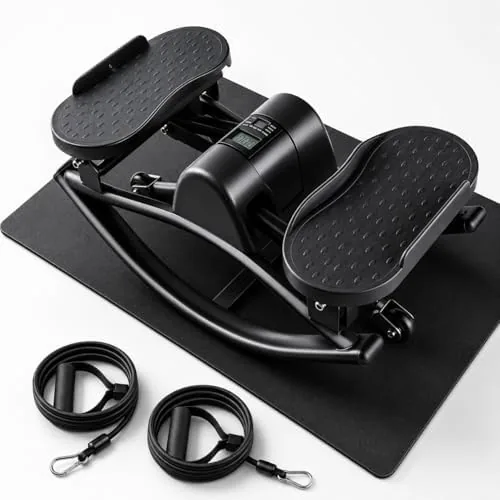

Most home cardio machines force you up and down, and every repetition of that motion lands on the knees, the ankles, and the lower back. The Rock side to side stepper takes a different path: it rocks laterally, sliding your feet side to side on a low platform instead of driving them toward the ceiling. That small change in direction makes the machine noticeably easier on the joints while still raising the heart rate and engaging the legs, the core, and, with the included resistance bands, the arms. I spent three weeks stepping on the Rock stepper most days, tracked my sessions, and pushed it hard enough to find both its strengths and its limits.
Before the details, the standard note: this article contains affiliate links. If you buy through one of them, the site earns a small commission at no extra cost to you, and that commission never changes what I recommend or how I test.
Design and Build
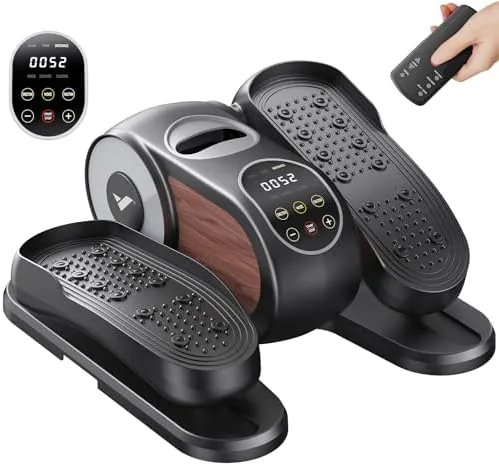
The Rock stepper is a wide, low platform with two independently moving foot pads that rock side to side on a central pivot. Out of the box it feels heavier than its compact footprint suggests, which is a good sign, because the extra mass comes from the steel frame and the wide base that keeps the whole machine planted while you move. The deck sits close to the floor, and the motion is a gentle sideways rock rather than a tall step, so there is very little distance for a foot to fall.
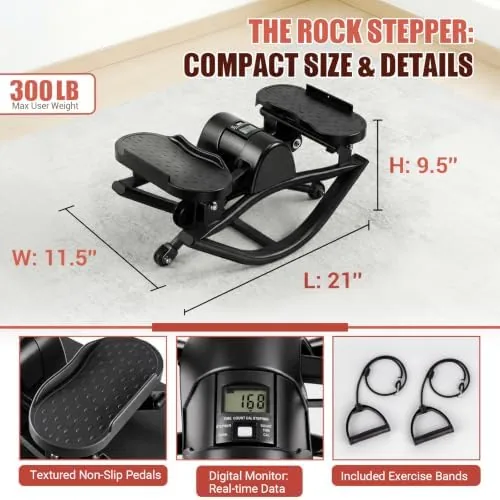
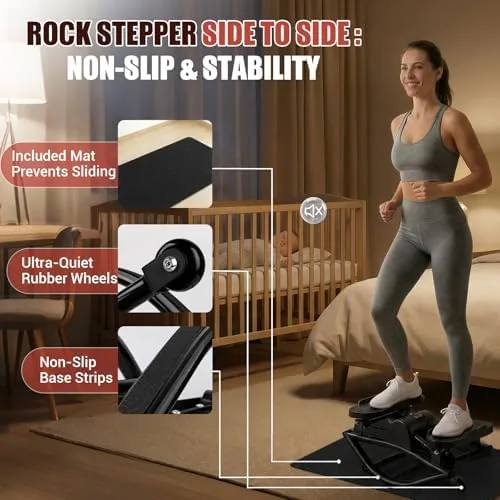
The foot pads carry a textured anti-slip surface that held my sneakers firmly even during a fast rhythm, and the platform edges are rounded so they do not bite into bare feet. A small digital display sits in the center of the frame between the pads, angled so you can read it while standing. Under the platform, two resistance bands anchor on either side, and each band has a handle. The whole unit measures about the size of a large doormat, which means it slides under a couch or into a closet when a session ends.
The finish is a straightforward matte coating that hides scuffs well, and the frame joins are clean with no sharp metal edges. It is not a luxury piece, but it is built with the kind of solidity you expect from equipment rated for a 300 pound user, and nothing in the frame flexed or creaked under weight during my testing.
Key Features
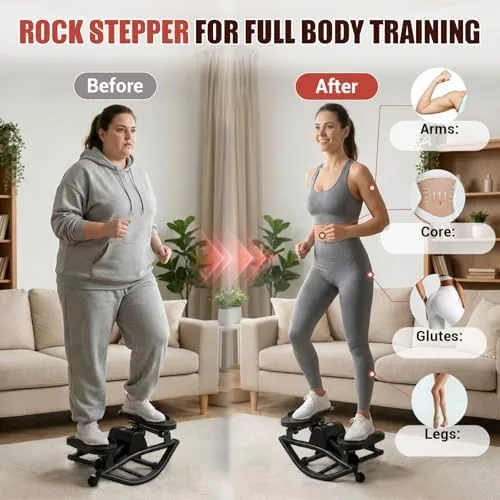
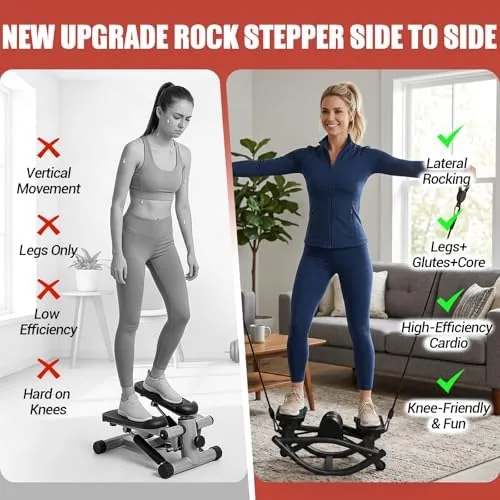
The defining feature is the side to side motion itself. Instead of a vertical step, the pads rock left and right, which shifts the work toward the inner and outer thighs, the glutes, and the hips while keeping the knees tracking in a natural plane. Because your feet stay low, the impact is minimal, and that is the whole appeal for anyone with sensitive joints.
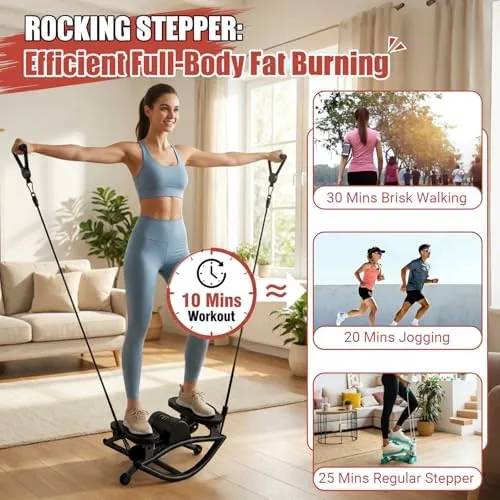
The resistance bands turn what would be a leg machine into a full body one. Attach the bands to the anchors, grab a handle in each hand, and the stepping motion naturally pulls against the bands as your arms move. You can hold the handles at waist height for a low-key addition or drive them overhead for a more demanding session. The bands are the kind of thick latex loops that hold their tension well, and they clip in and out quickly between exercises.
The digital display tracks time, step count, count cycles, and a calorie estimate, and it auto-starts when you begin stepping. The numbers are useful for pacing a session even if they are not laboratory grade. The anti-slip surface, the low deck height, and the 300 pound weight capacity round out the feature set, and together they make the machine approachable for a wide range of body types.
Real-World Performance
I started with fifteen minute sessions and worked up to thirty. The first thing I noticed is that the lateral motion engages different muscles than a treadmill: after a few minutes my outer thighs and glutes were doing real work, while my knees felt none of the jarring they usually absorb from a stair stepper or a jog. The rhythm is easy to find, and within a minute the stepping becomes automatic, which makes it easy to watch television or hold a conversation while you exercise.
Adding the resistance bands changed the character of the workout completely. With the bands attached, each sideways step becomes a pull against tension, and the arms, shoulders, and upper back join the legs. I found the band resistance better than I expected for the price point, and it gave me the option to turn a steady-state cardio session into a strength-flavored circuit. The machine stays quiet during use, with only the soft creak of the pivot and the padding of your feet, so it does not disturb anyone in the next room.
The platform never shifted under me, even at a fast stepping pace, and the low deck height meant there was no strain on my hips from climbing up and down. The digital display tracked my sessions reliably, and the calorie readout trended in the right direction when I compared it to my smartwatch. The one honest limitation is the calorie burn ceiling: this is a steady, low-impact conditioning tool, not a sprinting machine, and someone looking for a brutal interval burner should temper expectations.
Pros and Cons
Pros:
- Low-impact lateral motion is gentle on knees and ankles
- Resistance bands add a genuine upper body component
- Stable 300 pound capacity platform with a wide base
- Quiet enough for an apartment or a shared wall
- Compact footprint that stores flat when not in use
Cons:
- Calorie burn ceiling suits conditioning over intense intervals
- Display is basic and the calorie count is only an estimate
- No handlebars, so balance work falls to the user
How It Compares
Side steppers sit between traditional stair steppers and mini ellipticals, and the differences matter depending on your goals and your knees. I compared the Rock stepper against a standard stair stepper and a compact elliptical to see where each one earns its keep.
| Feature | Rock Side to Side Stepper | Stair Stepper | Compact Elliptical |
|---|---|---|---|
| Motion | Lateral rocking | Vertical stepping | Elliptical stride |
| Joint impact | Very low | Moderate | Low |
| Upper body included | Yes, with bands | Usually no | Yes, with arms |
| Weight capacity | 300 pounds | Varies | Varies |
| Footprint | Very compact | Compact | Larger |
| Best for | Knee-friendly lateral work | Vertical conditioning | Full stride cardio |
Against the stair stepper, the Rock wins clearly on joint comfort, because lateral motion avoids the repeated knee flexion of a vertical step. The stair stepper wins if you want maximum vertical conditioning in a short window. Against the compact elliptical, the Rock offers the same low-impact benefit in a smaller footprint and at a lower price, but the elliptical delivers a longer stride and a more continuous cardio rhythm. For most home users with knee concerns, the lateral stepper is the smarter pick, and you can check the current price of the Rock side to side stepper on Amazon to compare it directly.
Who Should Buy It
Buy this stepper if your knees object to running and stair climbing but you still want real cardiovascular work at home, or if you want a machine that quietly runs a session while you watch television. It is a strong fit for older Exercisers, people recovering from lower-body joint irritation, and anyone who wants a compact addition to a home office or living room. The resistance bands also make it a reasonable choice for anyone who wants upper body work without buying a separate set of equipment.
Skip it if your goal is maximal calorie burn in minimal time, if you need a machine with handlebars for balance support, or if you prefer the continuous glide of an elliptical. It is a conditioning tool, not a sprint machine, and it delivers exactly that without pretending to be more.
How We Test
I used the Rock stepper five days a week for three weeks, running sessions between fifteen and thirty minutes at a steady rhythm. I tested it with the resistance bands at waist height, at chest height, and in an overhead press position, and I compared the motion against a stair stepper and a mini elliptical across the same weeks. I tracked the display against a smartwatch to sanity check the pace and calorie figures, and I measured the platform for stability at fast stepping speeds.
I did not test it for heavy sprint-style use or for long-duration standing sessions beyond thirty minutes, and I did not place it on plush carpet, where a low deck can compress the padding. Independent guidance such as Healthline's guide to stepper benefits is a useful companion when deciding whether a low-impact machine fits your plan. The Amazon listing for the Rock side to side stepper has the latest pricing and shipping details.
Rock Side to Side Stepper: Questions People Ask
Can the Rock side stepper give a full body workout?
Yes. The stepping motion works the legs and the core while the resistance bands add upper body work, turning a single machine into a full body session when you use both together.
Is a side stepping machine safe for bad knees?
The low-impact lateral motion is gentler than jogging or step-ups, because the knees stay low and track in a natural plane. Still, anyone with existing knee pain should check with a doctor before starting a new routine.
What does the digital display track?
The display shows time, step count, count cycles, and an estimate of calories. It is enough to keep a session honest without wearing a separate tracker, though the calorie figure is an estimate rather than a precise measurement.
How much weight can the Rock stepper hold?
The frame is rated to 300 pounds, and the platform stayed stable across that range during my testing, with no flex or shifting even at a fast pace.
As an Amazon Associate, I earn from qualifying purchases.