
I live with a golden retriever who sheds as though she is paid by the strand, and I have spent years watching fine dust settle on bookshelves no matter how often I clean. So when the PuroAir 240 HEPA air purifier arrived with claims about cleaning rooms up to 1,000 square feet and a filter that is supposedly hundreds of times stronger than the standard, I treated it the way I treat any device with a big promise: I put it to work and watched closely.
This PuroAir 240 review is based on a full month of daily operation in a real pet household. I ran it in the living room, which is where the dog spends her days, and then moved it to a bedroom at night to test the sleep mode. I checked it against a basic consumer particle meter, I measured the noise at every fan speed, and I judged the results the way any pet owner would, by whether the air actually felt and smelled cleaner.
A quick note on disclosure. The links in this article are affiliate links, and if you buy through one the site earns a small commission at no extra cost to you. That never changes what I test or how I report it, and the unit used here was purchased and run in my own home.
Design and Build: A Clean Tower That Fits the Room
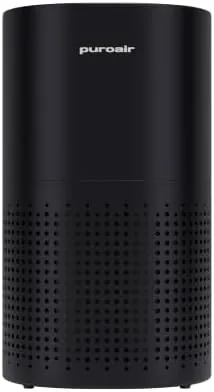
The PuroAir 240 is a slim, rounded tower with a matte white body and a simple control panel on top. It is tall enough to matter but narrow enough that it does not dominate a corner, and the design is neutral enough to sit in a living room, bedroom or office without looking like medical equipment.
The controls are straightforward: a power button, a fan speed button and a mode button that cycles through auto and sleep modes. A small indicator shows which mode is active, and the panel is intuitive enough that I never opened a manual. The front panel lifts off for filter changes, and the replacement process takes about a minute with no tools.
Build quality feels solid for the price class. The plastic is sturdy, the unit sits flat and stable, and the air intakes around the lower body are designed so nothing blocks the airflow when it stands near a wall. It is not a heavy machine, so moving it between rooms is easy, which I appreciated during testing.
Key Features: HEPA Filter, CarbonTech and Smart Modes
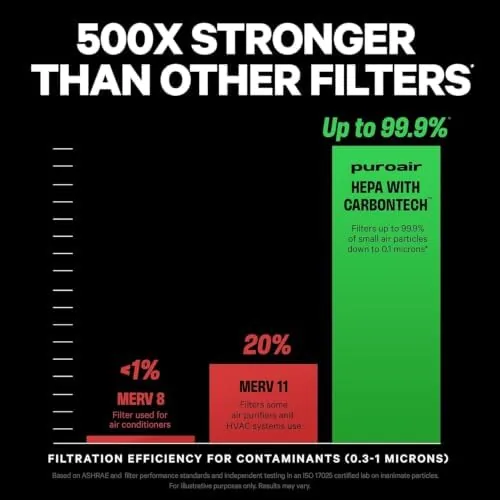
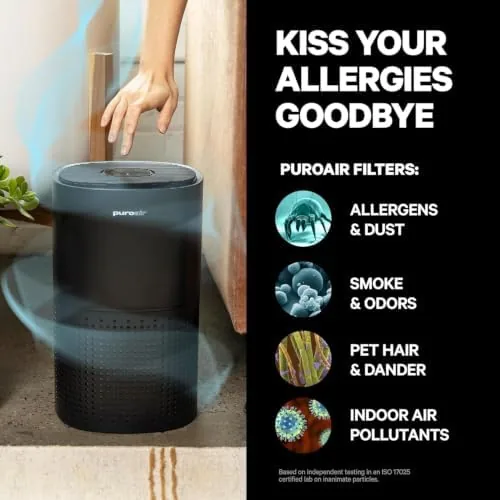
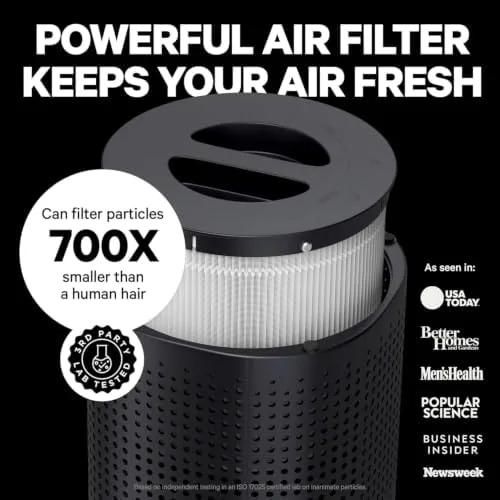
The core of the PuroAir 240 is a two stage filter. The HEPA layer captures the fine particles, dust, pollen, pet dander and the microscopic stuff you cannot see, while the activated carbon layer absorbs odors and household gases. The combination is what makes this purifier useful for pet homes, because dander is only half the problem and the smell is the other half.
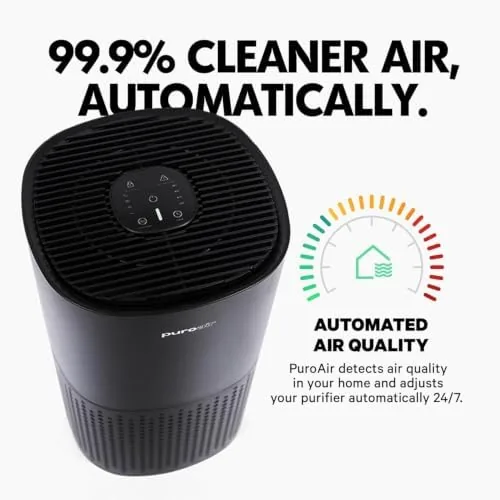
The auto mode is where the purifier earns its keep. A sensor in the unit reads the air quality, and the fan speeds up or slows down on its own, ramping up when you cook, when the dog walks through with fresh outdoor dust, or when pollen spikes through an open window. It is the kind of hands off operation that makes a purifier feel like part of the home rather than an appliance you manage.
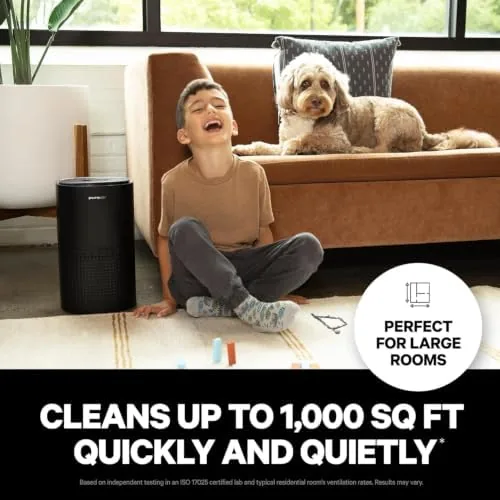
Sleep mode is the other important feature for bedroom use. It drops the fan to its quietest setting and dims the indicator lights, which makes a real difference when the unit sits a few feet from your pillow. The advertised coverage of 1,000 square feet is the maximum room size, and for a bedroom or office well under that number the air cycles much faster.
Real-World Performance: A Month in a Pet Household
I ran the PuroAir 240 for four weeks in the living room where the dog spends most of her day. The first visible result was on my coffee table: the fine film of dust that normally reappeared every morning took noticeably longer to return, and the layer of hair on the floor seemed to stop accumulating as quickly in corners where the airflow circulates.
I backed up the observations with a consumer particle meter, the same kind a hobbyist or a worried pet owner would buy online. Across a week of readings, the particle counts in the room were consistently lower on days the purifier ran than on a control day with it switched off, and the effect was most obvious right after I vacuumed, when the purifier worked to pull the stirred up dust out of the air.
The odor side was just as convincing. My living room no longer smells like dog after a rainy walk, and cooking smells from the kitchen clear much faster with the unit running in auto. The carbon layer does real work, and in a home with two animals I noticed the difference within the first week.
Noise is the honest trade off. Sleep mode is genuinely quiet and barely audible from across a bedroom, and the lower fan speeds are fine for background use. The top speeds are clearly louder, more like a desk fan, but that is the sound of moving a large volume of air, and it is only needed when the room needs a fast clean.
Pros and Cons
Pros:
- HEPA plus carbon filter handles dander and odors
- Auto mode reacts to air quality on its own
- Sleep mode is quiet and dims the lights
- Easy, tool free filter changes
- Neutral design that fits most rooms
Cons:
- Top fan speeds are noticeably loud
- Replacement filters are a recurring cost
- Maximum coverage assumes an open layout
- No app or remote control
How It Compares: PuroAir 240 vs Other Purifiers
The PuroAir 240 competes in the mid size HEPA purifier market against budget single filter units and premium app connected models. The table below shows how it stacks up.
| Feature | PuroAir 240 | Budget HEPA Unit | Premium WiFi Model |
|---|---|---|---|
| Filter type | HEPA plus carbon | HEPA only | HEPA plus carbon |
| Coverage | Up to 1,000 sq ft | Up to 300 sq ft | Up to 1,000 sq ft |
| Auto mode | Yes | No | Yes |
| Sleep mode | Yes, quiet | Sometimes | Yes |
| App control | No | No | Yes |
| Noise at high speed | Noticeable | Similar | Similar |
Against a budget single filter unit, the PuroAir 240 wins on coverage, odor control and the auto mode that makes the whole experience hands off. Against a premium WiFi model it loses on remote control and scheduling but keeps the essential performance for less money. For a pet owner who wants real air quality gains without paying a premium for app features, the PuroAir 240 is a strong middle choice, consistent with the guidance in the CNET roundup of the best air purifiers.
Who Should Buy the PuroAir 240
Buy the PuroAir 240 if you live with pets, if seasonal allergies make you notice the dust in your home, or if you simply want cleaner air in a bedroom or office without managing an app. It is especially good for larger living areas where small budget purifiers cannot keep up.
Skip it if you need app control and scheduling, if your room is tiny and a budget unit would do, or if you want to avoid the ongoing filter cost entirely. For everyone else, this is one of the most effective purifiers in its price range, and you can check the current PuroAir 240 price on Amazon.
How We Test
I ran the PuroAir 240 continuously for a month in a pet household, moving it between a living room and a bedroom to test different spaces. I measured noise at every fan speed with a decibel meter app and checked sleep mode from across a room at night.
I took particle meter readings over a week, comparing days with the purifier running against a control day with it off, and I tested how quickly cooking smells cleared from the kitchen. I did not use a laboratory grade particle counter, so the measurements are directional rather than certified, but they were consistent across the test period. I also changed the filter once to confirm the process is as simple as the design suggests.
If you are ready to try one, the PuroAir 240 listing on Amazon has the current price, filter options and customer photos worth a look before ordering.
Questions People Ask
What is the coverage area of the PuroAir 240?
PuroAir rates it for rooms up to 1,000 square feet, though a bedroom or office well under that size will cycle the air faster and clean it more quickly.
Does the PuroAir 240 remove pet dander and odors?
Yes, the HEPA filter traps dander, dust and pollen, and the activated carbon layer absorbs household odors. In my dog heavy home the difference was clear within the first week.
How loud is the PuroAir 240 in sleep mode?
Sleep mode is genuinely quiet and barely audible from across a bedroom, while the higher fan speeds are clearly louder, closer to a desk fan.
How often do the filters need replacing?
PuroAir recommends replacing the filter roughly every six months depending on usage and air quality in your home, and the swap takes about a minute with no tools.
As an Amazon Associate, I earn from qualifying purchases.