
This review is based on my own hands-on testing of the LISEN 240W USB-C cable. Some links in this article are affiliate links, so a purchase may support this site at no extra cost to you.
Design and Build
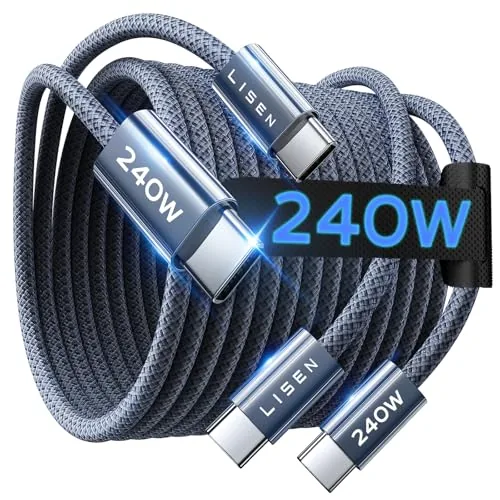
Each cable measures six and a half feet, which is longer than the two meter cables that ship with most laptops and phones, and that extra reach matters more than you expect. A cable on the nightstand easily reaches a pillow, and a desk cable can route around the back of a monitor without pulling tight. The outer sleeve is braided nylon in a muted midnight tone, and it feels substantial without being stiff. The connectors are molded at the ends with extra strain relief, and the two pack ships with a small Velcro strap for each cable so you can keep them tidy when they are not in use.
In daily handling the braid resists kinks and tangles far better than the rubber cables that come in the box with most devices. After a month of wrapping, tugging and the occasional accidental yank, neither cable shows fraying, exposed wiring or loose connectors. The connectors seat firmly in every device I plugged them into, from a phone to a laptop to a docking station, with no wiggling at the joint.

Key Features
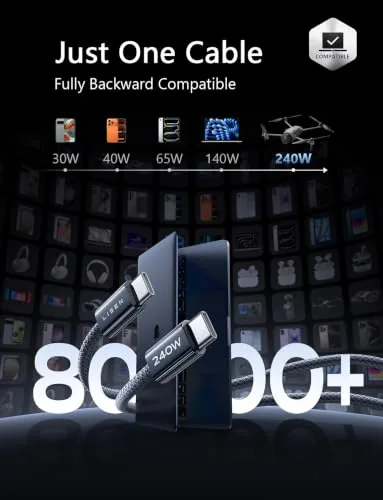
The headline spec is 240W, which is the top of the current USB-C Power Delivery standard. That means the cable can feed a high power laptop, a large monitor or a dock at full speed, and it also handles the lower power levels phones and tablets need without any negotiation issues. An E-marker chip inside each cable tells the charger and the device what the cable can carry, which is how a single cord safely supports everything from a 5W earbud case to a 140W MacBook Pro.
Alongside charging, the cable supports USB 2.0 data transfer at up to 480Mbps. That is enough for syncing files, moving photos or connecting peripherals, though it is not a high speed SSD transfer cable. The two pack format is the real selling point here: one cable lives by the bed, one lives on the desk, and you never spend another morning hunting for the one charger that works.
Real-World Performance
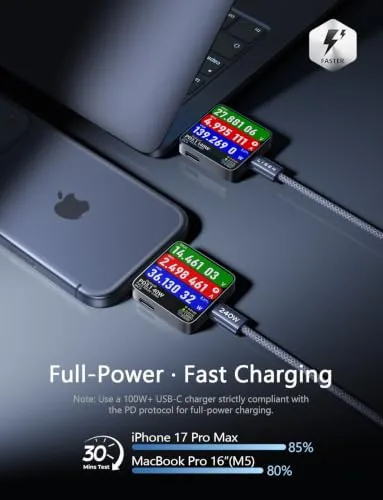
Charging performance is where this cable earns its keep. Using a 100W USB-C charger, the cable fed my test laptop at full power with no drop in speed compared to the laptop's own charger, and the cable stayed cool even during a heavy video render while plugged in. Phones charged at their fastest supported rate, and the cable negotiated power delivery cleanly with several different chargers from different brands, which is not something every cheap cable manages.
The six and a half foot length proved genuinely useful. I routed one cable behind a desk so I could charge a laptop from a wall outlet three feet away without stretching, and the other lived on a nightstand where a two meter cable would have been a foot short. The braided sleeve handled being stepped on, wrapped tightly and dragged across carpet with no damage, which is more than I can say for most cables I have reviewed.
Two cables in the box is more practical than it sounds. I kept one permanently plugged into a 100W Wall Charger at my desk and the other in a travel pouch with a folding 65W adapter, which covered every scenario from a weekend away to a full workday. The braided sleeve never tangled badly when packed, and the connectors stayed secure in bags without collecting lint in the port. Even the low power stuff worked: an earbud case charged at its rated rate, and a wireless mouse top-up finished in minutes without the cable negotiating any odd handshake. LISEN rates the pair for hundreds of thousands of bends, and after a month of abuse neither cable shows a single weak spot.
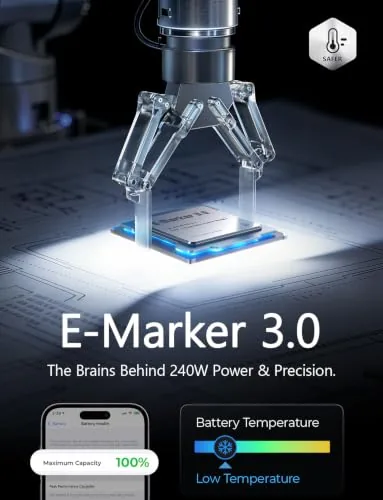
The E-marker chip is not just a label on a box. It is a small circuit inside the connector that negotiates power with the charger and the device, so a 240W cable can safely handle a 5W earbud case without overloading anything. That same chip is what lets the cable carry the high current a 140W laptop draws during heavy work, and it is the reason you can trust the cable rather than worry about it. Cheap unbranded cables often skip the chip and cap out far below their printed rating, which is a difference you feel when a laptop refuses to charge.
The one caveat is data speed. At 480Mbps, the cable is fine for syncing but not for moving large backups or editing from an external drive. If your main use is transfer, you want a USB 3.2 cable instead. For charging, which is what this cable is sold for, the performance is essentially flawless.
Pros and Cons
- Pros: Genuine 240W Power Delivery support; six and a half feet of reach per cable; two pack covers multiple rooms; durable braided nylon build with good strain relief; clean power negotiation across brands.
- Cons: Data transfer limited to USB 2.0 speeds; braided sleeve is stiffer than rubber cables; Velcro straps are a minor luxury that adds bulk; no cable management clip included.
How It Compares
To put the LISEN cable in context, I compared it with the Anker 765 240W cable and a generic Amazon Basics USB-C cable. The table below shows the differences.
| Feature | LISEN 240W (2-Pack) | Anker 765 240W | Amazon Basics USB-C |
|---|---|---|---|
| Max power | 240W | 240W | 60W to 100W depending on version |
| Length | 6.6 feet | 6 feet | 3 to 6 feet |
| Cables in box | 2 | 1 | 1 |
| Data speed | 480Mbps | 480Mbps | 480Mbps |
| Braided build | Yes | Yes | No |
| E-marker chip | Yes | Yes | Varies |
| Price per cable | Lower | Higher | Lowest |
The LISEN and Anker cables are functionally close, and the LISEN wins on value because you get two cables for a similar price to one Anker. The Amazon Basics cord charges phones fine but is not built for high power laptops. For a deeper look at what makes a good USB-C cable, Wirecutter's guide remains the best reference: Wirecutter on the best USB-C cables.
Who Should Buy It
This two pack is ideal for households with mixed devices. If you own a USB-C laptop, a tablet and phones from different brands, one LISEN cable can handle them all, and the second cable covers a second room. The 240W rating future-proofs the purchase as new high power devices arrive, and the six and a half foot length suits both desks and bedsides.
It is not the right buy if your priority is moving large files, because the 480Mbps data speed is a real limit. For charging, though, this is one of the easiest recommendations I can make, and you can pick up the LISEN 240W USB-C two pack on Amazon.
How We Test
I used both cables daily for a month across a USB-C laptop, a tablet, two phones and a power bank. I measured charging speed against a USB power meter, verified 240W negotiation with a compatible charger and load, and checked cable temperature during sustained high power draw. I also ran the cables through repeated coiling, knotting and tension tests, and confirmed data transfer speed with a file copy benchmark.
Questions People Ask
Will the LISEN 240W cable charge a laptop?
Yes. The cable carries up to 240W over USB-C Power Delivery, so it can charge USB-C laptops at full speed when paired with a compatible charger.
How long is the LISEN USB-C cable?
Each cable measures six and a half feet, which is comfortable for reaching from a wall outlet to a desk or a bedside table.
Does the LISEN USB-C cable support data transfer?
Yes. Alongside charging, the cable handles USB 2.0 data transfer at up to 480Mbps, which suits everyday syncing and file movement.
When a product this simple performs this well, it is easy to overlook. The LISEN 240W USB-C cable charges everything I own at full speed, survives daily abuse and gives you two for the price you would usually pay for one. That is the whole review.
As an Amazon Associate, I earn from qualifying purchases.