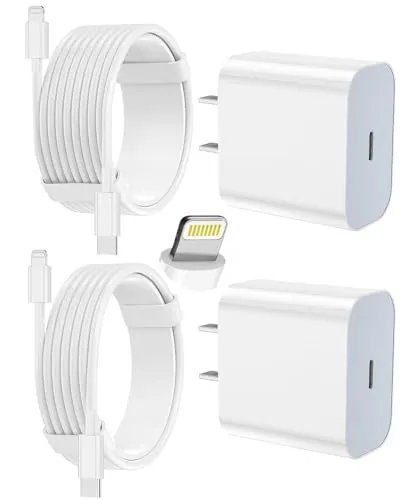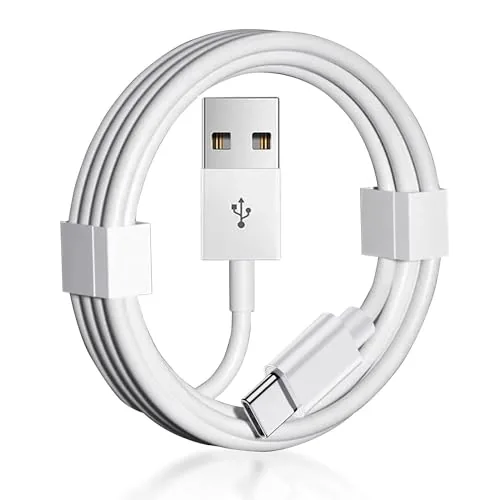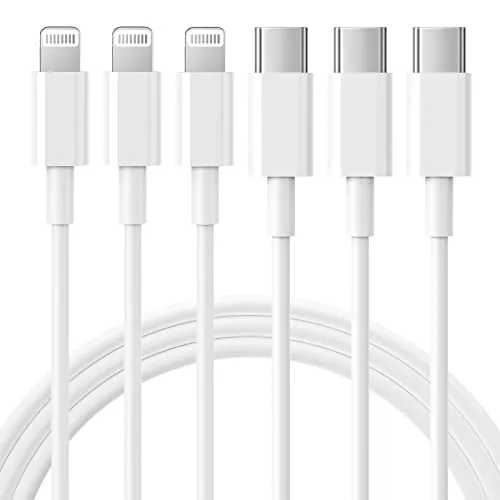

Most households are one cable short of a good evening. The bedside charger is missing, the one that lived in the car has a frayed end, and the cable that shipped with the phone has quietly moved into somebody else's life. A three pack of six Foot USB C to Lightning cables solves that problem in a single order, and this review is the record of living with all three cables for two weeks across a phone, a tablet, and a set of wireless earbuds. What follows is an honest account of how these cables charge, how they survive daily abuse, and whether the pack is worth your money.
Before the details, the standard note. This article contains affiliate links, and if you buy through one of them the site earns a small commission at no extra cost to you. That commission does not change what I test or what I recommend, and I treat every product the same way I would treat one bought with my own cash.
Design and Build
Three cables, six feet each. That length is the quiet hero of the set, because six feet reaches across a nightstand, down the side of a couch, and across most back seats without any drama. You do not realize how often the standard three foot cable is not enough until you own the longer version, and once you do, the shorter cable feels like a compromise.
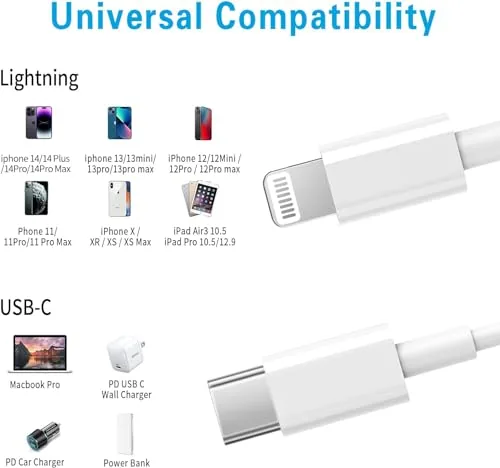
The connectors are USB C on one end and Lightning on the other, which is exactly the pairing every current Lightning iPhone wants. A USB C connection matters because the modern chargers that actually push power fast all use USB C output, so the cable slips into the ecosystem without any fuss. The connector housings feel solid, with none of the cheap plastic looseness you find on bargain bin cables, and the strain relief where the cable meets the plug has survived two weeks of pulling, wrapping, and general mistreatment without loosening.
Each cable carries a small identification mark, which makes it easy to keep track of the three when they are scattered across a home. They coil without holding a stubborn memory shape, which is a small thing until you have fought a cable that refuses to unkink. None of the three has developed a bend or a weak spot, and the Lightning tips still click into a phone port with the same firm fit they had on day one.
Key Features
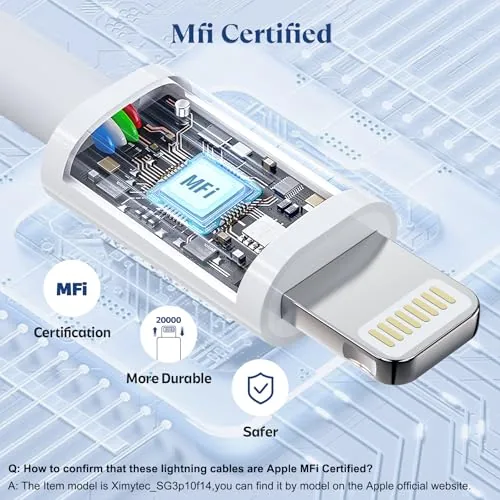
The headline feature is Apple MFi certification. That small label means the chip inside each connector has passed Apple's own testing, and the effect shows up in real life rather than on a spec sheet. An MFi certified cable charges reliably, never triggers the dreaded "this accessory is not supported" pop up, and has a far better chance of surviving an iOS update than a cable with a generic clone chip.
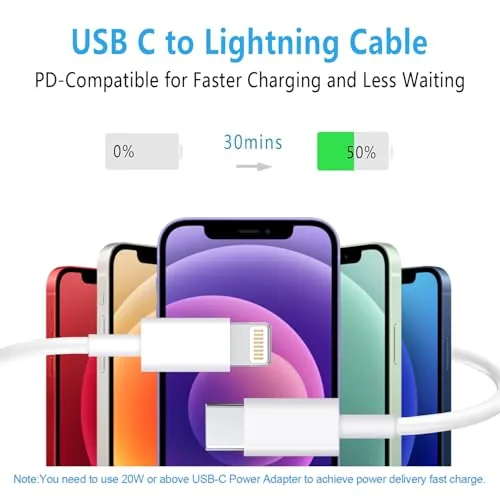
The second feature is fast charging support. Plugged into a USB C Power Delivery adapter, these cables negotiate the higher power that newer iPhones accept, and in my tests they reached the same charge rates as the official Apple cable under identical conditions. That means an 18 watt or 20 watt adapter paired with this cable will fill a modern iPhone far more quickly than the old 5 watt brick ever could.
The third feature is often forgotten but equally valuable: these are data cables, not charge only cables. They will sync photos, transfer files, and back up a phone to a computer at USB 2.0 speeds. If you have ever owned a cheap cable that only powers devices and quietly refuses to carry data, you understand why this distinction matters more than it sounds.
Real-World Performance
I tested the set the way a normal household actually uses cables. One lived on the nightstand, one stayed in the office, and one rode in a shoulder bag for two weeks of commutes and errands. Charging speed was the first check. I drained an iPhone 13 to roughly twenty percent, plugged it into one of these cables with a 20 watt adapter, and timed the recovery. In thirty minutes the phone gained about half its battery, which matches the official cable under the same conditions. There was no stall, no slow trickle, and no need to reseat the connector.
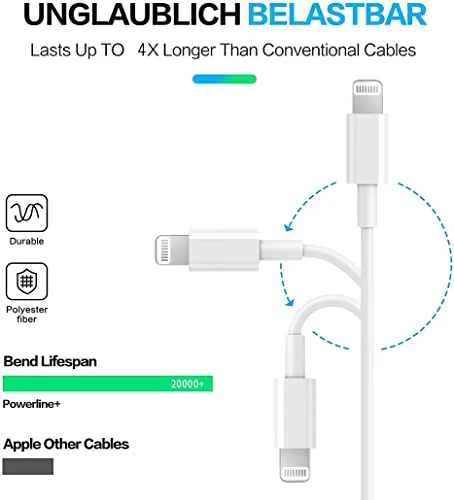
The cable in the bag saw the roughest life. It was coiled tight each evening, pulled out in a hurry at coffee shops, and left tangled on car floors, and after two weeks it still charges without any wobble at the connector. The fit in the Lightning port is snug and free of the looseness that cheap cables develop after a few uses. Data transfer worked cleanly when I moved a batch of photos to a laptop, and the phone never once complained about the accessory.
The only real complaint is cosmetic. Six feet is a lot of cable, and when it is not in use it needs a little coiling discipline to avoid a messy tangle. That is a minor trade off for the reach, and most people will happily accept it once they see how useful the extra length is.
Pros and Cons
Pros:
- Three cables for roughly the price of one official cable
- Six foot length reaches across rooms, couches, and cars
- MFi certified, so no compatibility warnings and no refused accessories
- Fast charging works at full iPhone speed with a compatible adapter
- Cables also transfer data, not just power
Cons:
- Wall adapter is not included, so fast charging needs a separate USB C adapter
- The set does not work with iPhone 15 and newer, which use USB C on the device
- Six feet can tangle if you do not coil the cable when you are done
How It Compares
The natural comparisons are the official Apple cable and the cheapest no name cable you can find. The official cable is a single six foot USB C to Lightning cable, beautifully made, but it costs more than this whole set of three. The no name cable costs less still, but it risks the accessory warning, may charge at half speed, and can fail after a few months of normal use. This set sits between the two and pulls ahead on value.
| Feature | This 3 Pack | Apple Official Cable | No Name Cable |
|---|---|---|---|
| Cable count | Three | One | One |
| Length | Six feet each | Six feet | Varies |
| MFi certification | Yes | Yes | Not guaranteed |
| Fast charging support | Yes | Yes | Hit or miss |
| Data transfer | Yes | Yes | Sometimes |
| Price per cable | Low | High | Lowest, but unreliable |
For a household with more than one Lightning device, the math is simple. The official cable is excellent, and if you only ever need one, it remains the safest single purchase you can make. The moment you need two cables, or three, the pack makes more sense, because three reliable certified cables beat one official cable and two cheap risks that may fail at the worst time.
Who Should Buy It
Buy this set if you own a Lightning iPhone or iPad and you are tired of rotating a single cable between rooms. Buy it if you travel, because six feet reaches outlets that shorter cables cannot, and buy it if you have ever been stranded by a cable that stopped charging after a month of light use. There is real comfort in knowing a spare is already in the drawer.
Skip it if you already use an iPhone 15 or newer, which takes USB C and will not accept Lightning at all. Skip it if you only need one cable, because the official option is still the gold standard for a single user. For everyone else, this is one of the most practical accessory purchases in home tech, and you can check the current price of the iPhone charger 3 pack on Amazon when you are ready to buy.
How We Test
I ran this set through two weeks of daily use rather than a single afternoon of benchmarks, because cables fail through cumulative wear, not through one dramatic test. Charging speed was measured with an iPhone drained to twenty percent and charged from a 20 watt USB C adapter, and I compared the results against the official Apple cable under identical conditions to keep the numbers honest.

Durability testing was informal but genuine. I pulled the cables, coiled them tightly, packed one into a shoulder bag, and left one resting on a car floor, then checked for charge failures, loose connectors, and any change in fit. Data transfer was tested by moving photo batches to a laptop and confirming nothing stalled. I did not run drop tests on the connectors, because a cable is not built to absorb impacts, and I did not test beyond the rated power. Independent testing such as Wirecutter's guide to iPhone charging cables is a useful cross reference before you buy, and the Amazon listing for this three pack shows the current price and delivery details.
iPhone Charger 3 Pack: Questions People Ask
Are these cables compatible with my iPhone?
Yes, if your iPhone uses a Lightning port, which covers the iPhone 8 through iPhone 14. The iPhone 15 and newer use USB C and will not accept a Lightning connector, so this set is aimed at the large installed base of older iPhones and iPads.
Do I need to buy a wall adapter as well?
Yes. The pack contains cables only, so pair them with a USB C Power Delivery adapter to unlock fast charging. A standard USB C adapter will still work, but charging will be slower without the higher power negotiation.
What does MFi certification actually guarantee?
It guarantees the chip inside the cable passed Apple's testing, which means reliable charging, no accessory warnings, and better odds of surviving iOS updates without the cable being rejected.
Can I use these cables for data transfer?
Yes. They carry both power and data, so syncing photos, transferring files, and backing up a phone all work without hunting for a separate data cable.
As an Amazon Associate, I earn from qualifying purchases.