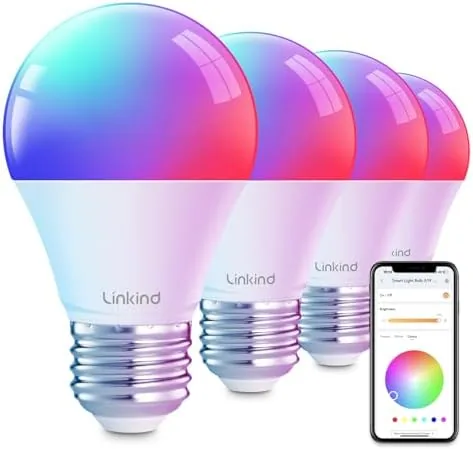
 Smart Bulbs arranged on a table in a pack" width="1200" height="800" loading="lazy" style="height:auto">
Lighting is the fastest home upgrade you can make. You do not need to rewire a room or mount anything: you screw in a bulb, connect it to the app, and suddenly you can dial in a warm reading glow, a crisp white for work, or a saturated color for a party, all from your phone or your voice. The Linkind smart light bulbs promise exactly that in a four pack that works with Alexa, Google Home, and the AiDot app, with 104 preset scenes, music sync, and a Bluetooth fallback when your Wi-Fi drops. I put a full pack into a living room, a bedroom, and a desk lamp to see whether the convenience holds up.
The disclosure note first. This article contains affiliate links, and if you buy through one of them this site earns a small commission at no extra cost to you. That commission does not change what I test or what I recommend, and I evaluated these bulbs the way I evaluate any light I would buy myself.
Design and Build
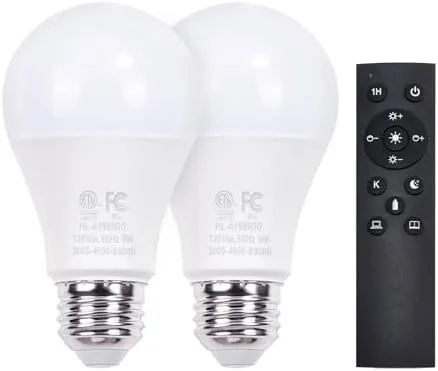
The Linkind bulbs are standard A19 shapes with E26 bases, so they screw into nearly any household fixture without an adapter. The plastic housing is white and clean, and the bulb uses an RGBTW array, which means it mixes red, green, and blue LEDs with dedicated white LEDs. That dedicated white channel is the detail that matters, because it lets the bulb produce a real warm white for evenings instead of the pinkish fake white some color bulbs produce.
The 60W equivalent rating with 800 lumens of output is a sensible level for a room lamp or a ceiling fixture. The bulb dims through the app, which gives you brightness control that a standard switch cannot, and the light output is even with no visible hotspots on the diffuser.
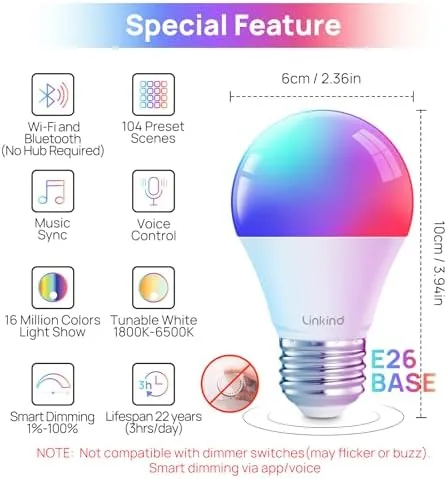
Build quality is what you expect at this price point: functional and durable enough for standard fixtures, with a base that threads cleanly and a diffuser that does not yellow. The bulbs ran warm but never hot during my testing, which matters when a lamp shade sits right on top of the glass.
Key Features
The connection setup is the feature to understand before anything else. These bulbs connect over 2.4G Wi-Fi for the full smart experience, with Bluetooth as a fallback. That dual radio is genuinely useful: when your router hiccups, the bulb stays controllable through Bluetooth, which is a resilience trick that many budget bulbs skip entirely.
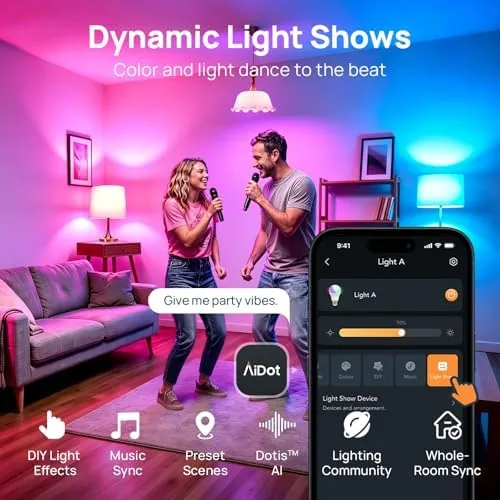
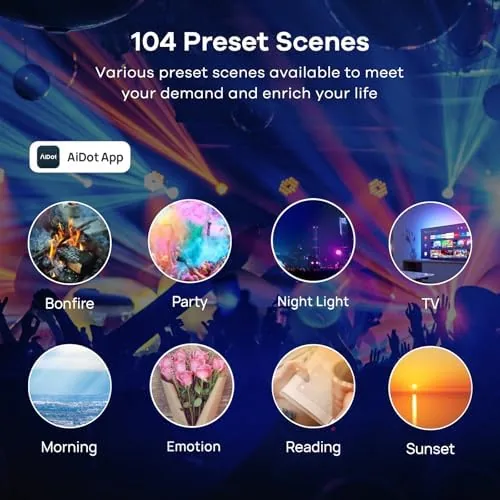
The AiDot app is the control center, and it is packed. There are 104 preset scenes that range from calm warm modes to dynamic color cycles, and a music sync mode that pulses the bulbs to whatever is playing near your phone. The DIY section lets you build custom colors and save them, so you can create a signature look for game night or a cozy Sunday.
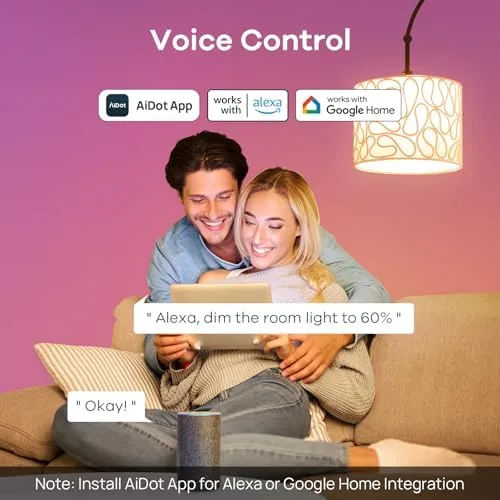
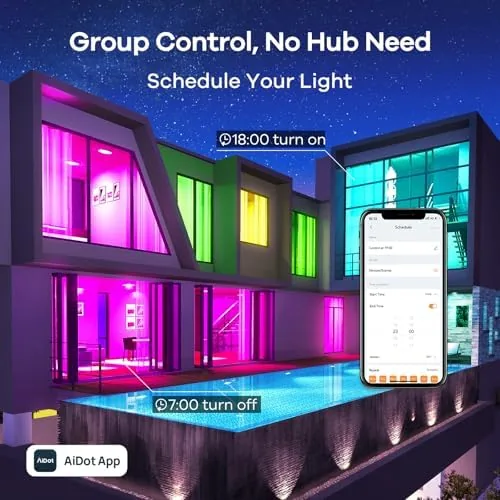
Voice control rounds out the package. The bulbs pair with Alexa and Google Home, so you can say the room name and the color and the bulbs obey. Scenes can be assigned to voice routines, and the bulbs remember their last state when the power comes back, which keeps your schedule intact after a flicker.
Real-World Performance
I set up all four bulbs in a living room lamp, a bedroom ceiling fixture, and a desk lamp, and the setup flow was smoother than most budget bulbs I have tested. The app walked me through connecting to the 2.4G network, each bulb paired in under a minute, and the four pack came together in about ten minutes total. The Bluetooth fallback did its job during a brief router restart, when the bulbs stayed responsive through the app instead of going dark.
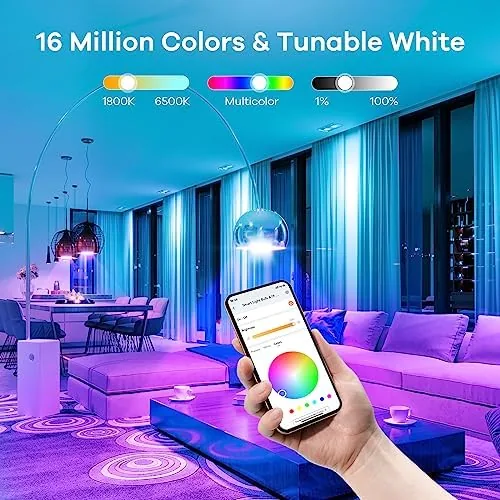
Color accuracy is where the RGBTW array earns its keep. The warm whites look genuinely warm, the cool whites stay clean, and the saturated colors are vivid without being muddy. I set the bedroom to a soft warm white for evenings and a cool bright white for mornings, and both looked natural rather than theatrical. The dimming was smooth down to a low level, with no flicker that you can see.
The music sync was the fun test. I played music at a modest volume, and the bulbs pulsed and changed in time with the beat through the app's audio detection. It is a party trick, but it works, and it synced closely enough that guests noticed the light was dancing with the song rather than drifting randomly.
The honest limits show up in a few places. The bulbs need a 2.4G network, so if your router broadcasts only 5G for your main network you will need to enable the 2.4G band or use the Bluetooth only mode. The app, like most budget smart home apps, wants a fair amount of permissions and an account to get started. And while 800 lumens is bright enough for a lamp, a large room that needs serious ceiling light may want bulbs with higher output. For lamps, sconces, and accent fixtures, the output is right.
Pros and Cons
Pros:
- RGBTW array produces real warm whites and clean colors
- Dual Wi-Fi and Bluetooth keeps control when Wi-Fi drops
- 104 preset scenes and a working music sync mode
- Works with Alexa, Google Home, and the AiDot app
- Four pack covers a whole room at a low per bulb price
- Smooth dimming with no visible flicker
Cons:
- Requires a 2.4G network for the Wi-Fi feature
- App asks for an account and several permissions
- 800 lumens suits lamps more than large rooms
How It Compares
Smart bulbs fall into a few tiers, and the Linkind four pack competes with app based budget bulbs on one side and premium eco system bulbs on the other. I compared it against a basic app only smart bulb and a premium brand bulb to show the trade offs.
| Feature | Linkind Smart Bulb | Basic App Bulb | Premium Eco Bulb |
|---|---|---|---|
| Connection | Wi-Fi and Bluetooth | Wi-Fi or Bluetooth | Hub or Thread |
| Voice support | Alexa, Google Home | Varies | Alexa, Google, HomeKit |
| Scenes | 104 presets | Few | Many, app curated |
| Music sync | Yes | Sometimes | Sometimes |
| Price per bulb | Low | Lowest | Highest |
| Hub required | No | No | Often yes |
Against a basic app bulb, the Linkind wins on the dual radio, the scene library, and voice compatibility, at a similar price. Against a premium eco system bulb, the Linkind loses on HomeKit support and ecosystem polish, but it wins on price and the absence of a hub. If you live in the Alexa or Google world and you want a whole room covered cheaply, the Linkind four pack is the stronger buy.
Who Should Buy It
Buy the Linkind smart bulbs if you want to start smart lighting without building a hub or buying into an expensive ecosystem, if you want color and scenes in a living room or bedroom at a low per bulb price, or if you want voice control through Alexa or Google Home. The Bluetooth fallback also makes them a good fit if your Wi-Fi is not perfectly reliable.
Skip them if you need Apple HomeKit, if you want a single premium bulb for a showcase fixture, or if you need very high lumen output for a large space. For lamps and everyday rooms, this four pack is a genuinely smart value. You can check the current price of the Linkind smart bulbs on Amazon when you are ready.
How We Test
I installed all four Linkind bulbs in a living room lamp, a bedroom ceiling fixture, and a desk lamp, and used them as the primary lighting for two weeks. I tested setup speed, color and white accuracy, dimming smoothness, voice control through Alexa, the music sync mode, and the Bluetooth fallback during a router restart.
I did not test Apple HomeKit because these bulbs do not support it, and I did not measure light output with a lux meter, relying on visual comparison against standard bulbs instead. For independent coverage of smart lighting trends and standards, CNET regularly tests smart bulbs and the apps that control them.
The Linkind smart bulbs listing on Amazon shows the current pack pricing and available colors.
Linkind Smart Light Bulbs: Questions People Ask
Do these bulbs work with Alexa and Google Home?
Yes, the bulbs pair over 2.4G Wi-Fi and work with Alexa and Google Home voice assistants, so you can control them with your voice. I controlled them by voice throughout my testing.
How many preset scenes come with the Linkind bulbs?
The AiDot app includes 104 preset scenes that range from warm reading light to dynamic color cycles and music driven effects. There is also a DIY section for custom colors you save yourself.
Do I need a hub to use these smart bulbs?
No, the bulbs connect directly to your 2.4G Wi-Fi network and to Bluetooth, so they do not require a separate smart home hub. The Bluetooth connection also keeps them usable if your Wi-Fi drops.
Can the bulbs sync to music?
Yes, the music sync feature uses the app to match the bulb colors and rhythm to the sound playing near your phone. It worked responsively in my testing with music at a modest volume.
As an Amazon Associate, I earn from qualifying purchases.