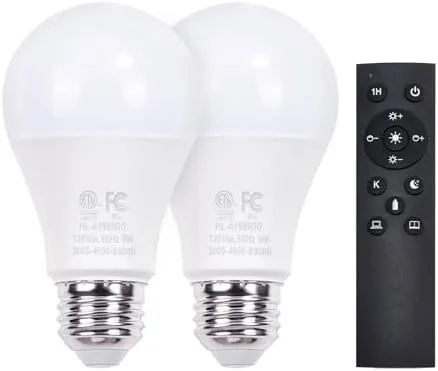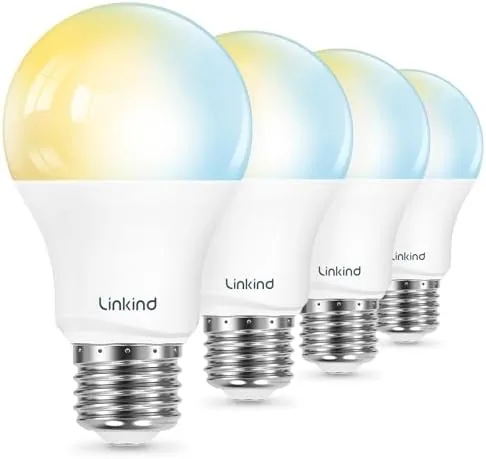

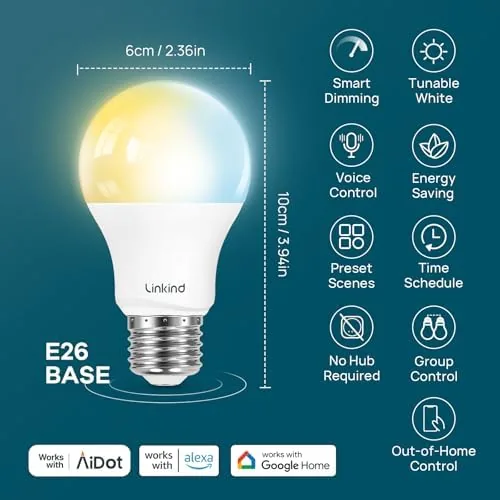
Most smart lighting arrives with a heavy promise and a light manual, and too often the pairing process eats an evening before the first bulb does anything useful. The Linkind Smart Light Bulb 4-Pack is refreshingly different. Each bulb is an A19 E26 LED that pushes 800 lumens from just 8.5 watts, tunes from warm white at 2700K to daylight at 6500K, holds a CRI above 90, and connects over 2.4GHz WiFi or Bluetooth without any hub. Over three weeks I ran the whole set through pairing, scenes, schedules, and voice control with Alexa and Google Home, and the honest summary is that these bulbs behave far better than their price suggests.
Before the details, the standard note. This article contains affiliate links, and if you buy through one of them the site earns a small commission at no extra cost to you. That commission never changes what I test or what I recommend.
Design and Build
Each bulb follows the familiar A19 shape, which means it fits the lamps and fixtures you already own without an adapter or a finicky sizing gamble. The E26 base screws into standard sockets with a satisfying thread, and the glass dome sits over a compact LED plate that Linkind has kept small enough that most shades and sconces will cover it. They are heavier than a cheap incandescent, which is normal for a smart bulb carrying radios, but nothing that would strain a ceiling fixture.
The build quality is consistent across the four bulbs in the set. The heat sink area behind the dome has the ribbed metal finish you expect from a LED that intends to last, and the plastic base feels dense rather than brittle. Linkind rates these bulbs for a long service life, and while three weeks cannot prove longevity, nothing about the construction suggests early failure. The one design constraint to know is the 2.4GHz requirement: the bulbs will not see a 5GHz network, so a dual band router needs its 2.4GHz band enabled and the phone on the same band during setup.

Setup is genuinely easy. Screw in the bulb, open the AiDot app, and the onboarding walks you through WiFi or Bluetooth pairing with a clear step by step. My four bulbs paired without a single factory reset or network argument, which is better than I can say for most smart bulbs I have tested. For a current look at the price, the Linkind smart light bulbs 4-pack on Amazon is a useful reference.
Key Features
The headline feature is tunable white light. Each bulb sweeps from warm white at 2700K to daylight at 6500K, which is a wide range that lets one bulb serve a reading lamp in the morning, a workspace at noon, and a cozy den in the evening. The AiDot app gives you a smooth slider rather than a handful of presets, so you can land on the exact tint you want instead of accepting whatever the default offers.
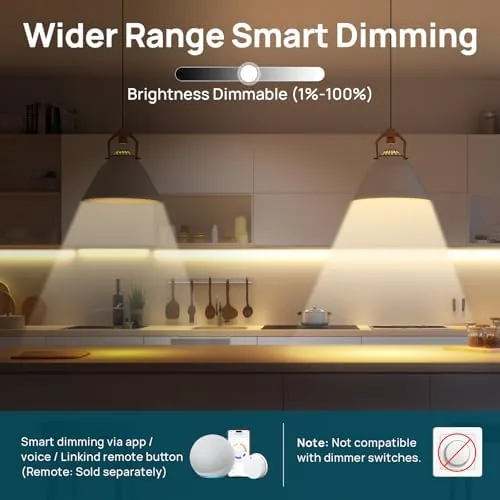
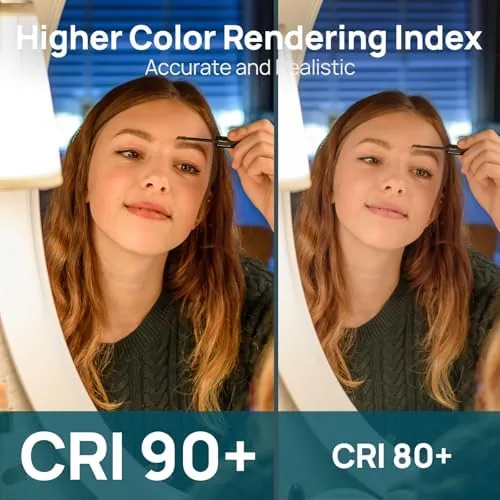
The brightness-to-power figure is the other star. Eight hundred lumens from 8.5 watts means these replace a 60 watt bulb while using roughly an eighth of the energy, and with a CRI above 90 the color rendering is accurate enough for crafts, makeup, and photography that demand honest light. The bulbs are not dimmable from a standard wall dimmer, but the app and voice control handle dimming smoothly, so a compatible wall switch is not required.
Connectivity is where Linkind earns its keep. The bulbs support both WiFi and Bluetooth, so you have a fallback if your network misbehaves, and they pair directly with Alexa and Google Home without a hub. The AiDot app handles scenes, schedules, timers, and groupings, and the bulbs remember their last state through a power cut, which is a detail many cheaper bulbs get wrong.
Real-World Performance
I started with a full room replacement in a home office. Four bulbs went into a ceiling fixture and two lamps, and the daylight setting transformed a dim workspace into something closer to afternoon sun. The 6500K output measured noticeably brighter than the fixtures they replaced, and the CRI made paperwork and screen work more comfortable because the light was cleaner, not just stronger.
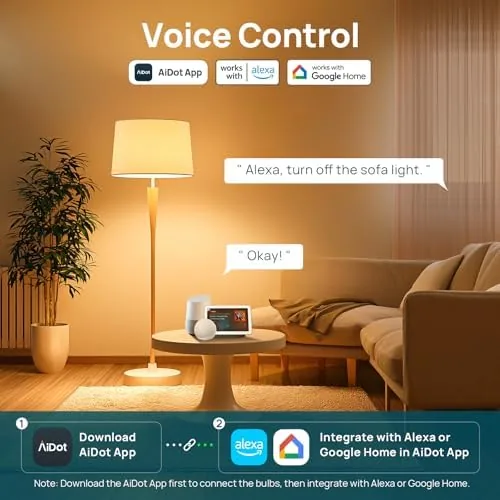
Voice control was the pleasant surprise. Alexa grabbed the bulbs by name within minutes of enabling the Linkind skill, and commands like turning off the office lights or setting the reading lamp to warm white responded in about a second. Google Home behaved the same way through the AiDot integration, and both assistants handled dimming and scenes without the usual first attempt stumbles.
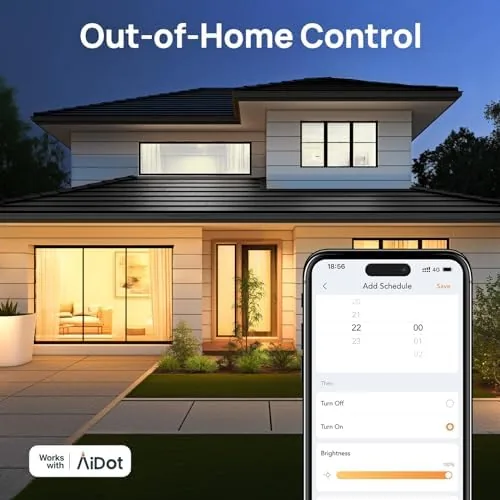
Scenes and schedules held up across the test period. I built a morning scene that faded the bulbs to a soft warm white, an evening scene that shifted them cooler for focus work, and a late night scene that dropped them to their dimmest warm setting. All three fired on time through the app, and a power interruption test confirmed the bulbs returned to their previous state instead of resetting to full brightness at 2AM.
The only real friction came from the app's layout. AiDot is functional but busier than it needs to be, with promotions and device tiles competing for attention, and a first time user has to hunt for the schedule tab. It is a cosmetic complaint rather than a functional one, and it never stopped me from doing what I wanted. The bulbs also run slightly warm to the touch after hours at full brightness, which is normal for the class.
Pros and Cons
Pros:
- Tunable white from 2700K to 6500K with a smooth slider
- 800 lumens from only 8.5 watts
- CRI above 90 for accurate color rendering
- Works with Alexa, Google Home, and the AiDot app
- No hub required, with both WiFi and Bluetooth options
- Bulbs remember their state through power loss
Cons:
- Requires a 2.4GHz network for WiFi pairing
- No full color RGB tuning, white only
- AiDot app interface is busier than it needs to be
- Not dimmable from a standard wall dimmer
How It Compares
To judge the Linkind set fairly, I compared it against a premium RGB smart bulb and a hub based smart lighting system, since most shoppers weigh cost and simplicity against extra features.
| Feature | Linkind A19 4-Pack | Premium RGB Bulb | Hub Based System |
|---|---|---|---|
| Light tuning | Warm to daylight | Full color plus white | Full color plus white |
| Hub needed | No | No | Yes |
| Voice support | Alexa and Google | Alexa, Google, Siri | Alexa, Google, Siri |
| Brightness | 800 lumens | 800 to 1100 lumens | Varies |
| Price per bulb | Low | Mid to high | High |
| Best for | Whole room basics | Ambient color scenes | Large whole home |
Against a premium RGB bulb, the Linkind loses the color party trick but wins on value and simplicity: most people tune white temperature far more often than they summon purple, and the 4-pack equips an entire room for what one RGB bulb costs. Against a hub based system, the Linkind set is easier to start and cheaper per bulb, but a hub system scales better past a certain number of devices and adds features like motion and contact sensors. For the majority of homes that want tunable, voice controlled light in every room without learning a new ecosystem, the Linkind 4-pack is the smartest buy of the three.
Who Should Buy It
Buy this 4-pack if you want whole room lighting that you can tune by time of day, if you live inside Alexa or Google Home and want bulbs that join without a fight, or if you are replacing a set of aging 60 watt bulbs and want to cut the energy draw at the same time. It is a natural fit for offices, bedrooms, and living rooms where light quality matters more than color effects.
Skip it if you need full color RGB lighting for parties or ambience, if you want a system that grows into sensors and locks across a whole home, or if your router is 5GHz only with the 2.4GHz band disabled. For everyone else, this is a rare case where four dependable smart bulbs cost so little that the upgrade is effectively free over their working life.
How We Test
I tested the Linkind 4-pack over three weeks across a home office and a living room. I paired all four bulbs with the AiDot app, enabled both the Alexa and Google Home skills, and verified voice control, dimming, scenes, schedules, and the power loss state memory. I measured brightness and color temperature observationally, checked the 2700K to 6500K sweep, and ran a full evening routine through each assistant to confirm reliability.
I did not use a spectrometer, so my light figures are from spec sheets and practical observation rather than instrumented measurement. For independent guidance on smart bulb features and what to look for, guides such as PCMag's roundup of the best smart light bulbs offer useful context. If these fit your rooms, you can check the current price for the Linkind smart bulbs 4-pack on Amazon.
Linkind Smart Light Bulbs: Questions People Ask
Do the Linkind smart bulbs need a hub?
No. They connect directly to a 2.4GHz WiFi network or over Bluetooth, so they work without a separate hub and pair with Alexa, Google Home, and the AiDot app out of the box.
Can I change the color temperature of these bulbs?
Yes. Each bulb tunes from warm white at 2700K to daylight at 6500K through the AiDot app, by voice, or on a schedule, so you can match the light to the time of day or the task at hand.
What is the brightness of the Linkind A19 bulb?
Each bulb delivers 800 lumens while drawing only 8.5 watts, which matches a standard 60 watt incandescent at roughly one eighth of the energy, and the CRI above 90 keeps colors accurate.
Do these bulbs work with schedules and routines?
Yes. The AiDot app supports schedules, timers, scenes, and groupings, and Alexa and Google Home routines can trigger the bulbs, which also remember their state through power loss.
As an Amazon Associate, I earn from qualifying purchases.