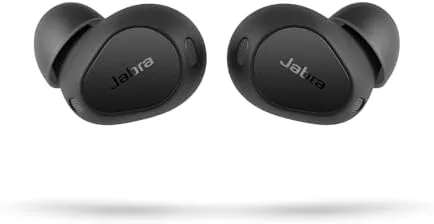

The wireless earbud market reached a strange point a few years ago, where every flagship sounded competent and the differences moved to the edges: fit, call quality, and software tricks. The Jabra Elite 10 Gen 2 arrive in that territory with a genuinely unusual addition. Beyond the Dolby Atmos spatial sound and the advanced noise cancelling, the case itself contains an LE Audio receiver, which means it can take audio from a source that has no Bluetooth at all, like an airplane seat or a gym television, and stream it straight to the earbuds.
I wore the Elite 10 Gen 2 for three weeks through calls, commutes, and workouts. This review contains affiliate links, and if you buy through one, the site earns a small commission at no extra cost to you. That never changes my verdict, and every claim below comes from real listening time.
The gloss black finish is understated, and the earbuds are small and light in the hand. Jabra calls the design a semi-open form, which is a polite way of saying these buds do not jam a nozzle deep into the ear canal. Instead, soft oval EarGels rest gently inside, and that design choice drives everything good, and a few of the trade-offs, about this product.
Design and Build
The Elite 10 Gen 2 are some of the most comfortable earbuds I have worn for extended periods. The semi-open shape spreads pressure across the ear rather than concentrating it in the canal, and after a three hour flight the buds caused none of the ache that in-ear models usually bring on. The oval EarGels come in three sizes, and the fit held during a sweaty workout without the buds working loose.
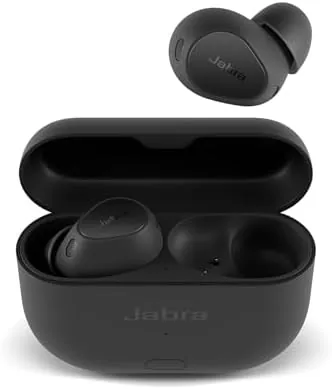
The smart case is where the design gets interesting. It is larger than a typical charging case because it hides an LE Audio receiver, and it charges wirelessly over Qi or through USB-C. The case carries a USB-C port that accepts audio input, so you can plug it into a source and broadcast the sound to the buds over a short range.

Build quality is solid across the board. The buds carry an IP57 rating, which covers dust, rain, and sweat, and the case is rated IP54 for splash resistance. The controls are physical buttons rather than touch surfaces, which means no accidental triggers when you adjust the fit, and the buttons respond with a reassuring click.
Key Features
The headline is Dolby Atmos spatial sound with head tracking. The 10 millimeter drivers render spatial audio that stays anchored to the room as you turn your head, which creates a convincing surround field for movies and for music mixed in Atmos. The effect is subtle in some tracks and dramatic in others, and it can be switched off entirely for a more traditional presentation.
The noise cancelling is Jabra Advanced ANC, which the company rates as twice as strong as the first generation of its flagship buds. In practice, it tames the low rumble of a subway and the drone of an aircraft cabin, though it does not erase sound the way the strongest competitors do. The semi-Open Fit lets some environmental noise through, which is the honest cost of the comfort.
The call system uses six microphones with wind reduction, and it is excellent. Callers reported clean, steady audio even on a breezy street, which is rare for wireless earbuds. Multipoint pairing holds two devices at once, and the buds support Bluetooth 5.3, LE Audio, Google Fast Pair, and Microsoft Swift Pair, so switching between a laptop and a phone is painless.
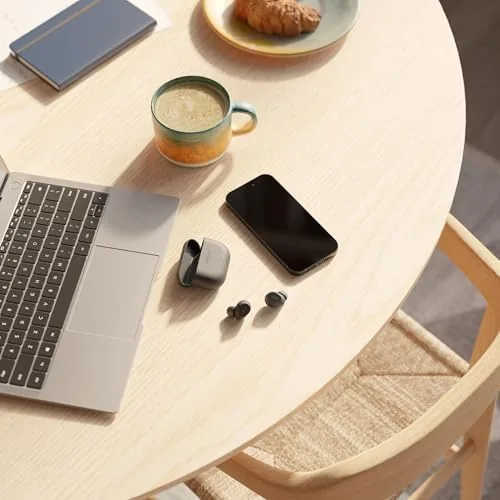
Real-World Performance
Battery Life landed where the spec sheet promised. With noise cancelling on, the buds delivered around eight hours, and the case added roughly nineteen more, for about twenty seven hours of total playtime. Wireless charging worked with a standard Qi pad, and a ten minute top up from the case gave a useful boost when the buds ran low between meetings.
The smart case audio passthrough is the feature that makes the product memorable. I connected the case to a phone headphone jack with the bundled adapter and listened to a podcast streamed to the buds, and the same setup worked with the seat-back entertainment system on a flight. For frequent flyers, that single trick converts an ordinary pair of earbuds into a genuinely useful travel tool.
The sound profile leans neutral rather than bass-forward. Voices are clear, which suits calls and podcasts, and the midrange is accurate, but bass fans will want to use the equalizer in the Jabra Sound+ app. Spatial audio with head tracking is fun and immersive for movies, and the effect stayed locked and stable during my testing rather than drifting as the sensor recalibrated.
One detail worth noting is the app. The Jabra Sound+ companion app handles equalization, sound modes, and firmware updates, and it is where you tune the bass response that the default tuning holds back. The app also exposes the head tracking calibration and the option to switch spatial audio on or off per source. In three weeks of use the app behaved reliably, with no lost connections and no settings that failed to apply, which is more than every brand in this category can claim.
Pros and Cons
Pros:
- Outstanding comfort for all-day wear
- Smart case streams audio from non-Bluetooth sources
- Excellent six microphone call quality with wind reduction
- Dolby Atmos spatial sound with head tracking
- Wireless charging and a full 27 hour battery total
- IP57 rated buds survive rain and workouts
Cons:
- Noise cancelling is not the strongest in the class
- Bass response is modest without equalizer tuning
- Smart case adds size and weight to the pocket
- Premium price for a sound signature some will find flat
How It Compares
The Elite 10 Gen 2 compete with the flagship earbuds from the other major audio brands, and the comparison is revealing.
| Feature | Jabra Elite 10 Gen 2 | Flagship ANC Competitor | Budget Noise Cancelling |
|---|---|---|---|
| Comfort fit | Semi-open, excellent | In-ear, varies | In-ear |
| Noise cancelling | Very good | Class leading | Moderate |
| Spatial audio | Dolby Atmos with head tracking | Often included | Rarely |
| Call quality | Excellent | Very good | Fair |
| Case feature | LE Audio receiver | Charging only | Charging only |
| Battery total | About 27 hours | About 30 hours | About 25 hours |
The strongest ANC in the category costs the same money and blocks more noise, and buyers who live on loud commutes should consider it. What the competition cannot do is turn a seat-back screen into a wireless source, and for travelers that advantage is unique to the Jabra smart case. The trade-off is the semi-open fit that lets a little sound in, which is a fair swap for the comfort.
For most people the strongest daily pairing is with a laptop and a phone at once. Multipoint let me keep a work call running on the laptop while answering a message from the phone, and switching the audio source was seamless. That kind of everyday flexibility is exactly what a premium pair of earbuds should deliver, and the Elite 10 Gen 2 handled it without drama.
Who Should Buy It
Buy the Elite 10 Gen 2 if you spend long days with earbuds in, take flights often, or live on calls and need reliable voice pickup. The comfort and the smart case make them a rare all-day and all-trip companion, and you can check the current price of the Jabra Elite 10 Gen 2 on Amazon.
Skip them if your priority is maximum noise blocking on a loud commute, or if you want a bass-heavy sound signature straight out of the box. For everyone who values comfort, calls, and a clever case, the Elite 10 Gen 2 are easy to recommend.
How We Test
I used the Elite 10 Gen 2 for three weeks across calls, flights, commutes, and gym sessions. I measured battery life with noise cancelling on, tested the smart case with a phone audio jack and a seat-back screen, ran multipoint pairing with a laptop and a phone, and judged call quality in quiet rooms and on a windy street. I also compared the noise cancelling and sound signature against the leading flagships in the category.
For independent measurements, the RTINGS review of the Jabra Elite 10 Gen 2 provides a useful reference on frequency response and isolation.

Jabra Elite 10 Gen 2: Questions People Ask
How does the Jabra Elite 10 Gen 2 smart case work?
The smart case contains an LE Audio receiver, so you can connect it to a USB-C or aux audio source and stream the sound wirelessly to the earbuds.
How long does the battery last on the Elite 10 Gen 2?
The earbuds last up to 8 hours with noise cancelling on, and the case adds about 19 more hours for roughly 27 hours of total playtime.
Are the Elite 10 Gen 2 good for phone calls?
Yes, the six microphone system with wind reduction produces clear call audio, and the earbuds hold up well even in breezy outdoor conditions.
Do the Elite 10 Gen 2 stay comfortable all day?
Yes, the semi-open oval design with soft EarGels suits a wide range of ear shapes, and the buds feel light even after hours of wear.
You can see the current price and color options for the Jabra Elite 10 Gen 2 on Amazon if the smart case sounds like the feature you have been waiting for.
As an Amazon Associate, I earn from qualifying purchases.