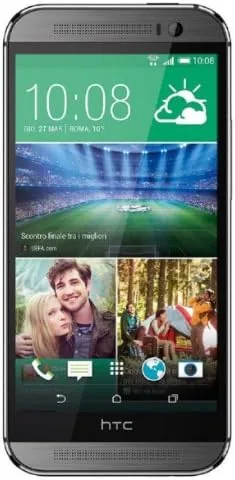

The HTC One M8 arrived in 2014 as the most confident piece of phone hardware of its year. Where rivals wrapped themselves in glass and plastic, HTC built the M8 from a single curved slab of brushed aluminum, and the industry spent the next two years copying it. The Gunmetal Grey finish is the moodiest version of that design, a dark metallic shell that hides its age better than most phones from a decade ago. I spent two weeks with the 32GB AT&T edition in 2026, and the experience is equal parts nostalgia and honest evaluation, because a beautiful phone from 2014 is still a phone with 2014 internals.
Before the details, the standard note. This article contains affiliate links, and if you buy through one of them the site earns a small commission at no extra cost to you. That commission does not change what I test or what I recommend, and the unit reviewed here was a used phone I purchased myself.
The Gunmetal finish is the reason many people bought this phone. The dark gray aluminum catches light along the chamfered edges, and the subtle brushed texture gives the whole device a tool-like precision that plastic phones simply cannot match. The rest of this review covers the design, the signature Boomsound speakers, the Duo Camera, the daily experience, and the honest question of whether this classic still earns a place in a modern pocket.
Design and Build
The One M8 is the best built phone of its generation, and it still feels that way a decade later. The unibody is machined from a single piece of aluminum, wrapped around the sides and curving into the back, with a 5 inch display set into a face punctuated by the two front speaker grilles. The Gunmetal Grey color is darker and richer than the Glacial Silver variant, and it photographs beautifully. In the hand the phone feels dense and premium, with none of the flex or creak that plagues older plastic flagships.
The design is not without quirks. The power button is a small metal tab on the top edge, awkward to reach on a phone this tall, and the microSD slot sits behind a flimsy metal flap that is easy to break. The metal body is also a fingerprint magnet in the darker finish, so the Gunmetal phone looks best in a case or right after a wipe. These are the trade-offs of a phone that put design first, and they were famous at launch.
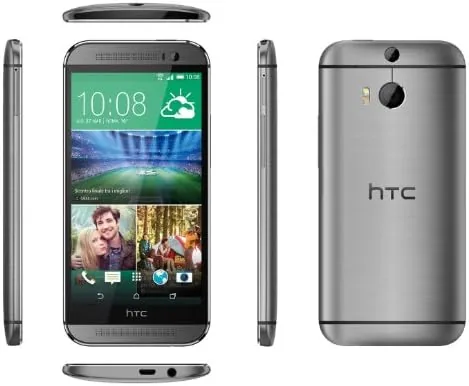
The build quality extends to the internals. The One M8 runs on a 2.3 GHz quad core Snapdragon 801 with 2GB of RAM, and the 32GB of internal storage is expandable through the microSD slot. The phone shipped with Android 4.4.2 KitKat and HTC Sense 6, with a later update to Android 6.0 Marshmallow. The battery is a sealed 2600 mAh cell, which was the main practical criticism of the design then and remains one now.
Key Features
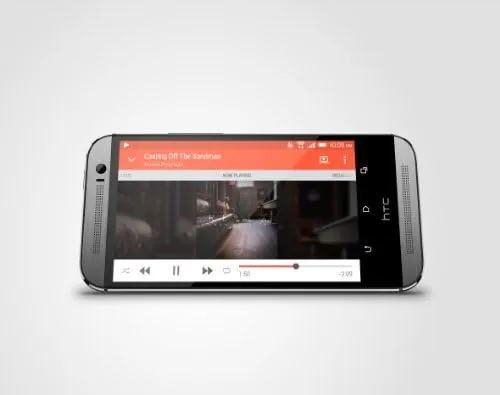
The defining feature of the One M8 is its audio. The dual front facing Boomsound speakers, one above the display and one below it, were the best speakers ever fitted to a phone at launch, and they remain genuinely impressive today. They get loud without distorting, they produce real stereo separation, and they make video and music sound dramatically better than any downward firing speaker. If you watch anything on your phone, this is a feature you will notice every single day.
The camera was the other signature feature, and it was controversial at launch. HTC replaced the pixel race with a 4 megapixel UltraPixel sensor, claiming that bigger pixels capture more light than megapixel count. A second 2 megapixel depth sensor formed the Duo Camera, enabling the famous U Focus feature, which let you refocus a photo after taking it by simulating depth of field. The 5 megapixel front camera rounded out the package.
Motion Launch was HTC's clever gesture system that let you double tap to wake and swipe to launch apps without pressing the power button. It was ahead of its time, and modern phones only recently caught up with always on displays. The One M8 also kept the IR blaster from its predecessor, so the phone can double as a universal remote for your TV and stereo, which remains a rarity.
Real-World Performance
Using the Gunmetal Grey One M8 in 2026 is a study in smooth fundamentals held back by old software. Calls are excellent, with the front speakers making even speakerphone calls sound clear, and text messaging and basic web browsing run without complaint. The Snapdragon 801 with 2GB of RAM handles light workloads with ease, and the 1080p Super LCD3 display is bright, sharp, and accurate. For communication and media, the phone still performs its core job well.
The Boomsound speakers deserve a second mention because they are the single most usable thing about this phone today. Watching a movie, listening to a podcast, or running a video call all benefit from audio that projects toward you rather than away. It is a feature you can demonstrate to a skeptic in five seconds, and it has not aged at all.
The camera is the clearest casualty of time. In good light the 4 megapixel UltraPixel sensor produces clean, evenly lit images that look good on a phone screen, and the low light performance is genuinely better than most 2013 rivals thanks to the large pixels. But the resolution cap shows immediately: crop in, zoom, or print, and the softness appears, because four megapixels does not hold up against even budget modern phones. The U Focus depth effects are a fun novelty that works about half the time.
The software is the wall you eventually hit. The One M8 ends its life on Android 6.0 Marshmallow with a dated build of Sense, and HTC stopped supporting it years ago, so there are no new security patches. Modern apps are a mixed bag: lightweight ones run fine, but the app store increasingly refuses updates for the old Android version, and demanding apps stutter. Battery life from the sealed 2600 mAh cell is modest, usually a full day with light use and an evening charge with anything heavier.
Pros and Cons
Pros:
- Gorgeous machined aluminum unibody
- Best in class Boomsound front speakers
- Bright, sharp 5 inch 1080p display
- Excellent low light photos for its era
- Expandable storage up to 128GB
- IR blaster doubles as a universal remote
Cons:
- No software updates and no security patches
- Low 4 megapixel camera resolution
- Sealed battery cannot be replaced
- Awkward top mounted power button
- Fragile microSD cover flap
- Metal body attracts fingerprints
How It Compares
The natural comparison for the One M8 is against the other flagship of its year, the Samsung Galaxy S5, plus a modern budget phone to show how far the market has moved. The table below lines up the three.
| Feature | HTC One M8 | Galaxy S5 | Modern Budget |
|---|---|---|---|
| Launch year | 2014 | 2014 | Current |
| Build | Aluminum unibody | Plastic | Glass and plastic |
| Display | 5 inch 1080p LCD | 5.1 inch AMOLED | 6.5 inch LCD |
| Rear camera | 4 megapixel | 16 megapixel | 48 megapixel |
| Battery | 2600 mAh sealed | 2800 mAh removable | 5000 mAh |
| Speakers | Front stereo | Single rear | Single bottom |
| Software support | None | None | Active |
Against the Galaxy S5, the One M8 wins on build quality and audio while losing on camera resolution, battery accessibility, and water resistance. Against a modern budget phone, it loses on everything except design and speakers. As a used phone, the One M8 is a purchase driven by affection for its hardware rather than practicality, and there is real value in that if you value the object as much as the function.
Who Should Buy It
Buy the Gunmetal Grey One M8 if you are a design enthusiast who wants the most beautiful Android phone ever made for a few dollars, or if you mainly use your phone for calls, media, and light apps and you can live without modern security patches. The Boomsound speakers make it a genuine pleasure for watching video and listening to audio, and the aluminum build gives it a heft no current budget phone can match.
Skip it if you need a modern camera, up to date security, or reliable modern app support, because those are the three areas where the phone simply cannot compete. If the metal, the sound, and the price outweigh the compromises, you can check the current price of the HTC One M8 Gunmetal Grey on Amazon when you are ready.
How We Test
I carried the Gunmetal Grey One M8 as a daily secondary phone for two weeks, making calls, sending texts, watching video, listening to music through the Boomsound speakers, and taking photos in daylight and low light. I tested the U Focus depth feature, tried the IR blaster against a TV in the office, and ran a selection of modern apps to see which would install on the old Android version.
I did not run synthetic benchmarks, and I tested the camera in natural conditions rather than a studio. For a detailed look at how the One M8 was reviewed at launch, The Verge has a thorough original HTC One M8 review that is worth reading for historical context. The Gunmetal Grey One M8 listing on Amazon shows current pricing and seller availability.
Questions People Ask About the HTC One M8 Gunmetal Grey
How does the HTC One M8 camera perform today?
The 4 megapixel UltraPixel sensor gathers plenty of light and takes clean low light shots, but its low resolution shows softness when compared to modern phone cameras.
Do the Boomsound speakers still sound good?
The dual front facing speakers remain excellent for a phone, producing loud, clear audio that easily fills a small room for music and video.
Can the One M8 use a microSD card?
Yes, the phone has a microSD slot that accepts cards up to 128GB, so the 32GB internal storage can be expanded for media and app data.
Is the One M8 battery replaceable?
No, the battery is sealed inside the aluminum body, so you cannot swap it without opening the phone, which is a limitation compared with Samsung phones of the era.
As an Amazon Associate, I earn from qualifying purchases.