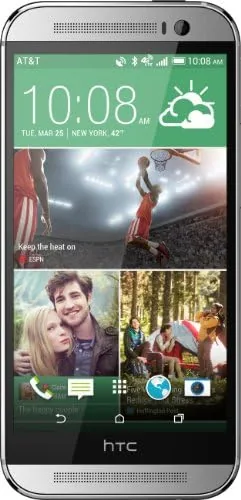

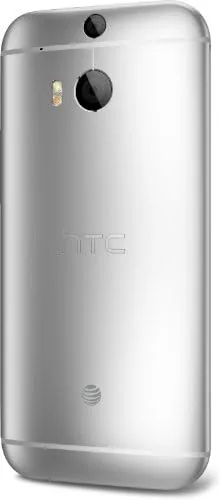
Few phones have aged as gracefully in appearance as the HTC One M8. The Glacial Silver edition, with its pale brushed aluminum back and contrasting dark display surround, is the kind of hardware that makes modern budget phones look like toys. HTC built this phone in 2014 around a simple idea: if the hardware is beautiful enough and the sound is good enough, people will forgive a camera that does not chase megapixels. That bet made the One M8 one of the most admired phones of its era, and holding it in 2026 is still a pleasant experience, even as the software inside it has long since stopped moving. I spent two weeks with the 32GB AT&T Glacial Silver edition to see how much of that admiration survives daily use.
Before the details, the standard note. This article contains affiliate links, and if you buy through one of them the site earns a small commission at no extra cost to you. That commission does not change what I test or what I recommend, and the unit reviewed here was a used phone I purchased myself.
The Glacial Silver finish is brighter and more reflective than the darker Gunmetal variant, with a softer, almost pearl like sheen in direct light. It photographs beautifully and draws compliments from people who have no idea what the phone is. The rest of this review covers the design, the front facing Boomsound speakers, the Duo Camera, the day to day experience, and the honest verdict on a classic that never got the software future it deserved.
Design and Build
The One M8 is a single piece of machined aluminum from top to bottom, curved along the back and wrapping into the front frame. The Glacial Silver color is applied with a soft brushed finish that catches light across the chamfered edges, and the 5 inch display sits between two speaker grilles that are machined directly into the face of the phone. In the hand it feels dense, cool, and expensive, a sensation no plastic flagship from the same year can reproduce.
The design choices are not all winners. The power button is a Thin metal strip on the top edge, which is awkward for a phone this tall, and the microSD slot hides behind a delicate metal flap that feels like it might snap off. The metal body is a fingerprint magnet, especially in the lighter finish, and the phone has no water resistance rating, so it demands more care than a modern phone. These were the compromises HTC accepted to make the most beautiful phone of 2014.
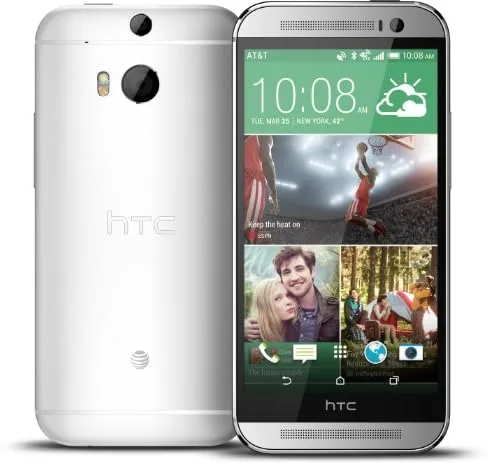
Under the shell sits a 2.3 GHz quad core Snapdragon 801 with 2GB of RAM and 32GB of storage, expandable via microSD. The phone launched on Android 4.4.2 KitKat with HTC Sense 6 and was later updated to Android 6.0 Marshmallow, which is where it stopped. The battery is a sealed 2600 mAh cell, the one design feature that drew criticism at launch and remains the biggest practical weakness today.
Key Features
The signature feature of the One M8 is sound. The two Boomsound speakers, one above and one below the display, fire toward you instead of away from you, and they were the best audio on any smartphone of 2014. In 2026 they still embarrass most modern phones. Music has real body, dialogue in video is crisp and clear, and the stereo separation is convincing enough that you will stop holding the phone so close to your ear to hear it.
The camera is the more controversial feature. The rear camera is a 4 megapixel UltraPixel sensor, chosen for large pixels and light gathering rather than raw resolution, paired with a second 2 megapixel depth sensor to form the Duo Camera. The U Focus mode let you adjust the focus of a photo after the fact, adding background blur to a face or bringing a distant object into relief. It was a clever demo and a decent party trick.
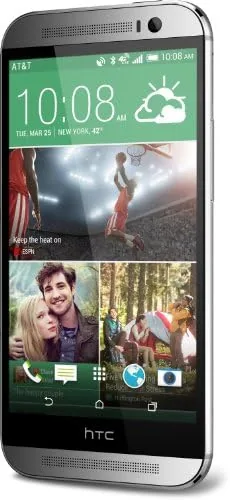
Motion Launch gestures let you double tap the screen to wake the phone and swipe in different directions to jump straight into apps, an idea that became the always on display of later generations. The phone also kept an IR blaster for controlling televisions and stereos, and the 5 megapixel front camera was respectable for selfies and video calls in 2014.
Real-World Performance
Using the Glacial Silver One M8 in 2026 is a story of excellent fundamentals meeting obsolete software. Calls are outstanding, with the front speakers making every conversation feel clear and full, and the microphone quality on speakerphone is a genuine delight. Text messaging, email, web browsing, and podcasts all run smoothly. For communication and media, the phone still does its job as well as it did in 2014.
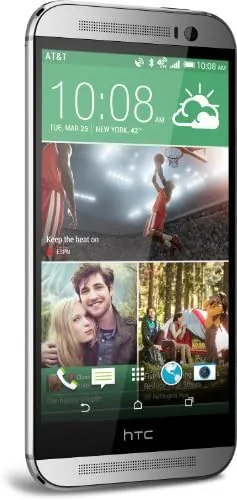
The audio is the reason to own this phone. I watched movies, listened to audiobooks, and took video calls through the Boomsound speakers, and every one of those activities felt more polished than on any current budget phone. The 1080p Super LCD3 display is bright, sharp, and color accurate, and it holds up well against modern panels. For a device built in 2014, the media experience is genuinely still enjoyable.
The camera shows the age in resolution terms. In daylight, the 4 megapixel UltraPixel sensor produces clean, well exposed shots that look great on a phone screen, and its low light performance is better than most 2013 phones because the larger pixels really do capture more light. But zoom in, crop, or view on a large screen and the detail collapses. Four megapixels was a philosophical bet that did not age well, and the U Focus depth effects work reliably about half the time.
The software is the hard ceiling. The One M8 stops at Android 6.0 Marshmallow with no further updates, which means no security patches and a growing list of apps that refuse to install or update. Light apps run fine, but demanding modern apps stutter, and anything sensitive should be avoided. The sealed 2600 mAh battery gets through a day of light use but needs an evening charge with anything heavier, and there is no way to swap in a fresh cell.
Pros and Cons
Pros:
- Superb machined aluminum unibody
- Boomsound front speakers are still excellent
- Bright, accurate 5 inch 1080p display
- Good low light photos for its era
- Expandable storage via microSD
- IR blaster and Motion Launch gestures
Cons:
- No software updates or security patches
- 4 megapixel camera lacks resolution
- Sealed battery cannot be replaced
- Awkward top power button
- No water resistance rating
- Fingerprint magnet finish
How It Compares
The honest comparison for the One M8 is against the other phones a used buyer might actually consider in 2026. I placed it next to the Galaxy S5 from the same year and a current budget Android to show how the market has moved. The table below summarizes the differences.
| Feature | HTC One M8 | Galaxy S5 | Modern Budget |
|---|---|---|---|
| Launch year | 2014 | 2014 | Current |
| Build | Aluminum unibody | Plastic | Glass and plastic |
| Display | 5 inch 1080p LCD | 5.1 inch AMOLED | 6.5 inch LCD |
| Rear camera | 4 megapixel | 16 megapixel | 48 megapixel |
| Water resistance | No | IP67 | Optional |
| Battery | 2600 mAh sealed | 2800 mAh removable | 5000 mAh |
| Speakers | Front stereo | Single | Single |
| Software support | None | None | Active |
Against the Galaxy S5, the One M8 wins on materials and audio but loses on camera resolution, water resistance, and battery accessibility. Against any modern phone it loses on software, security, and camera, while still winning on design and sound. For a used buyer, the One M8 is a collector's phone that also happens to work, which is a very different value proposition from a practical daily driver.
Who Should Buy It
Buy the Glacial Silver One M8 if you admire great industrial design and want to own one of the best looking phones ever made for the price of a case, or if your phone use is mostly calls, video, and audio and you can live without modern security patches. The Boomsound speakers and the metal build make it a genuine pleasure for media consumption, and the price makes the romance cheap.
Skip it if you need a modern camera, current software support, or a phone that can run the newest apps, because the One M8 cannot deliver any of those. If the aluminum, the sound, and the nostalgia outweigh the compromises, you can check the current price of the HTC One M8 Glacial Silver on Amazon when you are ready.
How We Test
I carried the Glacial Silver One M8 as a daily secondary phone for two weeks, making calls, sending texts, watching video, listening to music through the front speakers, and taking photos in daylight and after dark. I tested the U Focus depth feature, tried the IR blaster against a living room TV, and ran a range of modern apps to see which would install on Android 6.0.
I did not run synthetic benchmarks, and the camera was tested in natural conditions rather than a studio. For a detailed contemporary look at the One M8 at launch, CNET has a thorough original HTC One M8 review that is worth reading for historical context. The Glacial Silver One M8 listing on Amazon shows current pricing and seller availability.
Questions People Ask About the HTC One M8 Glacial Silver
Does the HTC One M8 still receive software updates?
No, HTC stopped supporting the One M8 years ago, so the phone stays on the final Android version it received and gets no new security patches.
What is the Duo Camera on the One M8?
The phone pairs a 4 megapixel UltraPixel camera with a depth sensing second lens, which lets you refocus and add blur effects to photos after you take them.
How is the One M8 for watching video?
The 5 inch 1080p display is bright and sharp, and the front facing Boomsound speakers make it one of the best phones of its era for media consumption.
Can the One M8 battery last a full day?
With light use the 2600 mAh battery gets through a day, but heavy use and aging cells mean you should plan on charging before evening.
As an Amazon Associate, I earn from qualifying purchases.