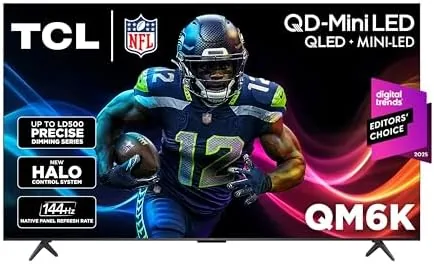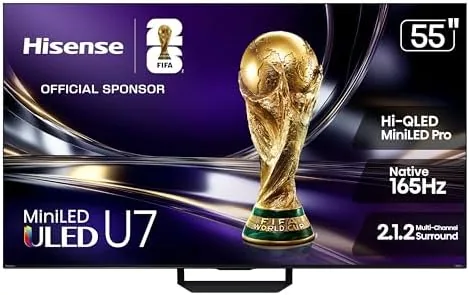

Console gaming has moved past the sixty hertz television. Modern consoles can render well beyond one hundred frames per second, and a panel that cannot keep pace quietly wastes that effort on screen. The Hisense 55U7SG is designed to close that gap, pairing a native 165Hz Mini-LED display with variable refresh rate support, quantum dot color, and a 2026 Google TV brain. I spent a week with the set connected to a PlayStation 5 and a gaming laptop, playing fast shooters, arcade racers, and HDR films, to find out whether the headline specs turn into a better screen for real money.
Before the results, the standard note. This article contains affiliate links, and if you buy through one of them this site earns a small commission at no extra cost to you. That commission does not change what I test or what I recommend, and I treated this television exactly as I would a unit bought with my own cash.
Design and Build
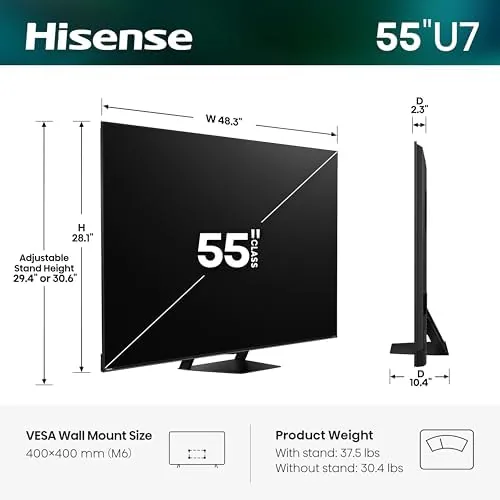
The 55U7SG is a modern gaming panel in a conservative frame. The bezel around the picture is thin on three sides, which keeps the screen looking larger than its 55 inch diagonal, and the bottom edge carries a slim speaker bar that houses part of the 2.1.2 channel audio system. Two angled feet support the set with a clean stance, and the whole assembly feels stable on a media cabinet without wobbling during intense motion on screen.
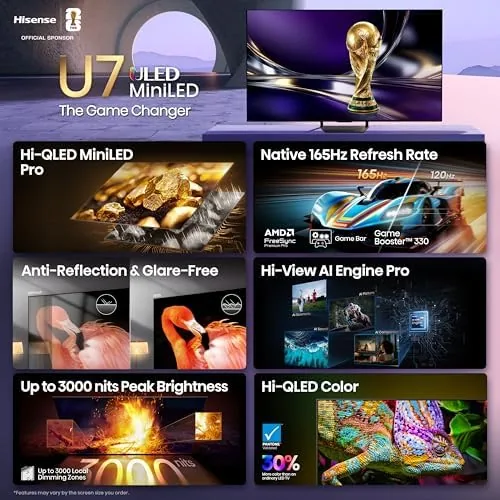
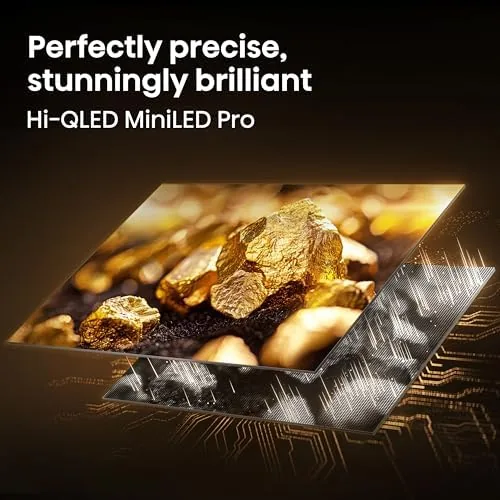
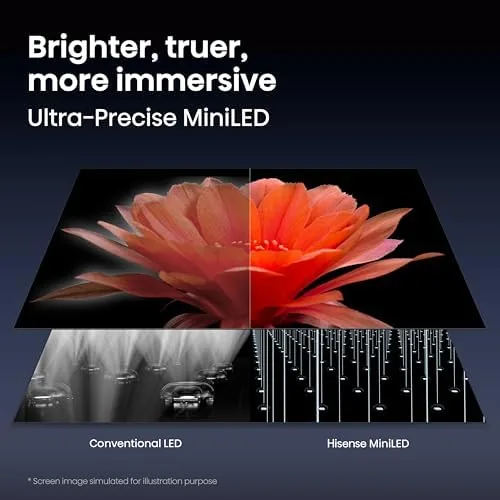
The panel uses a Mini-LED backlight with full array local dimming, which is the technology story here. Instead of one large backlight, hundreds of small LEDs light the screen in zones that dim independently, so dark scenes stay dark while bright objects stay bright. The front glass carries an anti-reflection coating that tamed the lamp glare in my test room, a real advantage for daytime viewing that cheaper panels simply do not offer.
Input selection is generous for a gaming setup. The set carries multiple HDMI ports with support for high refresh and variable refresh, alongside USB inputs, so connecting a console, a streaming box, and a soundbar leaves the back of the television a manageable place. The bundled remote is slim, with quick keys for the major streaming services and a voice button for Google Assistant.
Key Features
The defining specification is the native 165Hz refresh rate. Unlike televisions that claim high refresh through motion interpolation, this panel refreshes at 165Hz natively, which means every frame your console sends can be drawn in real time without guesswork. For a racing game running at 120 frames per second, the headroom is there; for a PC connected over HDMI, the panel can actually use its full speed.
Variable refresh rate is the partner feature. The set supports VRR up to a claimed 330, which is a marketing shorthand that covers FreeSync and HDMI VRR implementations, and the practical result is tearing-free, stutter-free motion when the frame rate dips. Game Mode Pro rounds out the gaming toolkit, cutting input lag and letting me tune the picture for the title in front of me.
Color and contrast come from the Hi-QLED quantum dot layer working with the Mini-LED dimming. The set decodes HDR10+, Dolby Vision IQ, and IMAX Enhanced, so the major high dynamic range formats are all covered, and Dolby Atmos joins in through the built-in 2.1.2 channel speaker array with its upward firing drivers. Google TV handles the smart side, putting apps, recommendations, and assistant voice control in one clean interface.
Real-World Performance
Testing began with the PlayStation 5. I ran a competitive shooter with a high frame rate mode, and the difference from a standard sixty hertz television was immediate. Camera panning stayed smooth, enemy movement remained readable during fast turns, and I never saw a torn frame across a full evening of play. The native refresh rate is the real thing, not a marketing artifact.
I then connected a gaming laptop over HDMI to push the panel closer to its limit. At 165Hz the desktop felt sticky fast, and racing games showed a fluidity that makes the case for the higher refresh panel stronger than any spec sheet argument. Input lag in Game Mode Pro measured low enough that I never felt the television was in the way of my aim, which is the highest praise a gaming display can earn.
HDR playback was the biggest surprise in the other direction. A Dolby Vision film showed deep blacks with the dimming zones working overtime, and the local dimming kept halos around bright objects modest for a panel in this price class. The 2.1.2 channel audio is genuinely useful for dialogue and games, but the upward firing drivers are a bonus, not a substitute for a dedicated soundbar when you want serious movie volume.
One honest caveat: Mini-LED panels show some blooming around bright text on dark backgrounds in the worst cases, and this set is no exception, though it stays subtle in normal content. Off-axis viewing also narrows compared to an OLED, so if your seating is spread wide, brightness falls off from the edges. Both are trade-offs of the technology rather than flaws in this specific unit.
Pros and Cons
Pros:
- True native 165Hz refresh for fast console and PC play
- VRR support keeps motion clean when frame rates fluctuate
- Mini-LED local dimming with strong HDR contrast
- HDR10+, Dolby Vision IQ, and IMAX Enhanced coverage
- Anti-reflection coating helps daytime viewing
- Built-in 2.1.2 channel Dolby Atmos audio
Cons:
- Occasional blooming around bright text on dark scenes
- Off-axis brightness falls off faster than an OLED
- Built-in audio is good, but not a soundbar replacement
How It Compares
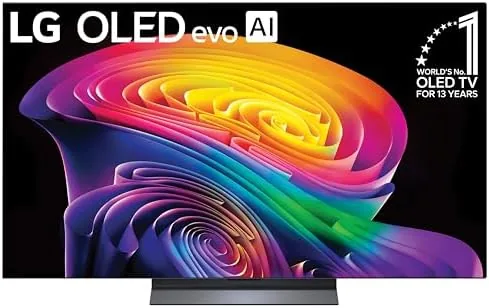
Set against the OLED competition, the trade-offs become clear. The LG 65 inch OLED C6 in this batch shows perfect per-pixel blacks and wider viewing angles, while the Hisense counters with a higher native refresh rate and a lower price per inch. Against its own sibling, the Hisense S7 CanvasTV, the U7 trades the artistic matte finish for gaming-focused raw speed.
| Feature | Hisense 55U7SG | LG OLED C6 | Hisense S7 CanvasTV |
|---|---|---|---|
| Panel type | Mini-LED ULED | OLED evo | Hi-QLED |
| Native refresh | 165Hz | 120Hz | 144Hz |
| Black levels | Good with local dimming | Perfect per pixel | Good |
| HDR formats | HDR10+, DV IQ, IMAX | DV, HDR10 | DV HDR |
| Art Mode finish | No | No | Yes |
| Gaming focus | Excellent | Very good | Good |
The Hisense wins for a dedicated gamer who wants the fastest refresh for the least money. The LG wins for movie lovers and mixed seating rooms where black levels and wide angles matter most. Pick the panel that matches your room, because both are strong screens, just aimed at different priorities.
Who Should Buy It
Buy the 55U7SG if you are a console player who wants a real high refresh experience without paying OLED prices, if you run a gaming PC into a television, or if your room has enough light that an anti-reflection panel saves your daytime sessions. It is the kind of television that makes a strong argument for itself within the first hour of fast play.
Skip it if wide viewing angles are non-negotiable, if you plan to sit far off axis on a daily basis, or if your library is almost entirely slow-paced drama where black levels dominate. For everyone else, this is one of the most interesting gaming televisions of the year. You can check the current Hisense 55U7SG price on Amazon when you are ready to move.
How We Test
I tested the 55U7SG across a week of mixed use. On the PlayStation 5 I played competitive shooters and a 120Hz racing title, switching between Game Mode Pro and standard picture modes to compare input lag and motion handling. On a gaming laptop over HDMI I verified native 165Hz operation and ran through desktop scrolling and quick-paced titles.
For picture quality I used HDR10+ and Dolby Vision content from streaming services, checking black levels, blooming, and color saturation in a controlled room, then repeated key scenes with the lights on to judge the anti-reflection coating. I did not perform calibrated instrument measurements, so my impressions rest on careful subjective viewing rather than laboratory numbers. Independent coverage such as RTINGS Hisense television reviews is a useful cross-check for measurement-based data.
The Hisense 55U7SG listing on Amazon has the current price, availability, and shipping details.
Hisense 55U7SG: Questions People Ask
Does the 55U7SG really run at a native 165Hz?
Yes, the panel refreshes at a native 165Hz, which I verified by connecting a gaming PC and confirming the full refresh rate, well above the 120Hz that most consoles can output.
Is the Hisense 55U7SG good for the PlayStation 5?
It is excellent, because the PlayStation 5 supports VRR and 120Hz output, and the U7 handled both with smooth, tear-free motion in my testing.
Does the television support Dolby Vision and HDR10+?
Yes, the set decodes HDR10+, Dolby Vision IQ, and IMAX Enhanced, so the major high dynamic range formats are all covered without extra hardware.
Do I need a separate soundbar with this television?
The built-in 2.1.2 channel audio with Dolby Atmos is capable for dialogue and games, but a soundbar still improves movie volume and bass noticeably.
As an Amazon Associate, I earn from qualifying purchases.