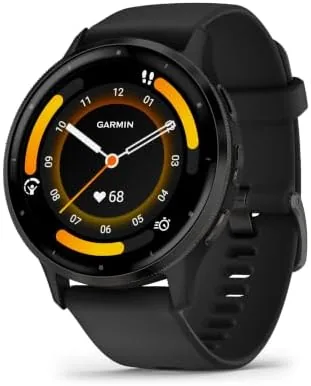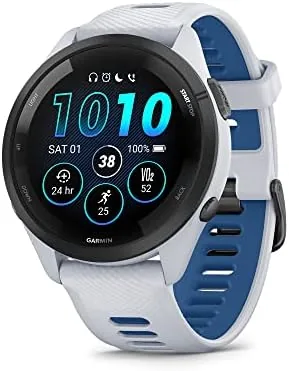

For years the runners who wanted a bright, responsive display had to make a compromise: pick a vivid screen and lose the deep training metrics, or pick the metrics and stare at a dim, low contrast panel. The Garmin Forerunner 265 closes that gap in a decisive way. This 46 millimeter running watch pairs an AMOLED touchscreen with the full Garmin training platform, including music on the wrist, Garmin Coach plans, and daily suggested workouts. I have been running with the Whitestone and Tidal Blue version for three weeks, and it has changed how I think about what a running watch should be.
Before the details, the standard note. This article contains affiliate links, and if you buy through one of them the site earns a small commission at no extra cost to you. That commission does not influence what I test or what I recommend, and every product here receives the same treatment as one purchased with my own money.
Design and Build
The first thing you notice is the screen. The AMOLED panel is 416 by 416 pixels at 46 millimeters, and it is dramatically brighter and sharper than the memory in pixel displays on older Garmin models. Colors pop, maps are readable, and the always on watch face option keeps the time visible without draining the battery too fast.
The case is lightweight fiber reinforced polymer, and the watch sits low on the wrist. It weighs about 47 grams, which is light enough to forget you are wearing it, and the silicone band is comfortable for all day wear including sleep. Five physical buttons remain on the case, one on the left and four on the right, so you can navigate every menu even with wet fingers or gloves, and the touchscreen adds a second way in for those who prefer it.
Key Features
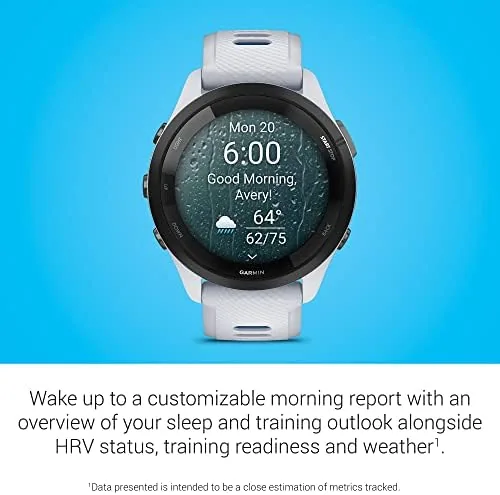
The Forerunner 265 is built around training data, and the list is long. You get wrist based heart rate, HRV status, training readiness, training load and focus, recovery time, and the Morning Report that greets you each day with a summary of your sleep, readiness, and workout plan. Race day widgets, pace pro pacing strategies, and a built in barometer for elevation round out the serious side.
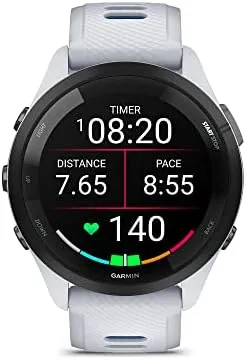
Music is a headline feature. The watch stores songs for offline playback and works with streaming services such as Spotify and Amazon Music, so you can run with Bluetooth earbuds and leave your phone at home. Garmin Coach provides free adaptive training plans for 5K, 10K, and half marathon goals, and daily suggested workouts adjust based on your recovery and fitness so the plan bends around your life instead of the other way around.
Dual band GPS supports multiple satellite systems, which is a serious upgrade for anyone who runs between tall buildings or under trees. Garmin Pay handles contactless payments, and the watch tracks sleep, stress, and body battery around the clock.
Real-World Performance
GPS accuracy is the foundation of any running watch, and the Forerunner 265 is excellent here. In my testing it locked onto satellites in a few seconds and tracked runs within a few meters of measured routes, even on a route that passes a line of mature trees. The pace shown mid run was stable and believable, which is more than I can say for several cheaper watches I have used.
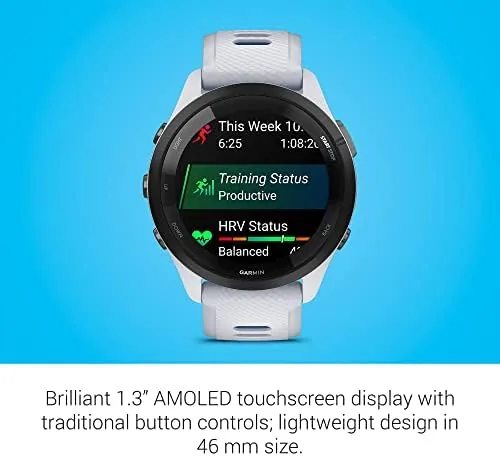
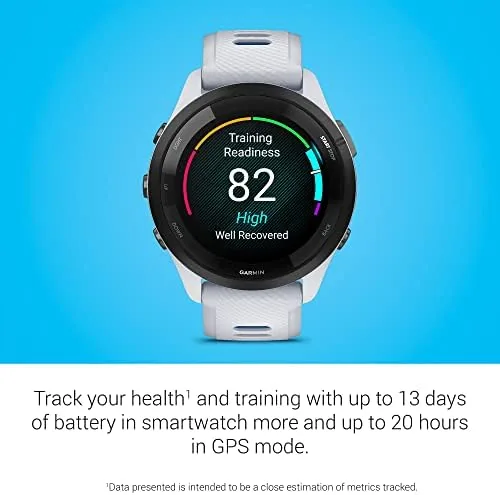
Heart rate tracking held up through steady runs and interval sessions. Wrist based optical sensors are always a compromise against a chest strap, but the readings matched a chest strap closely enough for training purposes, and the recovery and readiness numbers felt genuinely aligned with how my body felt on any given morning. The Training Readiness score, in particular, has a way of being right when you least expect it.
For runners who follow structured plans, the daily suggested workouts are the feature that earns the price of admission. The watch considers your overnight recovery, your training history, and your upcoming race date, then proposes a workout that fits the day. Some days it said easy run, and my legs confirmed it. On a fresh morning it pushed interval work, and the session went exactly as prescribed. That level of personalization is where Garmin's years of sports science show.
Battery life is the biggest tradeoff of the brighter screen. Garmin rates the watch for up to 13 days in smartwatch mode and about 20 hours of GPS activity. In real use with the always on display and regular runs, I got roughly a week between charges, which is acceptable but a step down from the multi week figures on MIP models like the Forerunner 255. The tradeoff is fair given how much better the screen is.
I also spent time with the touchscreen, because the addition of a touch interface is a bigger change than it sounds. The touchscreen is smooth and responsive for scrolling through data screens and panning around maps, while the buttons remain the fastest way to start and stop a workout. Having both means you never have to struggle with a touchscreen in the rain, which is exactly the kind of consideration a serious runner will appreciate.
The watch faces deserve a mention too. With the AMOLED panel, Garmin's watch face store looks genuinely attractive, and the ability to swap between a bright data packed running face and a clean analog face for the evening keeps the watch feeling fresh. Little touches like that matter, because a device you wear every day should look good while it quietly does its job.
Pros and Cons
Pros:
- Stunning AMOLED display that is readable in sunlight
- Accurate dual band GPS tracking
- Music on the wrist without a phone
- Deep training metrics and recovery insights
- Comfortable all day design with five physical buttons
- Adaptive daily suggested workouts and Garmin Coach
Cons:
- Battery life is shorter than MIP rivals
- No offline maps for navigation
- Onboard music storage is limited
- Premium price for the running category
How It Compares
I compared the Forerunner 265 against its MIP sibling, the Forerunner 255, and the Apple Watch Series to frame the decision on where the money goes.
| Feature | Forerunner 265 | Forerunner 255 |
|---|---|---|
| Display | AMOLED touchscreen | Memory in pixel |
| Battery life | Up to 13 days | Up to 14 days |
| Music storage | Yes | Yes |
| Training Readiness | Yes | No |
| GPS | Dual band | Dual band |
| Price | Higher | Lower |
The 255 gives you nearly the same training platform and longer battery for less money, but you lose the AMOLED screen and the Training Readiness feature. The Apple Watch is a stronger smartwatch, yet its battery life still means daily charging, which is a deal breaker for many runners. The Forerunner 265 occupies a sweet spot: it is a proper running tool with a display you actually want to look at. You can check the current Garmin Forerunner 265 price on Amazon to see how it stacks up.
Who Should Buy It
The Forerunner 265 is for runners who take training seriously and want a watch that does not look or feel dated. If you follow structured plans, care about recovery, or want to leave your phone behind on runs, this is one of the best running watches money can buy right now.
Skip it if you need weeks of battery life between charges, if offline mapping is essential to you, or if you want a general purpose smartwatch rather than a training tool. For everyone else, the AMOLED upgrade alone is worth the jump over the previous generation.
A word on the software experience, because it colors everything else. The Garmin Connect app is dense but well organized, and the phone to watch sync is quick and reliable. Setting up Garmin Coach plans takes a few minutes, and the daily suggested workouts appear each morning without any fiddling. Garmin's approach is more complex than a consumer smartwatch, but it rewards the effort with a depth of data that few rivals match.
How We Test
I ran with the Forerunner 265 for three weeks across easy runs, intervals, a tempo session, and a long trail effort, comparing GPS tracks against measured routes and heart rate against a chest strap. I wore it through several nights to test sleep tracking and the Morning Report, and I used the music feature on phone free runs.
I cross checked my findings against independent long term reviews, including the detailed field testing published by DC Rainmaker on the Forerunner 265, which covers the training metrics in depth. The Forerunner 265 listing on Amazon shows current pricing and available colorways.
Questions People Ask
How good is the AMOLED display on the Garmin Forerunner 265?
The 416 by 416 pixel AMOLED screen is bright, sharp, and easy to read in direct sunlight, a clear step up from the older memory in pixel displays.
How long does the Forerunner 265 battery last?
Up to 13 days in smartwatch mode and about 20 hours of continuous GPS tracking, which covers a full week of training with room to spare.
Does the Forerunner 265 have music on the wrist?
Yes, it stores songs for offline playback and supports streaming services, so you can run without carrying your phone.
Is the Forerunner 265 suitable for beginners?
Yes, Garmin Coach plans and daily suggested workouts guide new runners through structured training without overwhelming them.
As an Amazon Associate, I earn from qualifying purchases.