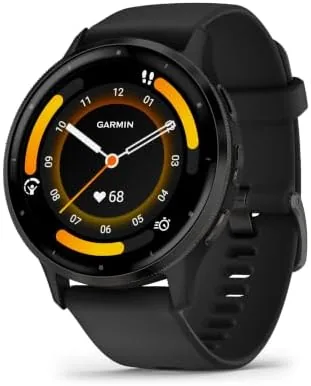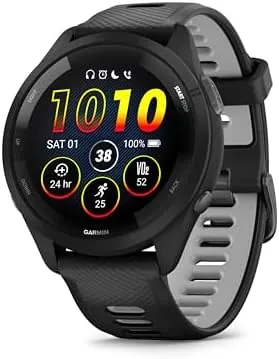

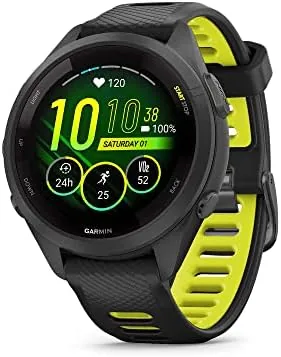
Most running watches make you choose between being a great training tool and being a pleasant thing to wear all day. The Garmin Forerunner 265 in Black and Powder Gray tries to be both, and it largely succeeds. This 46 millimeter watch has a vivid AMOLED display, deep recovery insights, music on the wrist, and enough battery to last a week between charges, which puts it a clear step ahead of the general purpose smartwatches that demand nightly charging. I have worn it for three weeks through runs, workdays, and nights, and it earned a permanent place on my wrist.
Before the details, the standard note. This article contains affiliate links, and if you buy through one of them the site earns a small commission at no extra cost to you. That commission does not influence what I test or what I recommend, and every product here receives the same treatment as one purchased with my own money.
Design and Build
The Black and Powder Gray colorway is understated and classy, which is exactly what a watch this capable should look like when it has to survive the office as well as the trail. The 46 millimeter case is fiber reinforced polymer, and the whole watch weighs about 47 grams, so it disappears on the wrist. The powder gray accents on the band break up the black nicely without looking sporty to the point of being loud.
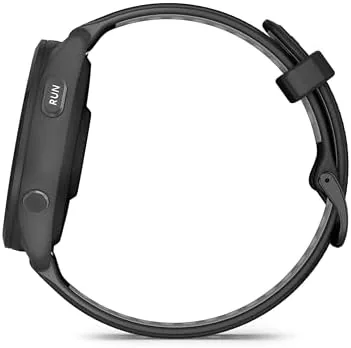
The AMOLED screen is the centerpiece. It is 416 by 416 pixels, bright enough to read in direct sun, and responsive to the touch, while the five physical buttons on the case mean you never have to rely on the touchscreen when your hands are wet or gloved. The silicone band is soft and flexible, and the quick release pins let you swap bands without tools.
Key Features
On the training side, the Forerunner 265 is loaded. Training Readiness combines your sleep, recovery, and recent load into a single score each morning, HRV status tracks long term recovery, and the Morning Report presents your sleep, readiness, and suggested workout before you have even gotten out of bed.
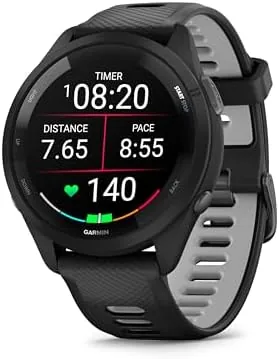
Daily suggested workouts adapt to your fatigue and fitness, so the watch tells you when to push and when to back off. Garmin Coach offers free adaptive plans for 5K, 10K, and half marathon distances, and music on the wrist supports offline playback and streaming services like Spotify, so you can run phone free.
Beyond running, the watch tracks sleep stages, stress, body battery energy, and an enormous list of sports from cycling and swimming to strength training and golf. Garmin Pay handles contactless payments, and smart notifications mirror your phone without demanding you reach for it. The one thing you do not get here is offline mapping, so if you need turn by turn navigation in remote terrain, you would look further up the range.
Real-World Performance
GPS performance is outstanding. The dual band receiver locks quickly and held a steady track on a run that passes beneath a line of tall trees and along a shaded river path where cheaper watches routinely wander. My logged distances matched known measured routes within a few meters, and the pace readout stayed believable through changes in speed.
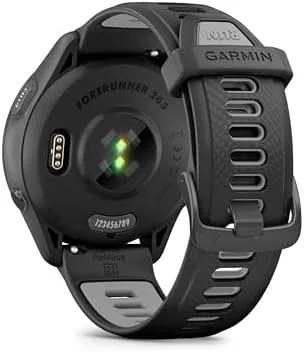
Heart rate tracking was consistent with a chest strap during steady effort, with the expected slight lag on rapid interval changes. The recovery numbers have been impressively accurate: on the mornings the watch told me to go easy, my legs agreed. That kind of alignment is what turns a gadget into a trusted training partner.
For athletes who train across disciplines, the breadth of the sport profiles is worth noting. I logged runs, rides, swims, and a strength session during testing, and the watch handled each with the right data screens and metrics. The ability to switch seamlessly between activities without losing sight of overall training load is a quiet strength that keeps the watch relevant year round, not just in race season.
As a daily watch, the Forerunner 265 earns its place. The battery lasted seven to eight days in mixed use with the always on display and regular runs, which means no charger in my bag and no low battery panic before a morning workout. Notifications are readable on the bright screen, and the watch does not shout for attention the way some smartwatches do.
The AMOLED display changes more than aesthetics. Menus scroll fluidly, data screens are easier to parse at a glance, and the watch face stays legible in harsh sunlight, which is the situation where older Garmin screens struggled. During a midday run the display was clearly visible without a tilt or a squint, and that small daily win adds up over months of use. It also makes the watch a pleasure to check for notifications, because the text is crisp and the colors are true.
I also appreciated the attention to small comforts. The band releases with quick pins so you can swap in a fabric band for formal occasions, the watch charges with a standard Garmin cable, and the five buttons provide full control when you are wearing gloves. These are details that do not make the spec sheet but define what it is like to live with the watch.
Pros and Cons
Pros:
- Bright, sharp AMOLED display
- Accurate dual band GPS
- Meaningful Training Readiness and HRV insights
- Music on the wrist for phone free runs
- Comfortable enough for all day and night wear
- Week long battery life
Cons:
- No offline maps for navigation
- Onboard music storage is limited
- Premium price for the category
- Not a full featured smartwatch like some rivals
How It Compares
I compared the Forerunner 265 against the rugged Garmin Fenix 7 and the Apple Watch Series to frame where each sits for different buyers.
| Feature | Forerunner 265 | Fenix 7 |
|---|---|---|
| Display | AMOLED touchscreen | Memory in pixel |
| Offline maps | No | Yes |
| Battery life | Up to 13 days | Up to 18 days |
| Weight | About 47 grams | About 79 grams |
| Training metrics | Full suite | Full suite |
| Price | Lower | Higher |
The Fenix 7 adds offline maps and longer battery but weighs far more and costs considerably more. The Apple Watch is a better smartwatch with a bigger app library, yet its battery life still means daily charging, which many athletes find unacceptable. The Forerunner 265 splits the difference cleanly: it is a serious training tool that also works as an everyday watch. You can check the current Garmin Forerunner 265 price on Amazon to see where it lands.
Who Should Buy It
The Forerunner 265 is for runners and athletes who want deep training data without sacrificing everyday usability. If you train several times a week, care about recovery, and want a watch you can wear from the track to dinner without thinking about it, this is a strong choice.
Skip it if you need offline topo maps for backcountry navigation, if you want a general purpose smartwatch with apps and a bigger screen, or if you are happy with a simpler tracker. For most active people, the Forerunner 265 delivers the right balance.
One more thing about the black and powder gray finish: it disappears into the background. Unlike brighter colorways, this version pairs with everything from running shorts to a work suit, and the subtle gray accents keep it from looking like a toy. If you intend to wear the watch all day, every day, the restrained look is a real advantage that only becomes obvious once you live with it.
How We Test
I wore the Forerunner 265 for three weeks through runs, intervals, workdays, and overnight sleep tracking. I compared GPS tracks against measured routes and heart rate against a chest strap, used the music feature on phone free runs, and tracked the battery across real days of mixed use rather than relying on the quoted figures.
I checked my findings against established long term testing, including the buying guide from Wirecutter on GPS running watches, which situates the Forerunner range among its rivals. The Forerunner 265 listing on Amazon shows current pricing and available colorways.
Questions People Ask
Is the Garmin Forerunner 265 good for everyday wear?
Yes, the 46mm case is comfortable for all day use, and features like the morning report, notifications, and Garmin Pay make it a practical daily watch.
How accurate is the GPS on the Forerunner 265?
Multi band GPS locks quickly and tracked my runs closely against known routes, even under trees and between buildings.
How long does the battery last on the Forerunner 265?
Up to 13 days in smartwatch mode and around 20 hours of GPS, so you can train through a full week without reaching for the charger.
Does the Forerunner 265 work with iPhone and Android?
Yes, it pairs with both platforms, and the Garmin Connect app keeps training data and notifications in sync on either phone.
As an Amazon Associate, I earn from qualifying purchases.