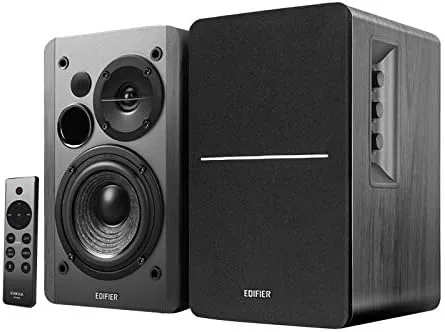

A good pair of speakers should disappear. You should stop thinking about the drivers and the tweeters and just enjoy the music, and the Edifier R1280DBs manages that trick at a price that would have seemed absurd a decade ago. This Edifier R1280DBs review is the record of a month with these active bookshelf speakers as my main desktop sound, and the honest verdict is that they sound far better than their price tag suggests.
Before the listening, the standard note: this article contains affiliate links. If you buy through one of them, the site earns a small commission at no extra cost to you, and it does not change what I play or what I write.
Design and Build
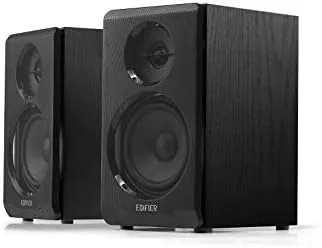
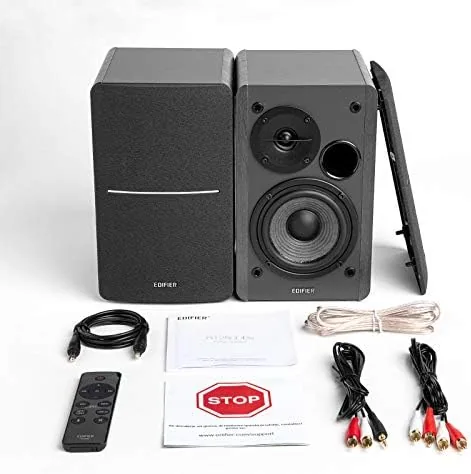
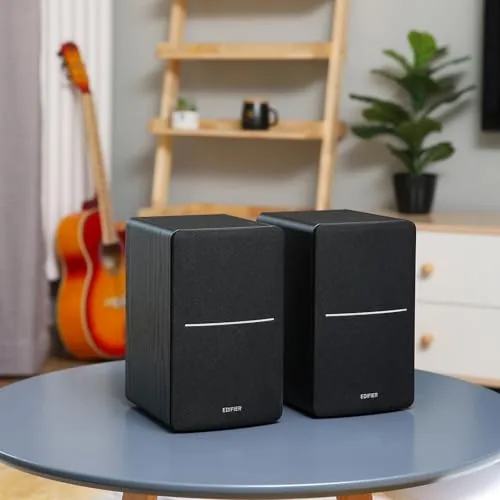
The R1280DBs look like proper grown up speakers rather than a gadget. The wood-grain cabinet is a warm mid brown, the front is a matte charcoal black, and the grilles are held on with four corner bumpers instead of pegs, which feels a touch old school but works fine. They are compact enough to sit either side of a monitor without dominating the desk, and heavy enough to stay put even at higher volumes.
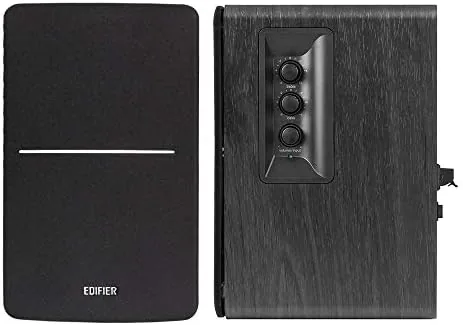
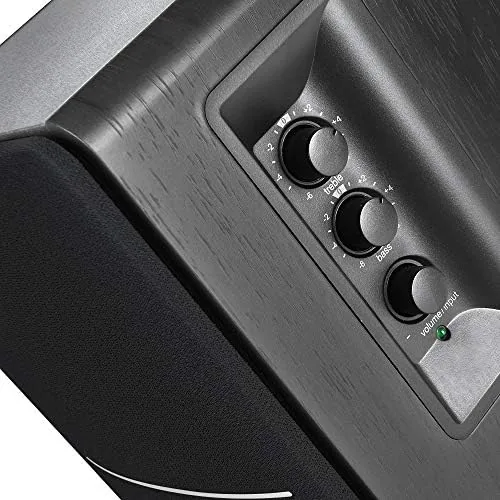
The active speaker carries the controls and the inputs. On the front of the right channel you get a volume dial, a bass knob, a treble knob, and the power switch, which means you can tune the sound without digging around the back. The left speaker connects to the right by a supplied speaker cable, and the whole setup takes about five minutes to get from box to playing, which is rare for speakers in this class.
The finish is better than the price suggests. The vinyl wood grain is convincing until you touch it, the cabinet is reasonably damped, and nothing rattles at moderate volume. The grilles come off for cleaning and simply stay off if you prefer the look of the exposed drivers, which show a 4 inch woofer and a small tweeter under the Edifier badge.
Key Features
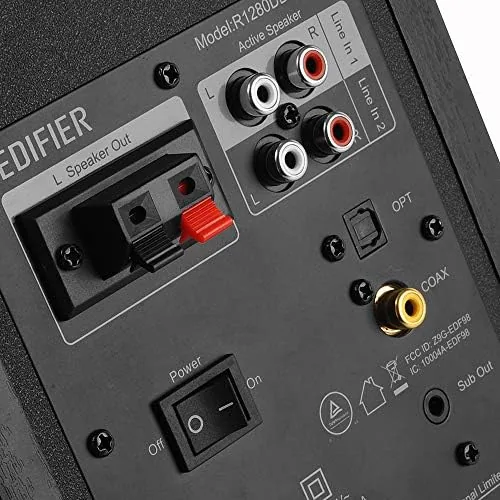
The headline here is the input selection. Bluetooth brings in a phone or tablet wirelessly, and the included remote switches sources cleanly. There are also two RCA inputs, which is useful for a turntable, an old phone, or a console, and there is a proper optical digital input, which is the reason most people pick this model over the cheaper base version. An optical cable to a TV or a computer sound card delivers a clean, noise-free feed that Bluetooth cannot quite match.
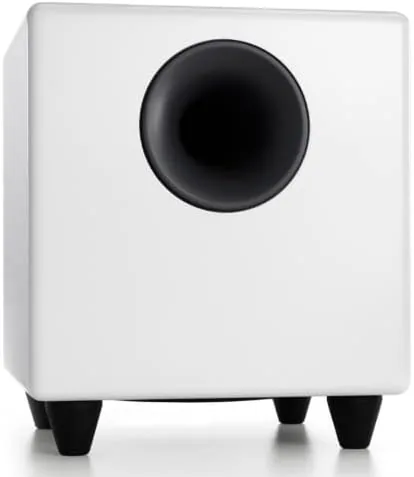
The extra over the plain R1280DB is the subwoofer line out. A single RCA output lets you add a powered subwoofer later, which is a genuine upgrade path for anyone who wants deeper bass for films without buying a whole new speaker system. That future-proofing is a real feature, not a sticker, and it quietly changes what you can do with these speakers over a few years.
The amplifier inside each speaker is rated at 42W total for the pair, which sounds modest on paper but is plenty for a bedroom or a desk. The remote adds treble and bass controls at arm reach, and the speaker remembers its volume across power cycles.
Real-World Performance
Here is where the spec sheet gives way to what these actually do all month. The sound is warm and easy going. The bass is present but polite, the mids carry vocals well, and the treble is smooth enough that long listening sessions do not tire the ears. It is not a neutral, flat studio monitor presentation; it is a relaxed, musical one, and for a desk or a living room that is usually the better choice.
Playing a vinyl record through the RCA inputs, the warmth of the speakers flatters the format; vocals sit forward and the low end is round without boom. On digital sources, Bluetooth streaming from my phone sounded clean at normal volume, though the optical feed from my television tightened everything up noticeably. Voices in films became clearer, and the speakers held together even when I pushed the volume across an afternoon of music.
I will be honest about the limits. These are not rock-crushers. At very high volumes the bass can soften and the cabinet shows its budget roots, and a real subwoofer or a set of floorstanders will go deeper. But at the volumes most people actually use, the R1280DBs stay composed and musical. The remote is small and a little cheap, and the Bluetooth codec is the standard one rather than the lossless high-res flavor, which matters only to the pickiest listeners.
For TV duty the optical input is the star. One cable, no pairing, no lip-sync drift from wireless, and the sound is a clear step up from any soundbar at this money, especially for music and dialog. That alone justifies the small premium over the cheaper Edifier models.
Pros and Cons
Pros:
- Warm, balanced, easy-going sound that flatters most music
- Optical, RCA, and Bluetooth cover almost any source
- Subwoofer line out gives a real upgrade path later
- Front volume, bass, and treble controls with a remote
- Quick, tool-free setup in about five minutes
Cons:
- Budget cabinet shows at very high volume
- No high-resolution Bluetooth codec
- Bass is polite rather than dramatic without a sub
- The supplied remote feels cheap in the hand
How It Compares
The obvious comparison is the Edifier R1280DB, the non-sub version without the optical input, which is cheaper but wired only to analog. The DBs is the better buy for most people because that single optical port makes a TV connection trivial. Against powered rivals from Micca and a Yamaha, the Edifier wins on input flexibility and ease, while trading a little on sheer clarity at the extremes.
| Feature | Edifier R1280DBs | Edifier R1280DB |
|---|---|---|
| Optical input | Yes | No |
| Bluetooth | Yes | Yes |
| Subwoofer out | Yes | No |
| Power | 42W RMS | 42W RMS |
If you already own the R1280DB, the jump is not urgent, but if you are buying fresh with a TV in the mix, the DBs is plainly the one to spend on. The price difference is small and the connectivity difference is meaningful.
Who Should Buy the Edifier R1280DBs
Buy these if you want dramatically better sound than a laptop or a TV alone, without the money or the mess of a full receiver and separate amp. They suit a desk with a computer, a small living room with a television, or a bedroom turntable rig, and they disappear into the space instead of dominating it. After a month, they are the best cheap speakers I have lived with.
Skip them if you need to shake the walls, or if you already own a proper amplifier and passive floorstanders. For a genuinely deep, cinematic low end you will want to add the subwoofer that the line out invites. You can check the current Edifier R1280DBs price on Amazon when you are ready.
How We Test
I ran the Edifier R1280DBs for a month as my sole desktop and television speakers, playing vinyl, streaming over Bluetooth, and watching film through the optical input. I judged them on tone, clarity at volume, connectivity, and how little effort they took to live with.
I compared them with the cheaper R1280DB and a passive budget set on an amplifier, so the verdict comes from side by side time rather than a spec sheet. Independent testing elsewhere, such as What Hi-Fi on the Edifier R1280DB family, reaches broadly the same warm verdict on this popular line.
If you are building a desk setup, my monitor and keyboard reviews can round out the desk alongside these. When you are ready to decide, the Edifier R1280DBs listing on Amazon has the current price and options.
Edifier R1280DBs: Questions People Ask
Do the R1280DBs need a subwoofer?
No. They produce satisfying bass on their own for a desk or a small room. The subwoofer line out is there as an upgrade path for film and heavy bass tracks, not a requirement.
Can they connect to a television?
Yes, and this is the reason to choose this model. The optical input takes one clean cable from most modern televisions and delivers clearer dialog and music than the Bluetooth route.
Are they suitable for gaming?
Very much so for the money. The warm, easy presentation handles most games well, though if you never game with headphones you may want the optional sub for extra impact.
Is there a Bluetooth audio delay?
Rarely a small lag on video. For music it is not audible, and for casual film watching it is fine; for precise editing or gaming, use the optical or RCA input instead.
As an Amazon Associate, I earn from qualifying purchases.