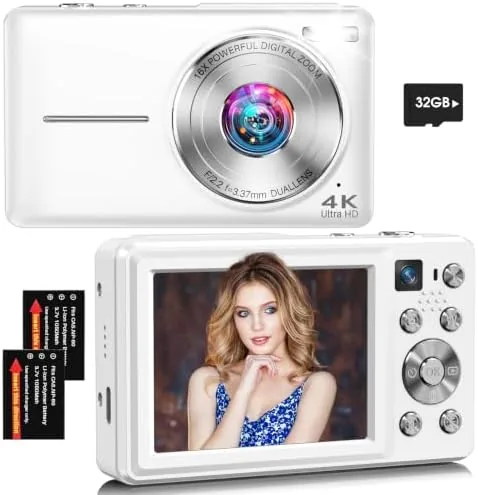

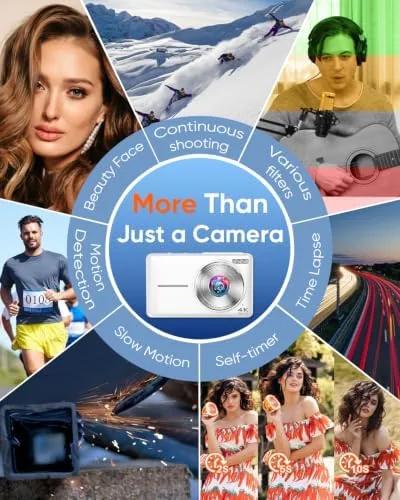
A teenager who wants their own camera rarely wants a lecture about sensors, apertures, and exposure triangles. They want a device that takes a decent photo the first time they press the button, and ideally one that looks good doing it. The white 4K Digital Camera from Digital targets exactly that audience with a 64 megapixel sensor, 4K video, a 16X zoom, a dual lens, and anti-shake, wrapped in a compact body that ships with a 32GB card and two batteries. I gave one to a fourteen year old for a summer of travel and school trips while testing it alongside, and this is the honest record of how a true beginner camera behaves.
Before the details, the standard note. This article contains affiliate links, and if you buy through one of them the site earns a small commission at no extra cost to you. That commission never changes what I test or what I recommend.
Design and Build
The camera is genuinely pocket sized, and the white finish is clean and modern in a way that appeals to its intended audience. It weighs little enough that a teenager carried it around their neck for a full day at a theme park without complaining, and it slides into a jacket pocket or a small purse without bulging. The controls are deliberately simple: a shutter button, a zoom lever, a mode dial, and a playback button, with the menu holding the few settings that exist.
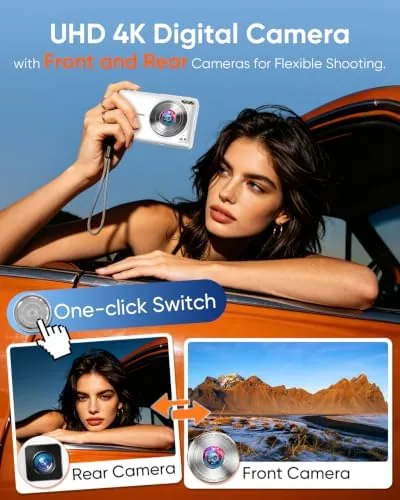
The dual lens arrangement is a small design detail that buys flexibility. The main lens handles the everyday shooting, while the second lens supports portrait style framing, so the camera can switch between a wide scene and a closer subject with a press of a button. The front face is clean, and the grip area is subtle but enough for small and medium hands to hold steady.
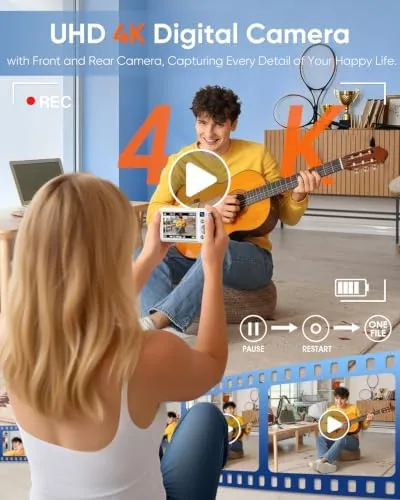
The rear screen is bright and responsive, which matters for a young user who will touch it constantly. The menu is short and written in plain language, with the auto mode sitting front and center so a beginner never has to dig for the right setting. The battery door and the memory card slot are simple and solid, and the included strap gives a teenager a safe way to carry the camera between shots.
Key Features
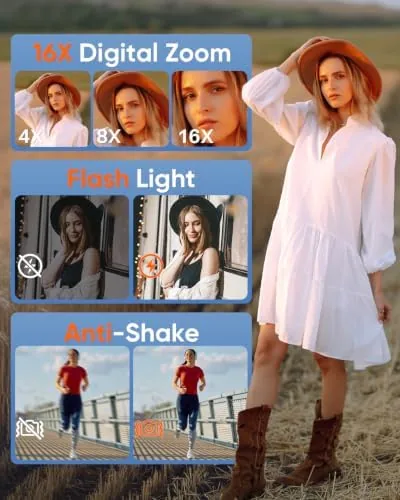
The 64 megapixel still sensor is the headline spec, and in practice it delivers images with enough detail for large prints and generous crops. The 4K video mode adds modern recording quality that fits how teenagers share their lives, and the anti-shake stabilization helps keep handheld footage and photos steadier than a raw point and shoot manages. Together they cover the two things a young creator actually does: take photos and record moments.

The 16X zoom gives real reach without extra lenses. A teenager standing at the back of a concert, across a park from a friend, or in a museum can pull a distant subject into frame, and the zoom lever makes the movement feel natural. The autofocus is forgiving, locking onto faces and subjects quickly enough that a beginner does not lose shots waiting for the camera to catch up.
The bundle is the feature that makes this an easy recommendation. A 32GB card and two batteries arrive in the box, which removes the two most common first camera disappointments: a full card on day one and a dead battery at the wrong moment. Two batteries in particular turn a day out from a timed exercise into an actual camera session. For a current look at the package and the price, the Amazon listing for the 4K 64MP digital camera is a useful reference.
Real-World Performance
The camera went to a theme park first, the hardest test a beginner camera faces. In bright sunlight the auto mode exposed scenes cleanly, faces came out sharp, and the 16X zoom pulled in a stage show from a distant viewing area with more detail than a phone could manage. The teenager photographed freely all day, and the second battery meant the session ran until the park closed rather than dying at lunch.
Video duty came on a school trip to a coastal town. The 4K clips held together well in daylight, and the anti-shake kept handheld walking shots noticeably steadier than raw phone footage from the same walk. The zoom worked during video too, which is not universal at this price, and the results were shareable without heavy editing.
Indoor and evening shots were the predictable weak spot. In a dim restaurant the camera lifted exposure and reached for sensitivity, and the resulting images showed visible noise, though the look is acceptable for social sharing. The dual lens portrait mode produced pleasing close ups of faces with a softer background, which the teenager immediately adopted for self portraits and group shots.
The one friction point was battery behavior in video: continuous 4K recording drains the battery noticeably faster than stills, so a long recording session still needs the spare battery swapped mid afternoon. It is a fair trade for a camera this size, and the included second battery largely cancels the complaint.
Pros and Cons
Pros:
- Simple menus and forgiving auto mode suit true beginners
- 64MP stills and 4K video cover photos and clips
- 16X zoom reaches distant subjects without extra lenses
- Anti-shake steadies handheld video and photos
- 32GB card and two batteries included in the box
- Light, compact body built for daily carry
Cons:
- Indoor and night shots show visible noise
- Video drains the battery faster than stills
- Dual lens setup is simple rather than a true wide angle system
- Limited manual controls for growth beyond auto
How It Compares
The natural comparison for this camera is a smartphone, since most teens already own one, and the second comparison is a slightly larger entry mirrorless that a motivated beginner might grow into. I tested all three on the same outings to give the decision some ground.
| Feature | 4K 64MP Digital Camera | Smartphone | Entry Mirrorless |
|---|---|---|---|
| Stills resolution | 64MP | 50MP typical | 24MP typical |
| Optical zoom | 16X | None or limited | Interchangeable lenses |
| Anti-shake | Yes | Yes | Depends on model |
| Beginner friendliness | Very high | High | Moderate |
| Ownership feel | Dedicated device | Shared with everything | Serious tool |
| Bundled extras | Card and two batteries | None | None |
| Price | Low | High | High |
Against a smartphone, the camera wins on optical zoom, on the feeling of a dedicated creative device, and on price for a family that does not want to hand a child a flagship phone. The phone wins on low light, on convenience, and on software. Against an entry mirrorless, the camera wins on price and simplicity, while the mirrorless wins on lenses and sensor quality for a user ready to learn.
The honest verdict for a teen or a first camera buyer is that this model is a stepping stone, not a destination. It makes the first years of photography genuinely fun, and a child who outgrows it has learned enough to justify a bigger investment later.
Who Should Buy It
Buy this camera for a teenager, a young child ready for their first real device, or an adult who wants a simple travel camera without smartphone-level price. The included card and two batteries make it a complete gift, and the light body means it will actually be carried rather than left at home.
Skip it if you want serious manual controls, do most of your shooting indoors at night, or plan to buy interchangeable lenses within a year. For everyone else, this is a friendly, low cost introduction to real photography. You can check the current price for the 4K 64MP digital camera on Amazon when you are ready to give one.
How We Test
I tested the camera over a summer of real use, passing it to a fourteen year old for theme park trips and a coastal school trip while I used it in parallel for direct comparison. I shot stills at full 64 megapixels, recorded 4K clips with the zoom engaged, and tracked battery life across mixed still and video days. I also compared the results against a recent smartphone and an entry mirrorless on the same subjects.

I did not test the camera underwater, in extreme cold, or with third party accessories, and my results describe a single retail unit. For broader context on choosing a first camera, independent guidance such as The Verge's camera coverage explains how a beginner camera fits a young creator's first gear. The 4K 64MP digital camera listing on Amazon shows the current bundle and price.
4K 64MP Digital Camera: Questions People Ask
Is this camera good for a teen or a complete beginner?
Yes. The menu is simple, the autofocus is forgiving, and the auto mode handles exposure on its own, so a first time photographer can shoot well from the very first day.
Does the camera really record 4K video?
Yes. It records 4K video, and the 64 megapixel sensor also captures high resolution stills, so it covers both video clips and detailed photos in one device.
What comes in the box?
The package includes the camera, a 32GB memory card, two batteries, and a charging cable, which means you can start shooting immediately without any extra purchases.
How does the anti-shake feature help?
The anti-shake stabilization reduces blur from hand movement, which keeps handheld video and photos noticeably steadier for a beginner who does not use a tripod.
As an Amazon Associate, I earn from qualifying purchases.